Where to Cut Ad Spend Without Hurting Growth

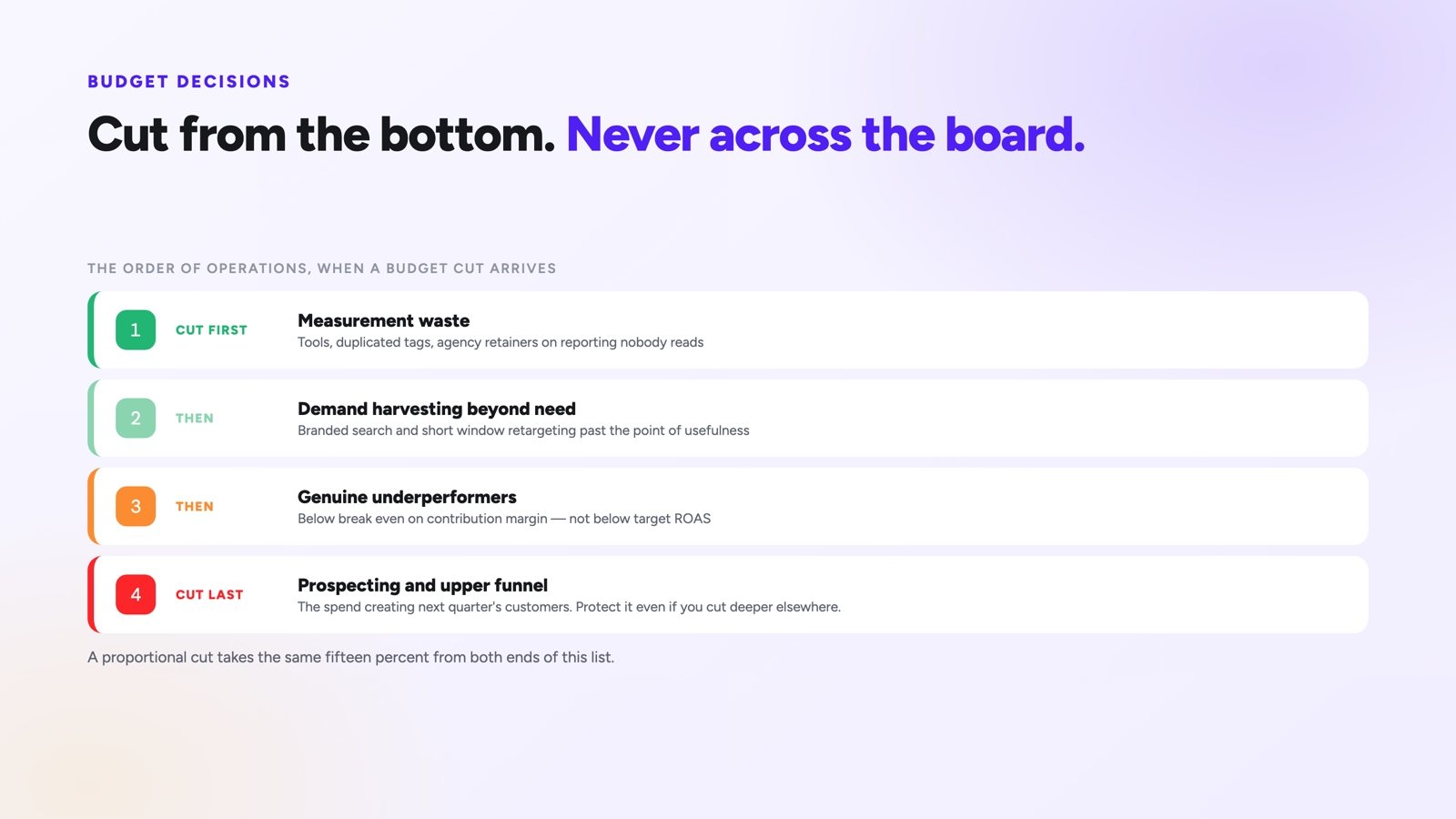
When a budget cut arrives, the default response is proportional: reduce everything by fifteen percent and hope the damage is evenly spread. It is the worst available option. Marketing spend is not uniformly productive, and a proportional cut takes the same fifteen percent from the campaigns creating your next quarter's customers as from the ones buying orders you already had. A better approach ranks spend by how much of it is genuinely incremental, cuts from the bottom of that ranking, and protects the top even at the cost of cutting more deeply elsewhere. This article sets out that ranking and the diagnostics behind it.
What you will learn
When a budget cut arrives, the default response is proportional: reduce everything by fifteen percent and hope the damage is evenly spread. It is the worst available option. Marketing spend is not uniformly productive, and a proportional cut takes the same fifteen percent from the campaigns creating your next quarter's customers as from the ones buying orders you already had. A better approach ranks spend by how much of it is genuinely incremental, cuts from the bottom of that ranking, and protects the top even at the cost of cutting more deeply elsewhere. This article sets out that ranking and the diagnostics behind it.
The Order of Operations
Cuts should proceed in a specific sequence, from spend that is almost certainly waste toward spend that is almost certainly productive.
First: measurement waste
Before cutting anything real, cut the spend that exists only because your reporting is wrong.
Bot and invalid traffic. A share of paid clicks come from automated traffic, click farms, and competitor activity. In display and some programmatic inventory the share can be substantial. Check the proportion of sessions with implausible behaviour: zero duration, no scroll, single page, repeated from the same network. Excluding known invalid sources and tightening placement lists costs nothing in real demand.
Untracked spend on channels you cannot evaluate. Campaigns running without tagging cannot be assessed at all. Either tag them or pause them, since spend you cannot evaluate is spend you cannot defend.
Duplicate targeting. Multiple campaigns competing for the same audience raise your own auction prices. Audience overlap reports show this directly.
Second: demand harvesting beyond the necessary level
This is where the largest real savings usually sit.
Branded search above the defensive minimum. A large share of branded search clicks would arrive through the organic result immediately below. The test is a controlled reduction in one market with total orders as the measured outcome, not branded search orders. Many brands find they can cut branded search substantially with little effect on total volume, keeping enough to defend against competitors bidding on their terms.
Retargeting frequency above the effective ceiling. Retargeting works, and it works within a few exposures. Beyond that, additional frequency reaches the same people repeatedly with declining effect. Check the frequency distribution and cap it. This typically reduces retargeting spend by a meaningful share with almost no order impact.
Cart abandonment overlap. When email, on site messaging, and paid retargeting all pursue the same abandoned cart, the paid element is the most expensive and least necessary of the three.
Coupon and voucher affiliate commission. Affiliates that activate at checkout, after the purchase decision, are paying commission on orders you already had. Reviewing the last click affiliate rules is frequently a direct saving.
Third: genuine underperformers
Only now do you get to the ordinary performance review.
Campaigns below break even on contribution margin. Not below target ROAS, below actual break even calculated from contribution margin. A campaign at 2.4 ROAS with 45 percent contribution margin is producing profit even if the target was 3.0.
Products with negative unit economics. Some products cannot be advertised profitably regardless of campaign quality, usually because of shipping cost, return rate, or margin. Stop advertising them rather than trying to optimise the campaign.
Markets below viable scale. A market receiving too little budget to achieve meaningful frequency is spending without reaching the threshold where advertising works at all. Consolidating into fewer markets often produces more total orders than the same budget spread thinly.
Last: prospecting and upper funnel
Cut here only when the earlier categories are exhausted, and cut knowing what it costs.
Upper funnel spend produces customers over a period measured in weeks and months. Cutting it produces an immediate improvement in reported efficiency, because the harvesting channels continue converting the demand already in the pipeline while the cost of creating new demand disappears. Reported ROAS improves, MER improves, and everything looks better for roughly one purchase cycle.
Then the pipeline empties. Branded search volume declines, retargeting audiences shrink, and new customer acquisition falls. The lag is what makes this cut so dangerous: the negative consequence arrives one to two quarters after the decision, by which point the connection is easy to miss and the improved efficiency numbers have been taken as evidence that the cut was correct.
Diagnostics That Distinguish Waste From Value
Several checks separate spend that looks inefficient from spend that is inefficient.
| Check | What it reveals |
|---|---|
| First touch versus last touch comparison | Which channels create demand versus harvest it |
| Frequency distribution by campaign | Where additional exposure has stopped adding value |
| Contribution margin by campaign | Which campaigns are profitable rather than merely efficient |
| Audience overlap report | Where you are bidding against yourself |
| Branded search correlation with paid spend | How much branded volume is inherited demand |
| Post purchase survey versus attribution | Which channels are systematically under credited |
The first touch versus last touch comparison is the fastest and most revealing. Run the same period under both models. Channels that gain heavily under last touch are harvesting, channels that gain heavily under first touch are creating. When cutting, take from the first group.
The contribution margin check reorders the list in a way that surprises most teams. Campaigns are usually ranked by ROAS, which ignores that a campaign selling high margin accessories at 2.5 generates more profit per euro than one selling discounted, heavily returned apparel at 4.0. Ranking by contribution margin rather than revenue frequently identifies a different set of cut candidates entirely.
Protecting What Matters
Three categories deserve explicit protection during a cut.
Creative testing budget. It is the first thing cut and among the worst things to cut, because it is what finds the next efficient asset. A brand that stops testing keeps running its current creative until it fatigues, at which point efficiency declines and there is nothing tested to replace it. Preserve at least a reduced testing allocation.
Proven prospecting. The campaigns that produce new customers at acceptable cost are the engine. Cutting them improves this quarter and damages the next three.
Enough budget per market to reach frequency. Spreading a reduced budget across the same number of markets can drop each below the threshold where it functions, producing worse total results than concentrating.
The decision factors when planning a cut:
- What is the cut for? A temporary cash constraint and a permanent efficiency target justify different approaches.
- Over what horizon are you judged? Cutting upper funnel improves the next eight weeks and damages the following six months.
- Do you know contribution margin per campaign? Without it, you are cutting on revenue efficiency and will make errors.
- Have you tested branded search and retargeting frequency? These are usually the largest available savings and the least painful.
- What is protected regardless? Decide this before cutting, not during.
That first question shapes everything. A cash flow constraint that needs to be solved this month legitimately points toward the fastest available reductions, which means accepting some future cost. A permanent efficiency improvement points toward removing structural waste, which takes longer and hurts less. Applying the first approach to the second problem is how brands end up with a good quarter followed by a bad year.
Summary
Cut in order: measurement waste first, then demand harvesting beyond the necessary level, then genuine underperformers on contribution margin, and only last the prospecting that creates future customers. The biggest available savings for most brands sit in branded search above the defensive minimum, retargeting frequency above the effective ceiling, and coupon affiliates activating after the purchase decision.
Rank campaigns by contribution margin rather than by ROAS before deciding, run a first touch versus last touch comparison to identify which channels harvest and which create, and protect creative testing budget even during a reduction. Above all, be clear about the horizon: cutting upper funnel spend reliably improves the next eight weeks of reported efficiency and reliably damages the two quarters after that, and the lag is long enough that the connection is easy to miss.
FAQ
What should I cut first if I need savings this week?
Retargeting frequency caps and branded search reduction, in that order. Both produce immediate savings with limited effect on total orders, and both are reversible if the impact turns out to be larger than expected in your specific case.
How do I know how much branded search I can cut?
Test it. Reduce branded search spend in one market by a defined amount for at least one purchase cycle and measure total orders in that market against a comparable control market. The result is specific to your brand and cannot be inferred from benchmarks.
Is it ever right to cut prospecting first?
Only under an acute cash constraint where survival over the next weeks outweighs the following quarters. Be explicit that this is the trade you are making, and plan the rebuild, because reported efficiency will improve for roughly one purchase cycle and then decline.
Should I cut creative testing budget?
Reduce it rather than eliminating it. Testing is what finds the next efficient asset, and a brand that stops testing runs its current creative until fatigue and then has nothing proven to replace it. A reduced testing allocation preserves the engine at lower cost.
How do I defend not making a proportional cut?
With the first touch versus last touch comparison and contribution margin per campaign. Both show concretely that spend is not uniformly productive, which is the argument against proportional reduction. A proportional cut is fair to campaigns and unfair to the business.
Decisions start with trust
14-days for free