Deterministic vs Modeled Attribution: What a Verified Session Actually Means

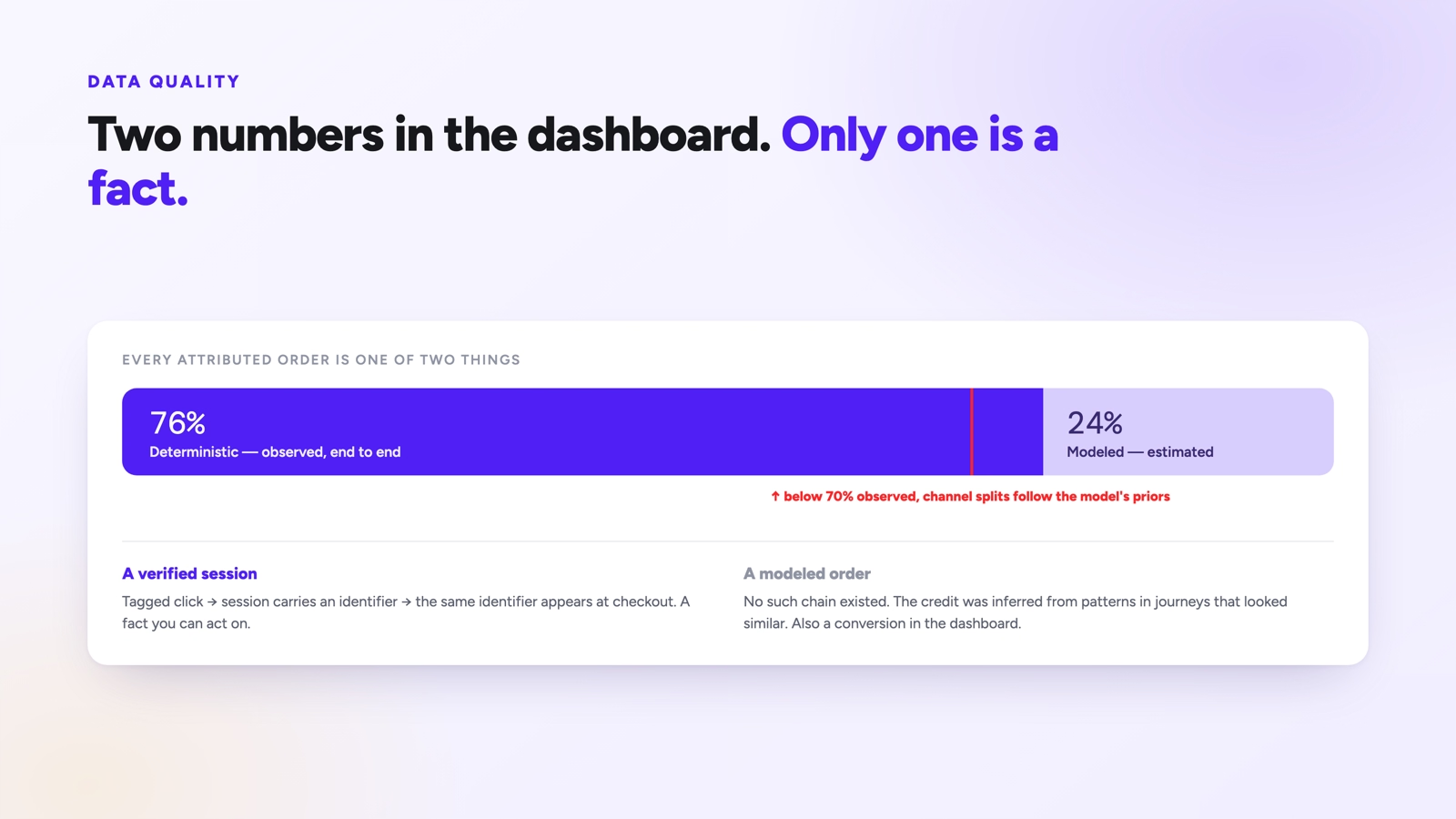
Two attribution reports can show the same number and mean entirely different things. In one, that conversion was observed: a tagged click produced a session, the session carried an identifier, and the identifier appeared again at checkout. In the other, no such chain existed and the conversion was estimated from patterns in similar journeys. Both appear in the dashboard as a conversion. Only the first is a fact. Understanding deterministic versus modeled attribution, and knowing what share of your reporting is each, is the difference between a number you can act on and one you are hoping is roughly right.
What you will learn
Two attribution reports can show the same number and mean entirely different things. In one, that conversion was observed: a tagged click produced a session, the session carried an identifier, and the identifier appeared again at checkout. In the other, no such chain existed and the conversion was estimated from patterns in similar journeys. Both appear in the dashboard as a conversion. Only the first is a fact. Understanding deterministic versus modeled attribution, and knowing what share of your reporting is each, is the difference between a number you can act on and one you are hoping is roughly right.
The Two Kinds of Attribution Data
Deterministic attribution connects a marketing touchpoint to an order through an unbroken chain of observed evidence. A visitor arrives with campaign parameters in the URL, a first party identifier is set, that identifier persists across their sessions, and the same identifier is present when the order is placed. Nothing is inferred. The connection either exists in the data or it does not.
Modeled attribution fills gaps by inference. When the chain is broken, typically by consent refusal, cross device switching, browser storage limits, or an untagged referral, the system estimates what probably happened based on aggregate patterns. Google's conversion modelling, Meta's modelled conversions, and every vendor's "unattributed" redistribution logic work this way.
Neither is inherently wrong. Modelling exists because deterministic coverage is never complete, and reporting only what you can observe would systematically understate channels that operate in the unobservable space. The problem is not that modelling exists. The problem is when the two are presented as one number with no indication of the mix.
Why the Mix Matters
A report showing 1,000 conversions where 850 are deterministic and 150 modeled is a strong report. The same 1,000 where 400 are deterministic and 600 modeled is a projection. The channel level splits in the second case rest largely on the model's assumptions about how unobserved journeys behave, and those assumptions are exactly where vendor bias enters.
A practical threshold: when modeled orders exceed roughly 20 to 30 percent of the total, channel level conclusions become fragile. Below that, the observed data dominates and the model is correcting at the margins. Above it, the model is doing the work and you are effectively trusting its priors.
What Makes a Session Verified
A verified session is one where the chain from marketing touchpoint to on site behaviour is complete and observed. Building that chain reliably takes several layers working together, because each layer covers a different failure mode.
Layer one: URL parameters. Campaign parameters carried in the landing URL identify the source of the visit. This is the foundation, and it is also the most fragile layer, because parameters get stripped by redirects, lost in app browsers, and dropped by link shorteners. Consistent tagging across every channel is the prerequisite for everything else.
Layer two: first party identification. An identifier set in a first party context, ideally server side rather than through browser script, persists across sessions. Server set identifiers survive browser storage restrictions that limit client side script to short lifetimes in Safari and other privacy focused browsers.
Layer three: server side event collection. Sending events from your server rather than only from the browser removes dependence on client side script executing successfully. Ad blockers, script errors, slow connections, and browser privacy features all interrupt browser only collection.
Layer four: order level stitching. At checkout, the identifier must be attached to the order record so that the journey and the transaction join. Without this, you have session data and order data in separate universes.
A session that survives all four layers is verified. The touchpoint that produced it, the behaviour it contained, and the order it led to are connected by observation rather than by inference.
Where the Chain Breaks
| Break point | Cause | Effect on attribution |
|---|---|---|
| Missing parameters | Untagged links, redirect stripping, in app browsers | Traffic lands in direct or organic |
| Consent declined | Visitor rejects tracking cookies | No identifier, journey unobservable |
| Browser storage limits | Client side storage capped at days | Long journeys fragment into separate visitors |
| Cross device switch | Discovery on mobile, purchase on desktop | Journey splits into two incomplete ones |
| Ad blocker | Browser script blocked | Events never sent without server side collection |
| Checkout not instrumented | Express checkout, app, or marketplace path | Order never joins to the journey |
Each of these converts a would be deterministic journey into a modeled one, or into no journey at all. The practical work of improving attribution quality is mostly the unglamorous work of closing these gaps rather than choosing a cleverer model.
Why Long Journeys Make This Urgent
The gap between deterministic and modeled matters more the longer your purchase cycle runs. A journey that completes in two days rarely encounters browser storage expiry or cross device switching. A journey that runs for months encounters both repeatedly.
In considered purchase categories, journeys stretching well beyond a year are not exotic outliers. Furniture, high value apparel, and B2B ecommerce all produce them. Any measurement setup relying on client side storage with a short lifetime will fragment such a journey into several unrelated visitors, each appearing to arrive from whatever channel touched them most recently. The first touch, which is where the discovery actually happened, disappears entirely.
This is why the identification layer matters more than the attribution model sitting on top of it. A sophisticated multi touch model applied to fragmented journeys will confidently allocate credit among the fragments it can see, and it will be wrong in a systematic direction: toward the bottom of the funnel, because that is where the surviving fragments cluster.
Judging How Much Modelling Is Acceptable
The criteria worth applying to any attribution setup:
- Is the modeled share disclosed? If a vendor cannot tell you what percentage of conversions were inferred, that percentage is not being managed.
- Is the modeled share stable? A share that jumps between months indicates a tracking problem, a consent change, or a silent model update.
- Does deterministic coverage hold above roughly 70 percent? Below that, channel splits are dominated by assumptions.
- Can you see coverage by channel? Some channels are far more observable than others, and blended coverage hides that.
- Does the total reconcile to shop revenue? Deterministic plus modeled should account for actual sales, with the remainder visible rather than silently redistributed.
- Are the identification layers actually in place? Server side collection and server set first party identifiers are the two that matter most.
The stability criterion is underrated. A modeled share that moves from 18 percent to 34 percent between two months is telling you something broke, and it is usually one of three things: a consent banner change, a checkout flow change that lost instrumentation, or a new traffic source arriving untagged. Watching that single percentage as a health metric catches tracking regressions faster than watching channel performance, because channel performance changes for many reasons and modeled share changes for very few.
The reconciliation criterion is the one that keeps everyone honest. If deterministic conversions plus modeled conversions equal your actual orders, the accounting is complete and the only question is how the modeled portion was distributed. If they do not, orders are being lost somewhere, and no amount of model sophistication recovers them.
Summary
Deterministic attribution observes the connection between a touchpoint and an order through an unbroken chain of first party evidence. Modeled attribution infers it from patterns when that chain is missing. Both appear identically in most reporting, which is why the modeled share is a number worth demanding.
A verified session depends on four layers: consistent campaign parameters, server set first party identification, server side event collection, and order level stitching at checkout. Getting those right raises deterministic coverage, which shrinks the portion of your reporting that rests on assumptions. Aim to keep modeled conversions below roughly 20 to 30 percent of the total, watch that percentage as a health metric in its own right, and treat a sudden change in it as a tracking incident rather than a performance one.
FAQ
Is modeled attribution unreliable?
Not inherently. Modelling is necessary because complete observation is impossible under current privacy conditions. It becomes unreliable when it dominates, when its assumptions are hidden, or when it is presented as observed data without any indication of the mix.
What percentage of conversions should be deterministic?
As high as your consent rate and tracking setup allow. Above roughly 70 percent deterministic, the observed data carries the conclusions. Below that, channel level splits increasingly reflect the model's priors rather than your customers' behaviour.
How does server side tracking improve deterministic coverage?
It removes dependence on browser script executing successfully, so ad blockers and script failures stop causing data loss. Server set first party identifiers also persist longer than client side storage, which matters enormously for purchase cycles measured in weeks or months.
Why does my modeled share suddenly change?
Almost always a tracking or consent change rather than a customer behaviour change. Check for recent consent banner modifications, checkout flow updates that may have dropped instrumentation, and new traffic sources arriving without campaign parameters.
Do I still need consent if I use server side tracking?
Yes. Server side collection is a technical architecture, not a legal exemption. Consent requirements apply to the processing of personal data regardless of whether the data is collected in the browser or on your server. Server side tracking improves data quality within consent, it does not replace it.
Decisions start with trust
14-days for free