CAC Payback Period: How to Calculate How Fast Acquisition Pays for Itself

A brand can have excellent unit economics and still run out of cash. That happens when every euro spent on acquisition takes eleven months to come back, and the business is growing fast enough that new spend keeps outrunning returning money. The CAC payback period is the metric that catches this. It measures how long a customer takes to generate enough contribution profit to repay what you paid to acquire them, and it is the number that decides how aggressively you can actually grow rather than how aggressively you would like to.
What you will learn
A brand can have excellent unit economics and still run out of cash. That happens when every euro spent on acquisition takes eleven months to come back, and the business is growing fast enough that new spend keeps outrunning returning money. The CAC payback period is the metric that catches this. It measures how long a customer takes to generate enough contribution profit to repay what you paid to acquire them, and it is the number that decides how aggressively you can actually grow rather than how aggressively you would like to.
Calculating the Payback Period
The basic formula divides acquisition cost by the profit a customer contributes per period.
CAC payback period = CAC / average monthly contribution profit per customer
Contribution profit means revenue minus everything variable: cost of goods sold, shipping, payment processing fees, packaging, and the cost of returns. It does not mean revenue, and it does not mean gross margin unless your gross margin already accounts for fulfilment.
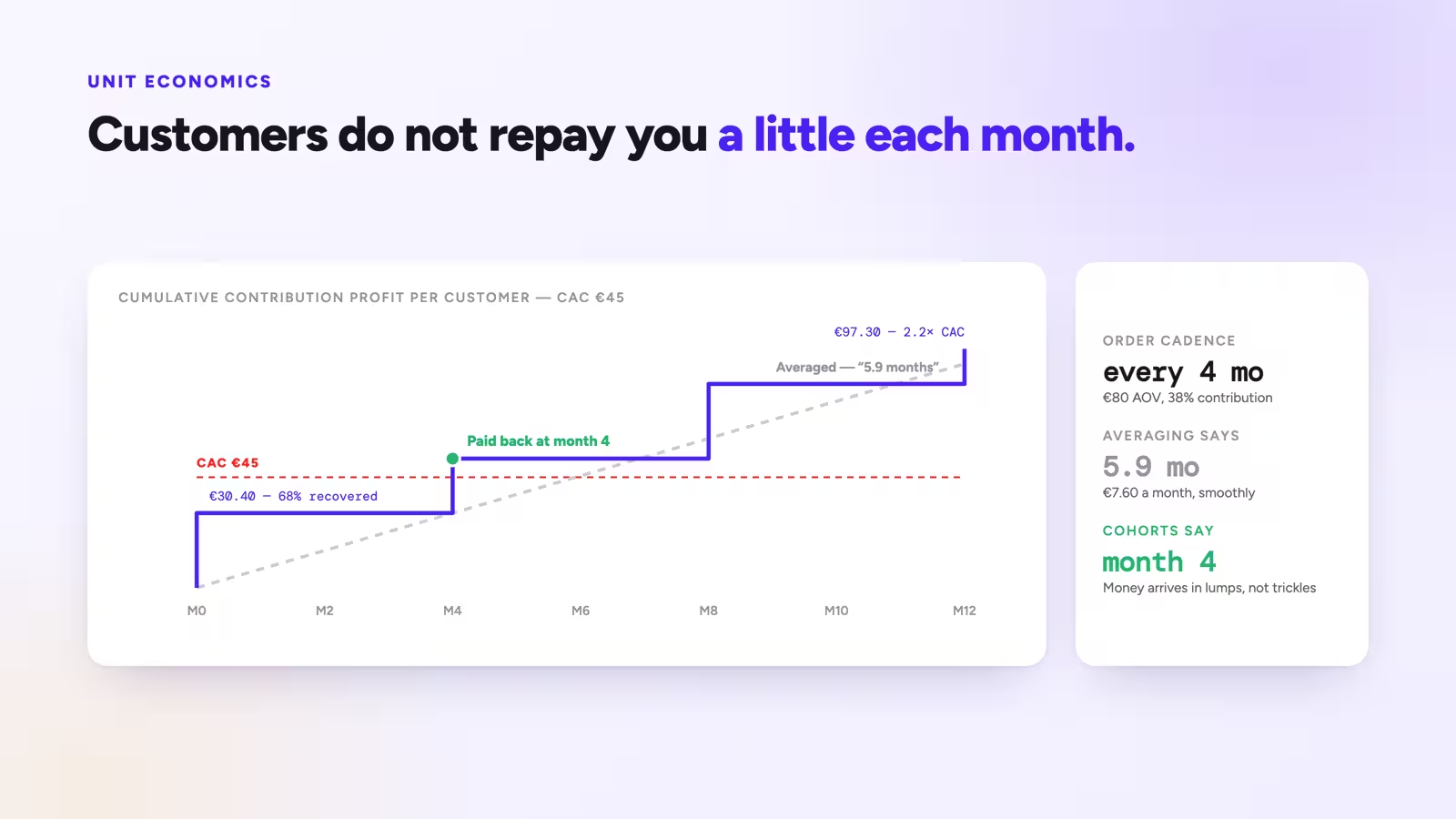
Take a customer acquired for 45 euros who orders every four months at an 80 euro average order value with a 38 percent contribution margin. Each order returns 30.40 euros of contribution profit. Spread across four months, that is 7.60 euros per month, giving a payback period of roughly 5.9 months.
The Cohort Method Is More Honest
The formula above assumes a steady drip of profit, which no ecommerce business actually experiences. Customers buy in lumps. A better approach builds the payback curve from cohort data.
Take everyone acquired in a given month, sum their cumulative contribution profit at the end of each subsequent month, and divide by the number of customers in the cohort. Then compare that running total against the CAC you paid for that cohort. The payback point is the month where cumulative contribution profit per customer crosses CAC.
| Months since acquisition | Cumulative contribution profit per customer | Against CAC of 45 euros |
|---|---|---|
| 0 (first order) | 30.40 | 68% recovered |
| 3 | 30.40 | 68% recovered |
| 4 | 52.60 | Paid back |
| 12 | 97.30 | 2.2x CAC |
This view immediately shows something the smooth formula hides: nothing happens between month 0 and month 4. A business that assumes linear payback will plan its cash flow badly, because the money arrives in steps, not in a stream.
First Order Payback
Many ecommerce brands track a simpler variant: does the first order alone cover CAC?
First order payback = first order contribution profit / CAC
In the example above, that ratio is 0.68, meaning the first order recovers 68 percent of acquisition cost and the business is exposed until the second purchase. A ratio above 1.0 means acquisition is self funding from day one, which is the strongest possible position and rare outside high margin or high basket categories.
Where Payback Period Changes Decisions
Payback period is a cash metric, so it shows up wherever cash is the constraint.
Founders and finance leads use it to set the ceiling on growth. If payback takes nine months, then every month of aggressive acquisition creates a nine month hole that has to be funded from working capital, a credit line, or investor money. Two businesses with identical LTV to CAC ratios but payback periods of three and nine months are not comparable investments, because one funds its own growth and the other requires capital.
Heads of growth use it to sequence channel investment. Channels differ enormously here. Branded search and retargeting typically pay back on the first order because they reach people already close to buying. Broad prospecting, influencer campaigns, and upper funnel video often pay back over two or three purchase cycles. A portfolio weighted entirely toward fast payback looks safe and quietly starves the top of the funnel.
Retention and CRM teams use it as their primary target. The fastest way to shorten payback is not to lower CAC, which is largely set by auction dynamics outside your control, but to pull the second purchase forward. Moving average time to second order from 120 days to 75 days can cut months off the payback period without touching acquisition at all.
The situations where the metric becomes urgent:
- Inventory heavy businesses. Cash tied up in stock plus cash tied up in unrecovered CAC compounds quickly.
- Rapid scaling. The faster you grow, the larger the share of your customer base that has not paid back yet.
- Rising CPMs. A CAC increase extends payback proportionally, so an auction shift can turn a comfortable position into a strained one within a quarter.
- Seasonal acquisition. Customers acquired in a Black Friday rush often have lower repeat rates and longer payback than customers acquired in a normal month.
What Determines Whether Your Number Is Trustworthy
The criteria that matter most:
- Contribution profit, not revenue. Using revenue in the denominator can make payback look three times faster than it is.
- Returns included. In apparel, return rates of 30 to 50 percent completely change the calculation, and returns arrive after the order.
- Cohort based, not blended. A blended calculation mixes mature cohorts with new ones and understates payback during growth.
- Discounts allocated correctly. A first order discount is an acquisition cost in economic terms even when it sits in a different line of the profit and loss statement.
- Payment terms and refunds. Money recognised is not money received. If your payment provider settles on a delay, the cash payback is later than the accounting payback.
- CAC accuracy. If attribution misassigns new customers between channels, channel level payback is wrong even when the blended figure is right.
The returns point causes the most damage in practice. A brand calculating payback on gross orders in a category with a 40 percent return rate is overstating contribution profit by roughly 40 percent and understating payback by a similar margin. The correction is to calculate on net orders after the return window closes, which means your most recent cohorts will always be provisional.
The discount point is subtler but structural. Many brands acquire with a 15 percent welcome code and then calculate CAC on media spend alone. The discount is a real cost of acquiring that customer, it reduces first order contribution profit, and excluding it makes acquisition look cheaper and payback faster than either really is.
Finally, payback period should be read next to the LTV to CAC ratio, never instead of it. Payback tells you when you get your money back. The ratio tells you how much you eventually make. A three month payback on a customer who never returns is a fast recovery of a small amount. A nine month payback on a customer worth four times CAC is a slow recovery of a large one. Growth planning needs both facts.
The Short Version
CAC payback period measures the time between paying to acquire a customer and recovering that cost in contribution profit. Build it from cohort data rather than a smoothed formula, use contribution profit after cost of goods, shipping, fees, and returns, and count acquisition discounts as part of the cost. The result is the metric that determines how fast you can grow without external funding.
Set a payback target that matches how your business is financed. A brand funding growth from operating cash needs payback inside roughly one purchase cycle. A brand with a facility or investor backing can carry a longer horizon in exchange for a higher eventual return. Then work the retention lever, since pulling the second purchase forward shortens payback faster and more reliably than trying to buy traffic more cheaply in an auction you do not control.
FAQ
What is a good CAC payback period for ecommerce?
Recovering CAC on the first order is the strongest position. Recovery within one to two purchase cycles, often three to six months, is comfortable for most brands. Beyond nine to twelve months you are effectively financing growth, which is viable only with capital behind it.
Should payback be calculated on gross margin or contribution margin?
Contribution margin, because shipping, payment fees, packaging, and returns are real cash costs that gross margin often omits. Using gross margin systematically understates payback time.
How do returns affect the calculation?
They delay and reduce it. An order counted at the point of purchase may be partially refunded weeks later, so recent cohorts always look better than they will once the return window closes. Calculate on net revenue after returns and treat the most recent months as provisional.
Does payback period replace ROAS?
No, they answer different questions. ROAS measures immediate efficiency of a campaign. Payback measures how long the business waits to recover acquisition cost. A campaign can have strong ROAS and slow payback if the orders it produces are small and repeat purchase is distant.
How do I shorten payback without cutting CAC?
Increase first order contribution profit through higher basket value, bundling, or reduced discounting, and pull the second purchase forward with post purchase flows and replenishment timing. Both act on the denominator, which is usually more controllable than the auction driven cost of acquisition.
Decisions start with trust
14-days for free