Why 4x Is the Cap on View Through Attribution

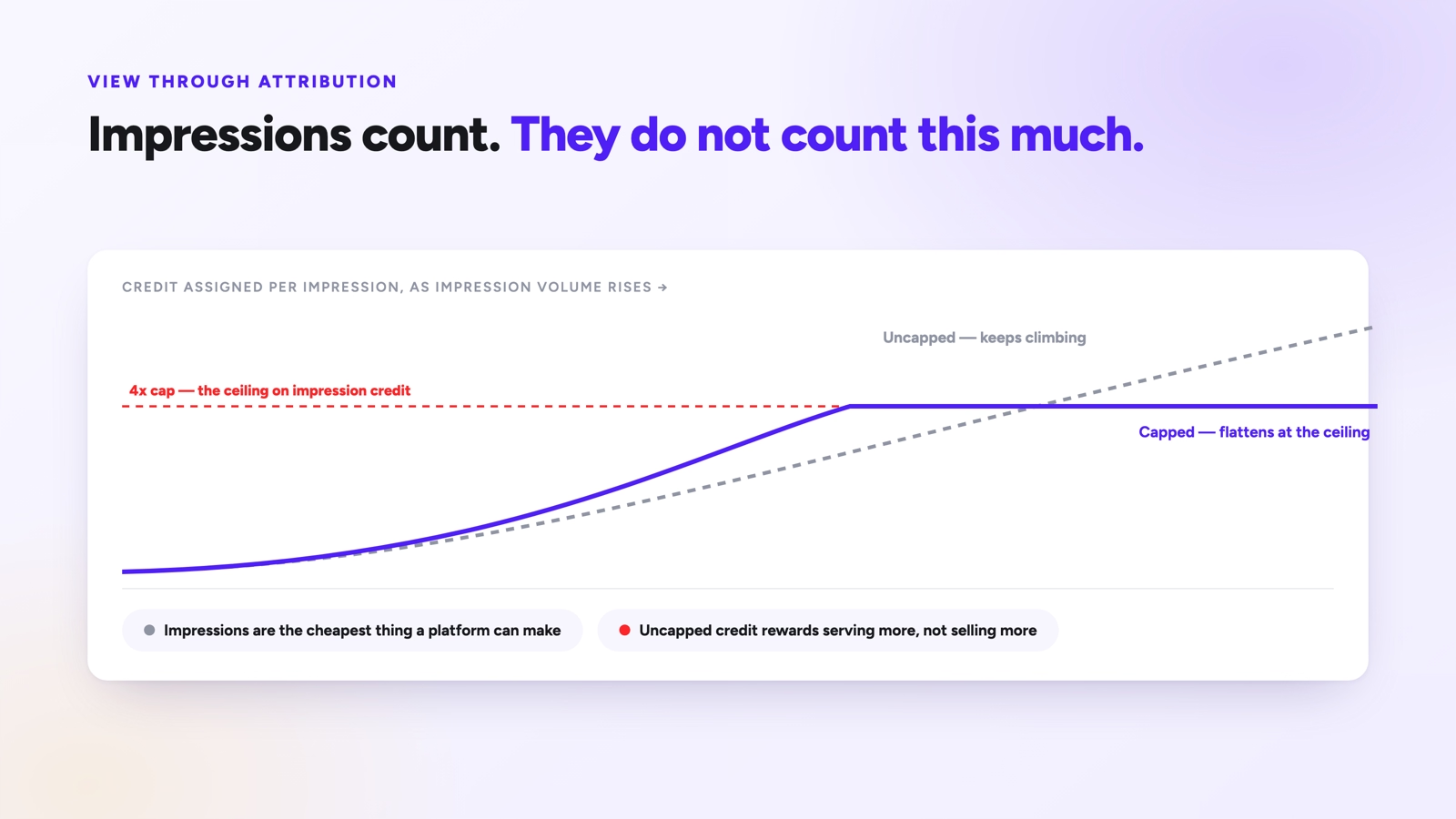
Impressions influence buying behaviour. Anyone who has run a brand campaign knows this, and pretending otherwise makes upper funnel video look worthless. But impressions are also the cheapest thing an advertising platform can produce, and any attribution system that credits them generously creates an obvious incentive: serve more impressions, claim more conversions, report better performance without improving anything. The question is not whether view through attribution should exist. It is where the ceiling sits. This article explains why view through credit needs an explicit cap, how a 4x limit works, and what an uncapped system does to your channel mix.
What you will learn
Impressions influence buying behaviour. Anyone who has run a brand campaign knows this, and pretending otherwise makes upper funnel video look worthless. But impressions are also the cheapest thing an advertising platform can produce, and any attribution system that credits them generously creates an obvious incentive: serve more impressions, claim more conversions, report better performance without improving anything. The question is not whether view through attribution should exist. It is where the ceiling sits. This article explains why view through credit needs an explicit cap, how a 4x limit works, and what an uncapped system does to your channel mix.
What View Through Attribution Is
A view through conversion is credited when someone saw an ad, did not click it, and later purchased. The evidence chain is weaker than a click by a wide margin.
A click is an action the person chose to take. It proves attention, intent, and arrival on your site. An impression proves only that the ad was served into a space the person was looking at, or scrolling through, or had in a background tab. Viewability standards vary, and a served impression is not the same as an ad a human processed.
The asymmetry in evidence quality is the entire reason a cap is needed. If a click and an impression receive similar weight, then a channel can improve its apparent contribution simply by increasing impression volume, which is the one thing every platform can do effortlessly and cheaply.
How Platforms Handle It
Meta's default attribution setting is seven day click plus one day view. Google Display and YouTube apply their own view through windows. Programmatic display has historically been the most aggressive, with view through windows measured in days and no meaningful weighting reduction.
In all these cases the impression credit is applied at full conversion value. A view through conversion counts as one conversion, exactly like a click through conversion. There is no discount for weaker evidence.
That design choice is defensible from a platform's perspective. It is not defensible in a measurement layer that is supposed to compare channels fairly, because it means impression heavy channels are structurally advantaged over click driven ones.
Why an Explicit Cap Is Necessary
Consider what happens without one. A retargeting campaign serves ads to people who visited your site in the last week. Those people are already far along in their purchase journey. Many of them will buy regardless. Serve them enough impressions and the campaign will accumulate view through conversions in proportion to impression volume, not in proportion to influence.
Double the impressions on the same audience and view through conversions roughly double. Nothing about the campaign's actual contribution changed. Only the exposure count did.
This produces three specific distortions:
Retargeting looks unbeatable. It reaches high intent people cheaply and claims their purchases through impressions. In uncapped systems, retargeting routinely shows the highest apparent efficiency in the account while being the least incremental thing in it.
Broad, cheap inventory looks efficient. Placements with low CPMs generate many impressions per euro. If each impression carries conversion claiming potential, cheap inventory accumulates credit disproportionately.
Budget flows to the bottom of the funnel. Because view through credit concentrates where audiences are already warm, uncapped systems systematically shift budget away from prospecting and toward harvesting, which degrades growth over the following quarters.
How a 4x Cap Works
The principle is straightforward: a click is worth more than an impression, and the ratio between them should be stated rather than left to accumulate.
A 4x cap means that a click carries up to four times the attribution weight of an impression on the same journey. Put the other way, an impression can never contribute more than a quarter of what a click contributes toward the same order. Regardless of how many impressions a channel served, its view through contribution to any single order is bounded relative to the click evidence present.
Two consequences follow.
First, impression volume stops being a lever for claiming credit. A channel that serves four times as many impressions does not accumulate four times the credit on a journey where a click also exists, because the click evidence dominates and the impression contribution is bounded.
Second, upper funnel channels retain genuine credit on journeys where no click occurred. A video ad that was seen but never clicked, followed weeks later by a branded search and a purchase, still contributes. It contributes at a discount, which reflects the weaker evidence, but it is not zeroed out. This is the part that pure click based attribution gets wrong in the opposite direction.
Calibrating the Ratio
Why four rather than two or ten? The ratio should reflect the observed difference in conversion probability between an exposed non clicker and a clicker, and that difference is measurable.
The calibration approach is to compare conversion rates. Take people exposed to a channel who did not click, and people who clicked. Measure how much more likely the clickers were to purchase within the same window, controlling for audience type. That ratio, observed across enough volume, is the empirical basis for the weighting.
In practice the ratio lands in a range rather than on a precise value, and it differs by channel and audience temperature. A cap of 4x sits at the conservative end of the plausible range, which is the right place for a bound to sit. A cap is not meant to be the exact answer, it is meant to prevent the failure mode where impression volume converts directly into attribution credit.
Where This Matters Most
The teams that feel the effect of view through policy most acutely:
- Brands running heavy retargeting. The apparent performance gap between retargeting and prospecting narrows dramatically once impression credit is bounded.
- Anyone buying programmatic display. Display's historical view through generosity makes it the channel most affected by capping.
- Video first advertisers. A cap that is too tight zeroes out legitimate video contribution, so the cap needs to be non zero rather than absent.
- Teams comparing platform reporting to independent attribution. View through policy is usually the single largest component of the discrepancy.
That last point is worth acting on directly. If your attribution tool reports substantially fewer conversions than Meta, switch Meta to click only reporting and compare again. The difference between the two Meta numbers is the view through component, and it is frequently 20 to 40 percent of the total on retargeting heavy accounts.
The Decision Factors
If you are setting or evaluating a view through policy, the points that matter:
- Is there an explicit cap at all? Unbounded impression credit is the default in most platform reporting and is the single largest source of inflated channel performance.
- Is the ratio disclosed? A model that weights impressions without stating how is not inspectable.
- Is the view window separate from the click window? Impressions should carry a shorter lookback than clicks, because the evidence decays faster.
- Does the cap apply per order or per channel? Per order is the meaningful level, since that is where the credit is divided.
- Is the ratio calibrated against observed data? A number chosen for convenience is a guess, even if it is a reasonable one.
- Does it hold constant over time? Silent changes to view through weighting make month over month comparisons meaningless.
The window point deserves elaboration. Click evidence justifies a long lookback, because a person who clicked demonstrated real engagement that plausibly persists. Impression evidence decays much faster, because being served an ad three weeks ago is weak grounds for claiming a purchase today. A model with a 30 day click window and a 30 day view window is treating those two very differently sized pieces of evidence as though they aged at the same rate.
The calibration point sets the boundary on how confident anyone should be about the specific number. Four is a defensible, conservative bound derived from observable differences in conversion behaviour between clickers and exposed non clickers. It is not a law of nature. What matters more than the exact value is that a bound exists, that it is stated, and that it does not move without announcement.
Summary
View through attribution credits impressions for conversions, and impressions are much weaker evidence than clicks. Without an explicit ceiling, impression volume becomes a mechanism for claiming credit, which advantages retargeting, cheap inventory, and bottom of funnel activity while starving the prospecting that actually creates demand.
A 4x cap bounds impression credit at a quarter of click credit on the same journey. That preserves genuine upper funnel contribution on journeys with no click, while removing the incentive to buy attribution through impression volume. If you are evaluating an attribution model, ask three questions: is there a cap, what is the ratio, and is the view window shorter than the click window. A vendor that cannot answer all three is applying a view through policy you have not seen and cannot audit.
FAQ
Should view through conversions be excluded entirely?
No. Excluding impressions completely understates upper funnel video and display, which do influence purchase behaviour without generating clicks. The right approach is bounded credit rather than zero credit, so that impressions count but cannot be accumulated into unlimited claims.
Why do my retargeting numbers drop so much under a capped model?
Because retargeting reaches people who were already close to buying and serves them many impressions. Uncapped view through credit converts that impression volume into conversions. Capping it reveals how much of the reported performance was exposure rather than influence.
What view through window is reasonable?
Shorter than your click window, because impression evidence decays faster. A one day view window against a seven or thirty day click window, as Meta's default applies, reflects that difference. Extending the view window without also reducing the weight compounds the problem.
How do I see the view through component in my own reporting?
Switch your platform reporting to click only attribution and compare against the default setting. The difference is the view through contribution. Doing this per campaign shows which parts of the account depend most on impression credit.
Does capping view through hurt brand campaigns unfairly?
It reduces their reported conversion credit, which is the point, but it does not eliminate it. Brand campaigns retain full credit on journeys where no other touchpoint exists, and the honest way to value them is incrementality testing rather than attribution credit in either direction.
Decisions start with trust
14-days for free