Touch, Tell, Sell: What a Non Black Box Attribution Model Looks Like

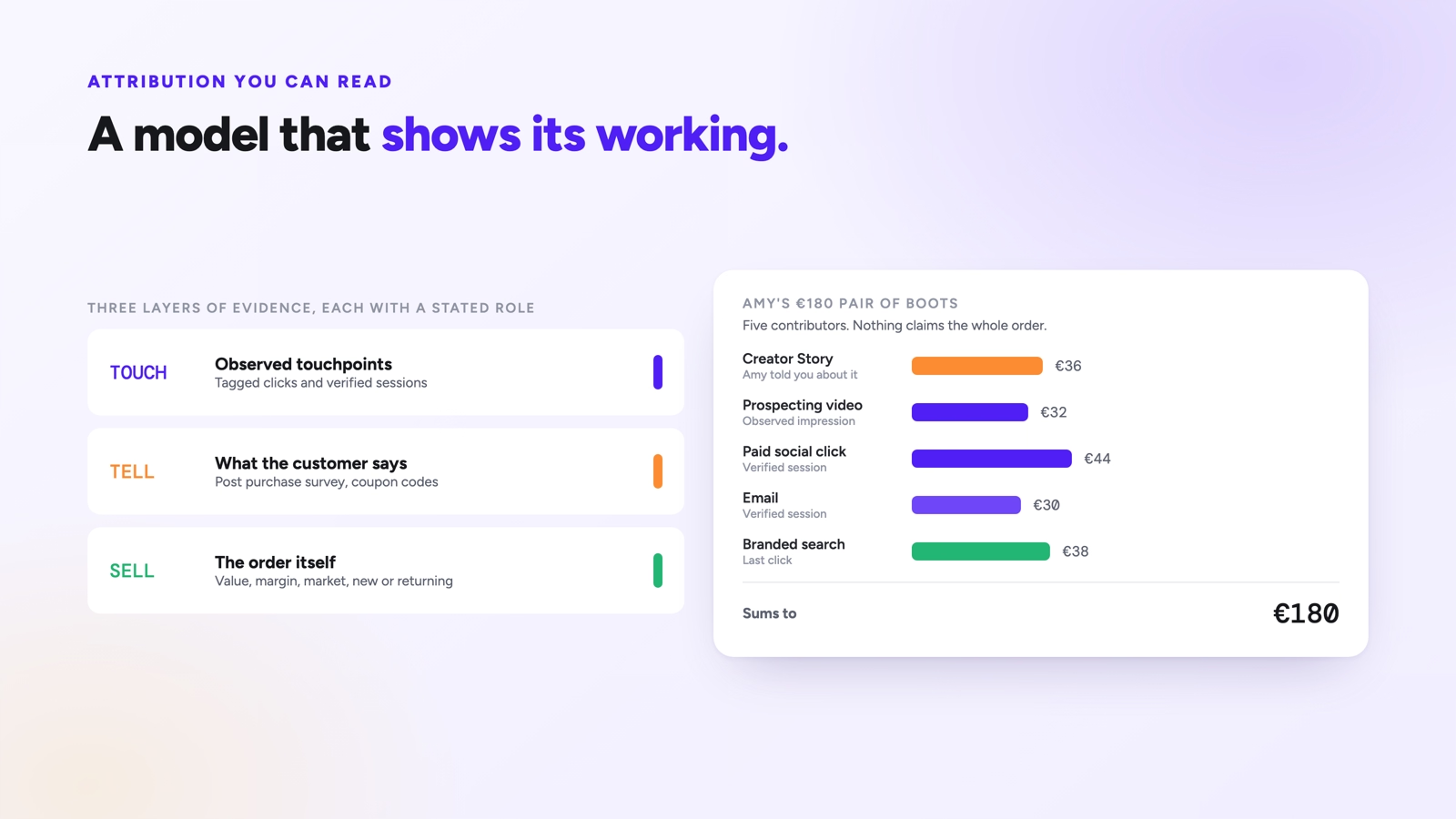
Ask most attribution vendors how their model reached a number and you will get a description of machine learning rather than an explanation. That is a problem, because a marketer who cannot explain why a channel received 31 percent of an order cannot defend the budget decision that follows from it. Touch, Tell, Sell is a deliberately inspectable alternative: three layers of evidence, each with a stated role, combined by rules you can read. This article sets out how the model works, walks through a single customer journey from first impression to purchase, and states plainly where the model runs out of road.
What you will learn
Ask most attribution vendors how their model reached a number and you will get a description of machine learning rather than an explanation. That is a problem, because a marketer who cannot explain why a channel received 31 percent of an order cannot defend the budget decision that follows from it. Touch, Tell, Sell is a deliberately inspectable alternative: three layers of evidence, each with a stated role, combined by rules you can read. This article sets out how the model works, walks through a single customer journey from first impression to purchase, and states plainly where the model runs out of road.
Three Layers of Evidence
The model rests on a simple premise. Different kinds of evidence about a customer journey have different reliability, and a model should treat them differently rather than blending everything into one opaque score.
Touch is the observed behavioural layer. It covers what actually happened: clicks, sessions, page views, referrers, campaign parameters, and the sequence and timing of those events. This is the strongest evidence type because it is deterministic. A tagged click that produced a session on your site is a fact, not an inference.
Tell is the self reported layer. It covers what the customer says, most commonly through a post purchase survey question asking how they heard about you, and through coupon or creator codes that a customer enters deliberately. This layer exists because it captures influence that leaves no digital trace: a podcast mention, a conversation with a friend, an offline poster, a creator recommendation watched without clicking.
Sell is the transactional layer. It covers the order itself: value, products, margin, new or returning customer, market, and currency. This is what the other two layers are trying to explain, and it is the reconciliation anchor. Every attributed euro must trace back to a real order.
The layers are not alternatives to each other. Touch tells you what happened, Tell tells you what mattered to the customer, and Sell tells you what it was worth. A model using only the first is blind to untrackable influence. A model using only the second is at the mercy of recall bias. Using both, with an explicit rule for how they combine, is the point.
How the Layers Combine
Within the Touch layer, credit is distributed across touchpoints using a weighting that reflects two things: how close a touchpoint sits to the purchase, and what kind of interaction it was.
Position matters because a touchpoint two hours before purchase and a touchpoint two months before purchase play different roles. Time decay handles this: credit declines as the gap to purchase grows, at a rate tuned to the actual length of the purchase cycle rather than a fixed default.
Interaction type matters because evidence quality differs. A click that produced a session is strong evidence of engagement. An impression with no click is weaker evidence. Treating them equally reproduces exactly the bias that makes platform reporting unusable, since platforms are generous with view through credit precisely because it inflates their contribution.
The Tell layer enters as a correction rather than a replacement. When a customer names a source that the Touch layer never observed, that source receives credit that the observed touchpoints would otherwise have absorbed. When a customer names a source that the Touch layer did observe, the two agree and confidence in the assignment rises.
The Sell layer constrains the whole thing. Total attributed value across all channels must equal actual order value. This is the property that separates an attribution model from platform reporting: credit is a fixed pie that gets divided, not a claim each channel makes independently.
A Worked Journey
Consider a customer, Amy, buying a 180 euro pair of boots.
| Day | Event | Layer | Evidence type |
|---|---|---|---|
| 1 | Sees a Meta video ad, does not click | Touch | Impression |
| 4 | Watches a creator review on Instagram | Not observed | Invisible |
| 6 | Clicks a Meta retargeting ad, browses two products | Touch | Click and session |
| 11 | Opens newsletter, clicks through | Touch | Click and session |
| 18 | Searches the brand name, clicks the organic result | Touch | Click and session |
| 18 | Purchases, enters creator code | Tell and Sell | Self reported plus transaction |
A last click model gives everything to organic search. A last paid click model gives everything to the newsletter. Meta's own reporting claims the order on the strength of the day 6 click and possibly the day 1 impression. Google Analytics sees no creator involvement at all.
Under the three layer approach, the day 1 impression receives a small weight, the day 6 click receives meaningful credit reduced by time decay, the newsletter click receives more, and the day 18 branded search receives credit reduced by the recognition that branded search largely harvests demand created elsewhere. Then the creator code, a Tell signal, claims a share that the Touch layer had no way to see, redistributing credit away from the observed touchpoints toward the source Amy actually names.
The output is one order worth 180 euros, split across five contributors, summing to 180 euros. No channel claims the whole thing. The invisible creator touchpoint is represented because Amy told you about it.
Where the Model Stops Working
Any attribution methodology worth trusting states its own failure modes. This one has four significant ones.
Consent gaps break the Touch layer. A visitor who declines tracking on their first session produces no observable first touch. In markets with strict consent enforcement, that missing first touch is systematically upper funnel, which biases the observed portion of the model toward the bottom of the funnel. Higher consent rates directly improve model quality, which is why banner design is a measurement decision and not only a legal one.
Survey response rates are low and recall is imperfect. The Tell layer depends on people answering a post purchase question and answering it accurately. Response rates of 20 to 40 percent are typical, and customers genuinely misremember. Tell is a corrective signal, not ground truth, and weighting it as though it were would introduce a different bias.
Attribution is not incrementality. The model distributes credit for orders that happened. It does not establish that those orders would not have happened without the marketing. A channel can receive a large, correctly calculated share of credit and still be non incremental, because it was present on journeys that were already going to convert. Retargeting and branded search are the standard examples. Geo holdout tests are the only real answer here, and no attribution model substitutes for them.
Long journeys stress every window. Purchase cycles in considered categories can run for many months. Any model has to choose a lookback window, and a journey longer than that window is truncated at the top. Extending the window improves coverage and reduces the practical influence of early touchpoints through time decay, so there is a genuine trade off rather than a free improvement.
Naming these limits is not a weakness of the approach. A model that claims no limitations is either not being examined closely or is not being described honestly.
What Makes an Attribution Model Inspectable
If you are evaluating any attribution methodology, including this one, the criteria that matter:
- Can you see a single order's split and understand it? Order level transparency is the test. Aggregate dashboards hide everything.
- Does the model reconcile to shop revenue? Attributed totals should match actual sales within a small margin.
- Is the treatment of impressions disclosed and bounded? Unbounded view through credit is how platforms inflate their own numbers.
- Is the lookback window a deliberate choice? It should reflect your purchase cycle, not a vendor default.
- Are the limitations published? A vendor that cannot tell you when its model is wrong has not examined it.
- Does it change silently? Model updates that are not announced make period comparisons meaningless.
The first criterion is the one that separates real transparency from marketing language about transparency. Being able to open a specific order, see the five touchpoints, see the weight each received, and follow the arithmetic to the split is what makes a number defensible in a meeting. Everything else follows from it. If you can inspect one order, you can spot check a hundred, and if a hundred hold up, the aggregate is credible.
Summary
Touch, Tell, Sell separates attribution evidence into three layers: what was observed, what the customer reported, and what was actually transacted. Observed touchpoints are weighted by recency and by interaction quality, self reported sources correct for influence that leaves no digital trace, and the transaction anchors the whole calculation so that attributed value always reconciles to real revenue.
The model's value is not that it is more sophisticated than the alternatives. It is that it can be read. If you are choosing an attribution approach, insist on order level inspectability, on reconciliation against shop revenue, on a disclosed and bounded treatment of impressions, and on a published statement of where the model fails. Then pair whatever model you choose with periodic incrementality testing, because attribution divides credit among the touchpoints that were present and only an experiment can tell you which of them actually caused the sale.
FAQ
How is this different from a standard multi touch attribution model?
Standard multi touch models work only from observed digital touchpoints. Adding a self reported layer captures influence that produces no click, such as podcasts, offline exposure, word of mouth, and creator content watched without engagement. The other difference is inspectability at the level of an individual order.
Are post purchase survey answers reliable enough to weight?
Individually, no. In aggregate they carry real signal, particularly for channels that are otherwise invisible. The correct treatment is as a corrective input that redistributes credit, weighted below deterministic click evidence rather than treated as ground truth.
Why give impressions any credit at all?
Because they genuinely influence behaviour, and excluding them entirely understates upper funnel video and display. The important design choice is that impression credit is bounded well below click credit, so that a channel cannot inflate its contribution simply by serving more impressions.
Does this model tell me which channels are incremental?
No, and no attribution model does. Attribution divides credit among the touchpoints present on converting journeys. Incrementality asks whether those journeys would have converted anyway, which requires a holdout experiment. Use attribution for continuous allocation and experiments to validate the largest bets.
What happens to journeys where the customer declined tracking?
The observed portion of the journey is incomplete, most often missing the first touch. The self reported layer partially compensates, and the reconciliation against shop revenue makes the size of the unobserved portion visible rather than hiding it. Improving consent rates is the most direct way to shrink it.
Decisions start with trust
14-days for free