ROAS vs aROAS: What Attributed ROAS Measures That Platform ROAS Cannot

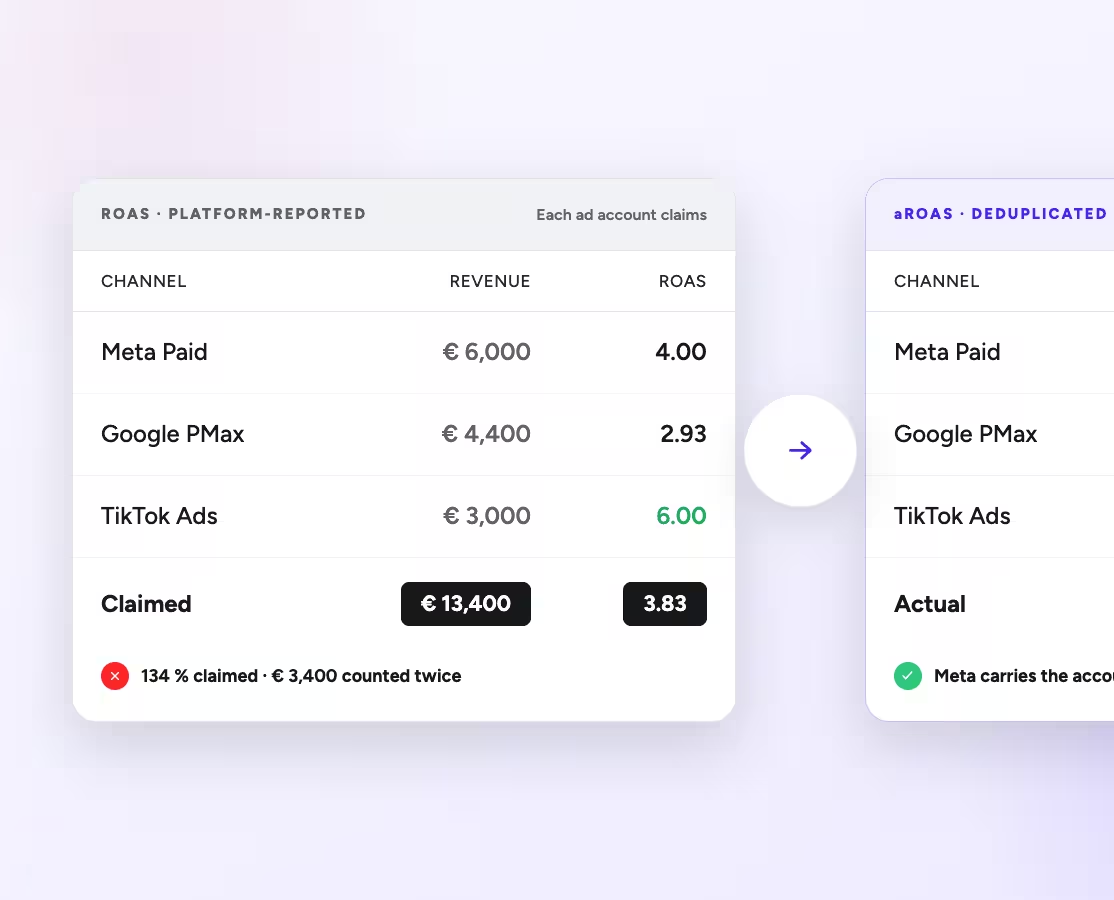
Open Meta Ads Manager and Google Ads side by side, add up the revenue both platforms claim, and compare it to what your shop actually sold. The two numbers almost never match, and the platforms almost always claim more. That gap is the reason attributed ROAS, usually written aROAS, exists as a separate metric. Understanding ROAS vs aROAS means understanding who is counting the revenue, what rules they use to assign it, and why a 4.0 in the ad platform can coexist with a 2.1 in your independent measurement without either number being a mistake.
What you will learn
Open Meta Ads Manager and Google Ads side by side, add up the revenue both platforms claim, and compare it to what your shop actually sold. The two numbers almost never match, and the platforms almost always claim more. That gap is the reason attributed ROAS, usually written aROAS, exists as a separate metric. Understanding ROAS vs aROAS means understanding who is counting the revenue, what rules they use to assign it, and why a 4.0 in the ad platform can coexist with a 2.1 in your independent measurement without either number being a mistake.
Two Metrics, One Formula, Different Inputs
The arithmetic is identical in both cases.
ROAS = revenue attributed to a channel / ad spend on that channel
What changes is where the revenue figure comes from and which rules decided it belonged to that channel.
Platform ROAS is calculated by the ad network itself, using its own conversion tracking and its own attribution window. Meta's default setting credits a conversion to an ad if the user clicked within seven days or viewed the ad within one day. Google Ads applies its own model across its own inventory. Each network sees only its own touchpoints, so each one credits itself for any order it plausibly influenced.
Attributed ROAS (aROAS) is calculated by an independent measurement layer that sees every touchpoint across every channel and applies one consistent set of rules to all of them. Instead of asking "did Meta touch this order," it asks "of all the touchpoints on this customer journey, how much credit does each one deserve." One order produces exactly one unit of revenue, split across the channels that contributed to it.
The structural difference matters more than the calculation. Platform ROAS is self reported and non exclusive. If a customer clicked a Google Shopping ad on Monday, saw a Meta retargeting ad on Wednesday, and bought on Friday after a branded search, all three platforms can claim the full order value. Add the platform numbers up and you get 300 percent of your real revenue. aROAS is exclusive by construction. The credit sums to one order, so channel numbers can be added together and compared against actual shop revenue.
A Worked Example
Take a month with 100,000 euros of shop revenue and 30,000 euros of ad spend split evenly between Meta and Google.
| Source | Meta revenue | Google revenue | Total claimed |
|---|---|---|---|
| Platform reporting | 78,000 | 61,000 | 139,000 |
| Attributed measurement | 41,000 | 38,000 | 79,000 (rest to organic, email, direct) |
Platform ROAS reads 5.2 for Meta and 4.1 for Google. aROAS reads 2.7 and 2.5. Nothing was calculated incorrectly. The platforms counted every order they touched. The attribution layer counted each order once and gave the remaining credit to the channels the platforms cannot see, including organic search, email, and direct traffic.
Where the Distinction Changes Decisions
The gap between ROAS and aROAS becomes expensive at exactly one moment: when you decide where the next 10,000 euros goes.
Performance marketers managing campaigns inside a single platform can reasonably work with platform ROAS for relative comparisons. Within Meta, comparing ad set A at 4.2 against ad set B at 2.8 is a fair comparison because both numbers were produced by the same rules. The bias applies equally to both.
Cross channel decisions break that assumption immediately. Comparing Meta at 5.2 against Google at 4.1 tells you nothing useful, because the two numbers come from different attribution windows, different view through policies, and different definitions of a conversion. Heads of growth and ecommerce managers who allocate budget across platforms need aROAS or they are effectively choosing based on which platform is more generous to itself.
The distinction also matters for anyone reporting upward. A finance team that receives platform ROAS figures will build revenue forecasts on numbers that sum to more than the company earned. When actual revenue lands below forecast, marketing gets blamed for underperformance that was really a measurement artefact.
Three situations make the gap especially wide:
- Heavy retargeting. Retargeting reaches people who were already going to buy. Platforms count those orders in full, so retargeting ROAS looks spectacular in platform reporting and mediocre in attributed measurement.
- Strong brand. Branded search and direct traffic inherit demand created upstream. Platforms that own that inventory report high ROAS on it.
- Low consent rates. In markets with strict consent enforcement, a share of journeys is only partly observed. How your measurement layer handles the unobserved portion has a direct effect on aROAS.
How to Judge Which Number to Trust
A few criteria separate a usable attributed ROAS from a number that just looks more conservative:
- Does the revenue reconcile? Sum attributed revenue across all channels. It should land within a few percent of what your shop system reports. If it does not, the model is either double counting or losing orders.
- Is the attribution window disclosed? A seven day click window and a ninety day window produce very different aROAS on considered purchases. The window should match your actual purchase cycle, not a platform default.
- How is view through handled? Impressions genuinely influence buying behaviour, but crediting them at the same weight as clicks overstates upper funnel channels. A defensible model caps view through credit rather than treating a view as equivalent to a click.
- Is the logic inspectable? If you cannot see why an order was split the way it was, you cannot defend the number when someone challenges it.
- Is it consistent over time? A model that changes weighting silently makes month over month comparisons meaningless.
Reconciliation is the test that catches most problems. It is also the test platform reporting cannot pass by design, because platforms are not trying to explain your total revenue, only their contribution to it.
Attribution windows deserve a second look as well. If your average customer takes eighteen days from first touch to purchase, a seven day window is structurally blind to the beginning of the journey. Everything that happens before day seven gets credited to whatever touchpoint happened to fall inside the window, which is usually a retargeting ad or a branded search. That is how a business ends up believing the bottom of its funnel is doing all the work.
The most common mistake, though, is simpler than any of this: teams switch between the two metrics without saying so. A channel looks good in platform ROAS on Monday and bad in aROAS on Thursday, and the argument that follows is really about definitions rather than performance. Pick the metric that matches the decision, label it clearly on every chart, and stop mixing them in the same table.
What to Take Away
ROAS and aROAS share a formula and differ in who supplies the revenue. Platform ROAS is a self reported, overlapping figure that is fine for optimising within one network and useless for comparing across networks, because every platform credits itself for orders it merely touched. Attributed ROAS assigns each order once across all touchpoints under one consistent rule set, which makes it additive, reconcilable against shop revenue, and safe to use for budget allocation.
The practical setup is to use both deliberately. Keep platform ROAS for in platform optimisation where relative comparisons are valid. Use aROAS for every decision that moves money between channels, for forecasting, and for anything that reaches finance. Then check once a month that attributed revenue reconciles with your shop system, because a measurement layer that cannot explain your actual sales is not measuring, it is guessing more conservatively.
FAQ
Why is aROAS almost always lower than platform ROAS?
Because platform ROAS double counts. Every network claims full credit for orders it touched, so overlapping journeys get counted multiple times. Attributed ROAS distributes one order across the touchpoints that contributed, so no revenue is counted twice.
Does a lower aROAS mean my campaigns are performing worse than I thought?
Not necessarily worse in absolute terms, but it does mean the platform figure was flattering. Your real business result did not change. What changed is that you can now compare channels on equal terms and see which ones are genuinely incremental.
Should I optimise campaigns against aROAS inside the ad platform?
Directly, no. Platform algorithms need their own signal to optimise on. Use platform ROAS and platform signals for in platform bidding, and use aROAS at the level above, when deciding how much budget each channel gets in the first place.
What is a good aROAS?
It depends entirely on your contribution margin. A 2.0 aROAS is comfortable on a product with 60 percent gross margin and unsustainable at 25 percent. If you want a target that survives scrutiny, work backwards from margin rather than copying a benchmark, or move to a profit based metric such as POAS.
How do I explain the drop to leadership when we switch metrics?
Show the reconciliation. Put platform reported revenue, attributed revenue, and actual shop revenue in one table. Once people see that platform numbers sum to more than the company earned, the lower figure stops looking like bad news and starts looking like the first honest one.
Decisions start with trust
14-days for free