Non Incremental Channels: Which Ones to Penalise and by How Much

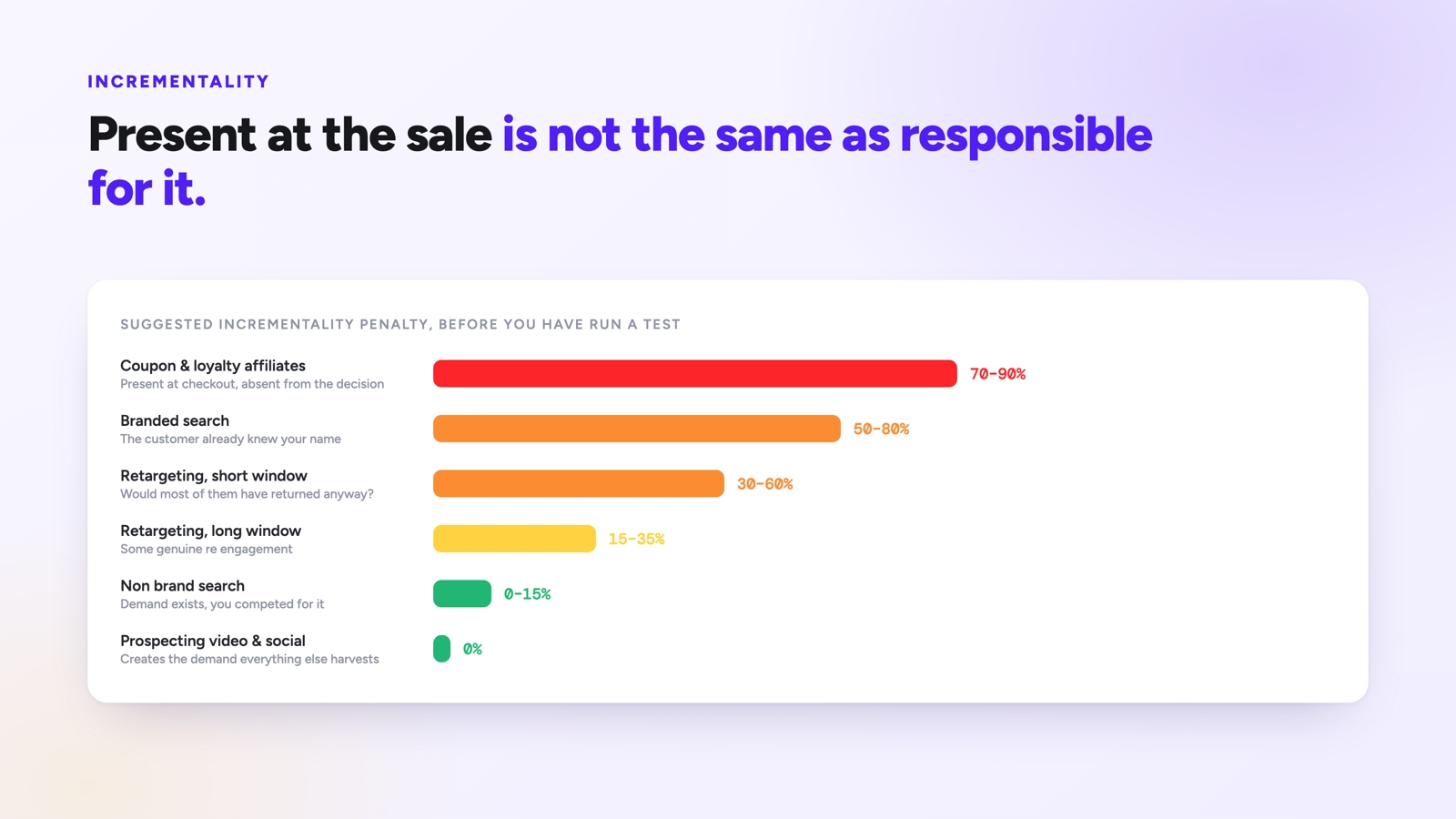
Attribution answers the question of which touchpoints were present when an order happened. Incrementality answers a different and more important question: would the order have happened anyway. A channel can receive a large, correctly calculated share of attribution credit and still contribute nothing, because it was simply present on journeys that were already going to convert. Retargeting, branded search, and coupon site affiliates are the standard examples, and every ecommerce brand allocates some budget to them on the strength of numbers that describe presence rather than causation. This article sets out how to identify non incremental channels, how to apply a practical penalty before you have run a test, and how to test properly when the budget justifies it.
What you will learn
Attribution answers the question of which touchpoints were present when an order happened. Incrementality answers a different and more important question: would the order have happened anyway. A channel can receive a large, correctly calculated share of attribution credit and still contribute nothing, because it was simply present on journeys that were already going to convert. Retargeting, branded search, and coupon site affiliates are the standard examples, and every ecommerce brand allocates some budget to them on the strength of numbers that describe presence rather than causation. This article sets out how to identify non incremental channels, how to apply a practical penalty before you have run a test, and how to test properly when the budget justifies it.
What Non Incremental Means
A channel is incremental to the extent that removing it would reduce total orders. That is the whole definition, and it is deliberately about totals rather than about the channel's own numbers.
Pause retargeting and your retargeting orders go to zero. That is not the measurement. The measurement is what happens to total orders, because most of those customers were on your site last week looking at products and a meaningful share were going to return regardless.
The distinction produces four categories:
| Channel type | Attribution credit | Incrementality | Typical examples |
|---|---|---|---|
| Demand creating | Often low | High | Prospecting video, creator content, non branded search |
| Demand converting | Moderate | Moderate | Non branded shopping, comparison content |
| Demand harvesting | High | Low | Branded search, site retargeting, cart abandonment |
| Demand capturing | High | Very low | Coupon and loyalty affiliates, last click voucher sites |
The systematic problem is that attribution credit and incrementality run in roughly opposite directions. The channels closest to the purchase collect the most credit and create the least demand. A budget process driven purely by attributed efficiency will therefore shift money steadily downward through this table until there is nothing left feeding the top.
Identifying the Suspects
Before running any test, several signals reliably flag a channel as likely non incremental.
It only reaches people who already know you. Site retargeting, cart abandonment, branded search, and email to existing subscribers all operate on an audience that was acquired elsewhere. Whatever they contribute, it is not new demand.
Its volume scales with your other spend rather than with its own budget. If branded search volume rises when you increase paid social spend and does not rise when you increase branded search budget, it is harvesting.
It appears late in journeys. Compare first touch and last touch attribution over the same period. Channels that gain heavily under last touch and lose heavily under first touch sit at the harvesting end.
Its efficiency looks implausibly good. A channel returning three times the account average is either genuinely exceptional or is claiming credit for demand it did not create. The second is more common.
It is triggered by user intent rather than by your targeting. Coupon extensions and voucher sites activate at checkout, after the customer has decided to buy. Their attributed conversion rate is near perfect for exactly that reason.
Applying a Penalty Before You Have Tested
Full incrementality testing is expensive and slow. Most brands cannot test every channel, so the practical approach is to apply a default adjustment based on channel type, then test the ones where the budget is large enough to justify it.
This means multiplying attributed contribution by an incrementality factor before using it in budget decisions.
| Channel | Suggested starting factor | Reasoning |
|---|---|---|
| Prospecting video and display | 0.9 to 1.0 | Under credited by attribution, if anything |
| Creator and influencer | 0.9 to 1.0 | Largely creates demand, often untracked |
| Non branded search and shopping | 0.7 to 0.9 | Real intent, but some would find you anyway |
| Site retargeting | 0.3 to 0.5 | Audience already acquired |
| Cart abandonment | 0.2 to 0.4 | Strong existing purchase intent |
| Branded search | 0.2 to 0.4 | Largely available through organic result |
| Coupon and voucher affiliates | 0.1 to 0.3 | Activates after the purchase decision |
These are starting assumptions, not findings. Their purpose is to stop budget decisions from being made on unadjusted attribution while you work toward actual evidence. Applying a 0.3 factor to branded search means treating a reported 200,000 euros of branded search revenue as roughly 60,000 euros of incremental contribution when comparing it against a prospecting campaign.
The immediate effect is usually to reorder the budget table, and the reordering points toward the top of the funnel.
Be explicit that these are assumptions when you present them. A penalty factor presented as a measurement invites an argument about the number. Presented as an adjustment pending a test, it invites the more useful conversation about which test to run first.
Testing Properly
Three methods, in increasing order of rigour.
Channel pause. Turn the channel off entirely for a defined period and compare total orders against the preceding period and against the same period last year. Simple, cheap, and confounded by seasonality and by everything else that changed in the same weeks. Adequate for a rough read on a small channel.
Geographic holdout. Turn the channel off in one region and keep it running in a comparable region. Compare total orders per region against their pre test baseline. This controls for time based confounds because both regions experience the same seasonality, promotions, and market conditions. It is the practical standard for most ecommerce brands.
Randomised holdout. Where the platform supports it, hold out a randomised share of the audience and measure the difference in conversion between exposed and held out groups. This is the cleanest design available and is offered natively by some platforms for brand lift and conversion lift studies.
The design considerations that determine whether a test produces a usable answer:
- Sufficient volume. A channel producing thirty orders a week cannot support a test that detects a twenty percent effect in two weeks.
- Long enough duration. The test must run for at least one full purchase cycle, otherwise you are measuring delayed conversions rather than absence of demand.
- Comparable regions. Geo tests need regions with similar baseline behaviour, not just similar size.
- Nothing else changing. A promotion launched mid test invalidates it.
- Pre registered success criteria. Decide what result would change your decision before you see the data.
That last point is what separates a test from a post hoc justification. Without a pre registered threshold, an ambiguous result becomes an argument, and the channel's existing budget usually survives the argument by default.
Living With the Answer
Two organisational realities are worth anticipating.
The first is that non incremental does not mean worthless. Branded search defends against competitors bidding on your brand terms, and the value of that defence is real even though it does not show up as incremental orders in a holdout. Cart abandonment emails may be near zero incremental on orders while genuinely improving customer experience. The finding should adjust the budget, not necessarily eliminate it.
The second is that whoever manages the channel will contest the result, and their objections are often technically valid. Holdout tests are noisy, purchase cycles blur the boundaries, and a two week test on a channel with a six week cycle genuinely does understate its contribution. The answer is better test design rather than dismissing the objection, and pre registering the criteria removes most of the argument in advance.
The practical governance approach is to review incrementality factors quarterly, test the largest one or two channels per year, and treat the untested factors as explicit assumptions that appear in the budget model rather than as hidden adjustments. Assumptions that are visible get challenged and improved. Assumptions buried in a spreadsheet formula do not.
Summary
Attribution measures presence on converting journeys, not causation, and the channels that collect the most attributed credit are frequently the ones creating the least demand. Retargeting, branded search, cart abandonment, and coupon affiliates all operate on customers who were already acquired, which is why their reported efficiency is so high.
Apply explicit incrementality factors to attributed contribution before making budget decisions, using conservative starting assumptions by channel type, and label them clearly as assumptions. Then test the channels where the budget is large enough to justify a geographic holdout, run each test for at least one full purchase cycle, and pre register what result would change your decision. The likely outcome is that budget shifts toward the top of the funnel, which is exactly where unadjusted attribution has been quietly taking it away from.
FAQ
How do I know if a channel is non incremental without testing?
Strong signals include reaching only audiences you acquired elsewhere, volume that scales with your other spend rather than its own budget, gaining heavily under last touch relative to first touch, and efficiency far above the account average. None of these are proof, but together they justify applying a penalty pending a test.
What incrementality factor should I use for retargeting?
Something between 0.3 and 0.5 as a starting assumption, meaning you treat roughly a third to a half of attributed retargeting revenue as genuinely incremental. Test it when retargeting represents a large enough share of budget that being wrong is expensive.
How long should an incrementality test run?
At least one full purchase cycle, and preferably two. A test shorter than the cycle measures delayed conversion rather than absent demand, which systematically understates the channel and produces a result that will be correctly contested.
Should I cut non incremental channels entirely?
Not usually. Reduce budget to the level justified by adjusted contribution, and account for defensive value where it exists, such as protecting brand terms from competitors. The goal is correct sizing rather than elimination.
Can attribution models measure incrementality?
No. Attribution divides credit among touchpoints that were present on converting journeys. Incrementality requires a counterfactual, meaning a group that did not receive the treatment. Only an experiment supplies that, which is why holdout testing remains necessary regardless of how good your attribution is.
Decisions start with trust
14-days for free