The Monday Morning Marketing Check In: A 20 Minute Weekly Review That Actually Works

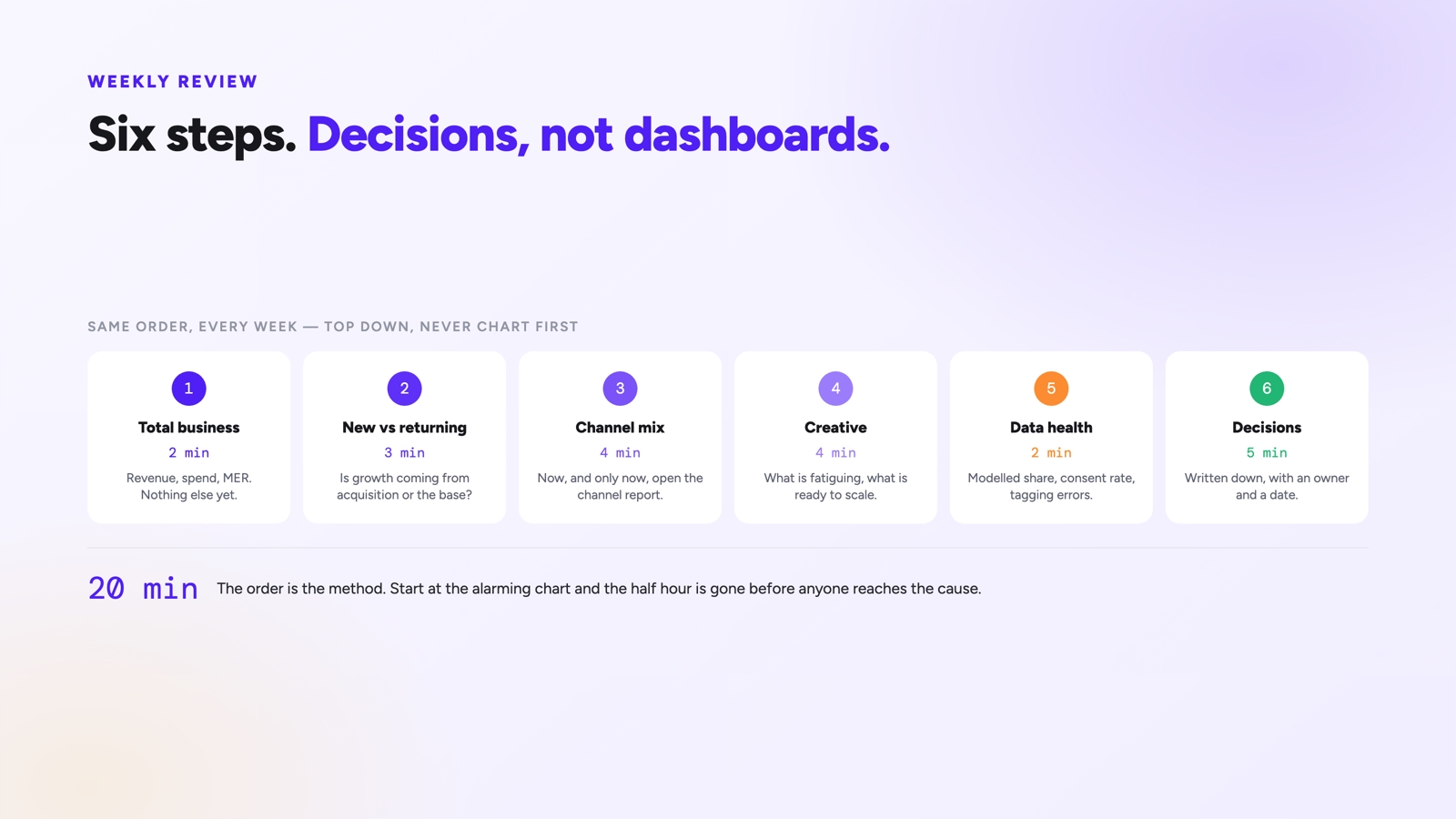
Most weekly marketing meetings are a tour of dashboards. Somebody shares a screen, everyone looks at last week's numbers, a few observations get made, and the meeting ends without a decision. The problem is not the data. It is that the review has no fixed order, so the conversation starts wherever the most alarming chart happens to be, and by the time anyone reaches the underlying cause the half hour is gone. A structured check in fixes this by going from the top down: total business first, then channel mix, then diagnosis, then decisions. Twenty minutes, six steps, same order every week.
What you will learn
Most weekly marketing meetings are a tour of dashboards. Somebody shares a screen, everyone looks at last week's numbers, a few observations get made, and the meeting ends without a decision. The problem is not the data. It is that the review has no fixed order, so the conversation starts wherever the most alarming chart happens to be, and by the time anyone reaches the underlying cause the half hour is gone. A structured check in fixes this by going from the top down: total business first, then channel mix, then diagnosis, then decisions. Twenty minutes, six steps, same order every week.
Why Order Matters More Than Content
Marketing metrics form a hierarchy. Business level efficiency sits at the top, channel performance below it, and creative and campaign level metrics below that. Each level explains movements in the one above.
Starting at the bottom, which is what happens when someone opens the ad platform first, means reacting to campaign level noise without knowing whether anything actually changed at the business level. A campaign whose cost per acquisition rose 15 percent in a week where total efficiency was flat is usually noise or a reallocation, not a problem.
Starting at the top means every subsequent question is anchored. If total efficiency is unchanged, campaign level movements are internal reshuffling and can be left alone. If total efficiency dropped, you now have a specific thing to explain and the lower levels become the search space.
The Six Steps
Step one: total business, two minutes
Look at three numbers for last week against the previous week and against the same week last year: total revenue, total marketing spend, and marketing efficiency ratio.
MER is the anchor because it requires no attribution and cannot be gamed. Total revenue divided by total marketing spend tells you whether the business converted marketing money into sales as efficiently as it did before.
The question at this step is binary: did overall efficiency hold, or not. Everything after this is either explaining a change or confirming stability.
Step two: new versus returning, three minutes
Split revenue and orders into new customers and returning customers. Look at new customer count, customer acquisition cost, and the ratio of new to returning revenue.
This step catches the most dangerous failure mode in ecommerce, which is total revenue holding steady while new customer acquisition quietly declines. The business looks fine for one to two quarters and then does not, because the returning base is no longer being replenished. MER alone will not surface this, since returning revenue arrives with little marketing cost attached and props the ratio up.
Step three: channel mix, four minutes
Now look at attributed channel performance. Not platform reported numbers, since those overlap and cannot be summed, but independently attributed contribution that reconciles to actual revenue.
Look at week over week change in attributed revenue and efficiency per channel, and at the share of budget each channel received. The question is whether the mix shifted and whether the shift was deliberate.
This is also where the branded search and retargeting sanity check belongs. If those channels are absorbing a growing share of credit while new customer acquisition is flat, budget is drifting toward harvesting.
Step four: creative, four minutes
Look at the top and bottom performing assets, but read them by dimension rather than individually. Which angles are working, which formats, and whether any previously strong asset is showing fatigue.
The fatigue signal is a falling hook rate or click through rate at rising frequency. It appears several days before cost per acquisition moves, which makes this the one step in the review that is genuinely predictive rather than descriptive.
Step five: data health, two minutes
Three numbers: consent rate, share of orders that are modelled rather than observed, and share of sessions with no identifiable source.
This step exists because tracking breaks silently. A consent banner update, a checkout change, or a new campaign launched untagged will all distort every number above without any obvious symptom. Checking three health metrics weekly catches these within days rather than at the end of the quarter when someone tries to reconcile.
A modelled order share that jumped from 18 to 30 percent is a tracking incident, and it needs to be treated as one before anyone draws conclusions from the channel report.
Step six: decisions, five minutes
Close by writing down what changes this week. Each decision needs an owner and a date. Typical decisions are budget shifts between channels, creative to cut, creative to scale, a test to launch, or a tracking issue to investigate.
If the review produces no decisions, that is an acceptable outcome and should be stated explicitly rather than left implicit. "Nothing changes this week" is a decision.
The Standing Question Set
The same five questions every week, in order:
- Did total efficiency hold?
- Is new customer acquisition keeping pace?
- Did the channel mix shift, and was that deliberate?
- Is any creative fatiguing or any angle emerging?
- Is the data healthy?
Asking identical questions weekly is what builds pattern recognition. After two months, the team knows what a normal week looks like, which means abnormal weeks are visible immediately rather than being noticed only when they compound into a monthly miss.
Making It Stick
The practical factors that determine whether the ritual survives:
- Fixed time, fixed order. Monday morning, same agenda, no reordering to chase the most dramatic chart.
- One prepared view. The numbers should be assembled before the meeting, not pulled live. Live dashboard navigation consumes the entire slot.
- Week over week and year over year together. Week over week catches changes, year over year catches seasonality.
- Twenty minutes, hard stop. Anything requiring deeper investigation becomes an owned task, not an extension of the meeting.
- Decisions written down. Otherwise the same observation gets made three weeks running with no action.
- Same attendees. Whoever can actually change the budget, the creative, and the tracking.
The prepared view is the single biggest determinant of whether these meetings work. Navigating dashboards live turns a twenty minute review into an hour, and the discussion follows whatever the person driving happens to click. A single page assembled in advance, with the six sections in order, keeps the conversation on the structure rather than on the interface.
The hard stop matters for a related reason. Weekly reviews that regularly run long get cancelled, and a cancelled ritual produces no pattern recognition at all. When something genuinely needs an hour of investigation, it belongs in a separate session with the two people who can actually resolve it, not in the review where six people watch.
What This Review Is Not For
Worth stating explicitly, because scope creep kills the format.
It is not a strategy session. Budget planning, channel strategy, and campaign concepting belong in monthly or quarterly sessions with different preparation and different attendees.
It is not a deep dive. When step three surfaces something odd in a channel, the output is an owned investigation, not thirty minutes of live analysis.
It is not a status update. Nobody should be reporting what they did last week. The review is about what the numbers say and what changes as a result.
Summary
A weekly marketing check in works when it goes top down in a fixed order: total efficiency, then new customer acquisition, then channel mix, then creative, then data health, then decisions. Twenty minutes, prepared in advance, with the same five questions asked every week so the team builds a sense of what normal looks like.
The two steps most reviews omit are new versus returning and data health, and both catch problems that are invisible at the top level. New customer decline hides behind stable total revenue for a quarter or more, and tracking regressions distort every other number without any obvious symptom. Close by writing decisions with owners and dates, and accept "nothing changes" as a legitimate outcome, since a review that manufactures action every week is as useless as one that never produces any.
FAQ
Why start with MER rather than channel performance?
Because MER requires no attribution and therefore cannot be distorted by tracking or modelling. It answers whether the business converted marketing money into revenue efficiently, which anchors every subsequent question. Channel numbers explain movements in MER, so looking at them first means analysing without knowing whether anything moved.
How long should the review actually take?
Twenty minutes with the view prepared in advance. If it consistently runs longer, the numbers are being assembled live or deep dives are happening inside the meeting. Both are fixable and both are the usual reason weekly reviews get abandoned.
Who should be in the room?
Whoever can change budget, creative, and tracking. Typically that is the person running paid media, the person owning creative, and whoever owns the marketing number overall. Adding observers turns a decision meeting into a presentation.
What if nothing changed this week?
Say so and end early. A review that manufactures a decision every week trains the team to react to noise, which is worse than doing nothing. Stability is a finding, and stating it explicitly is more useful than filling the time.
How do I catch tracking problems in a weekly review?
Check three numbers: consent rate, share of orders that are modelled rather than observed, and share of sessions with no identifiable source. Sudden movements in any of these are tracking incidents and should be resolved before drawing conclusions from the channel report.
Decisions start with trust
14-days for free