A Meta Ad Naming Convention Built for Creative Analysis

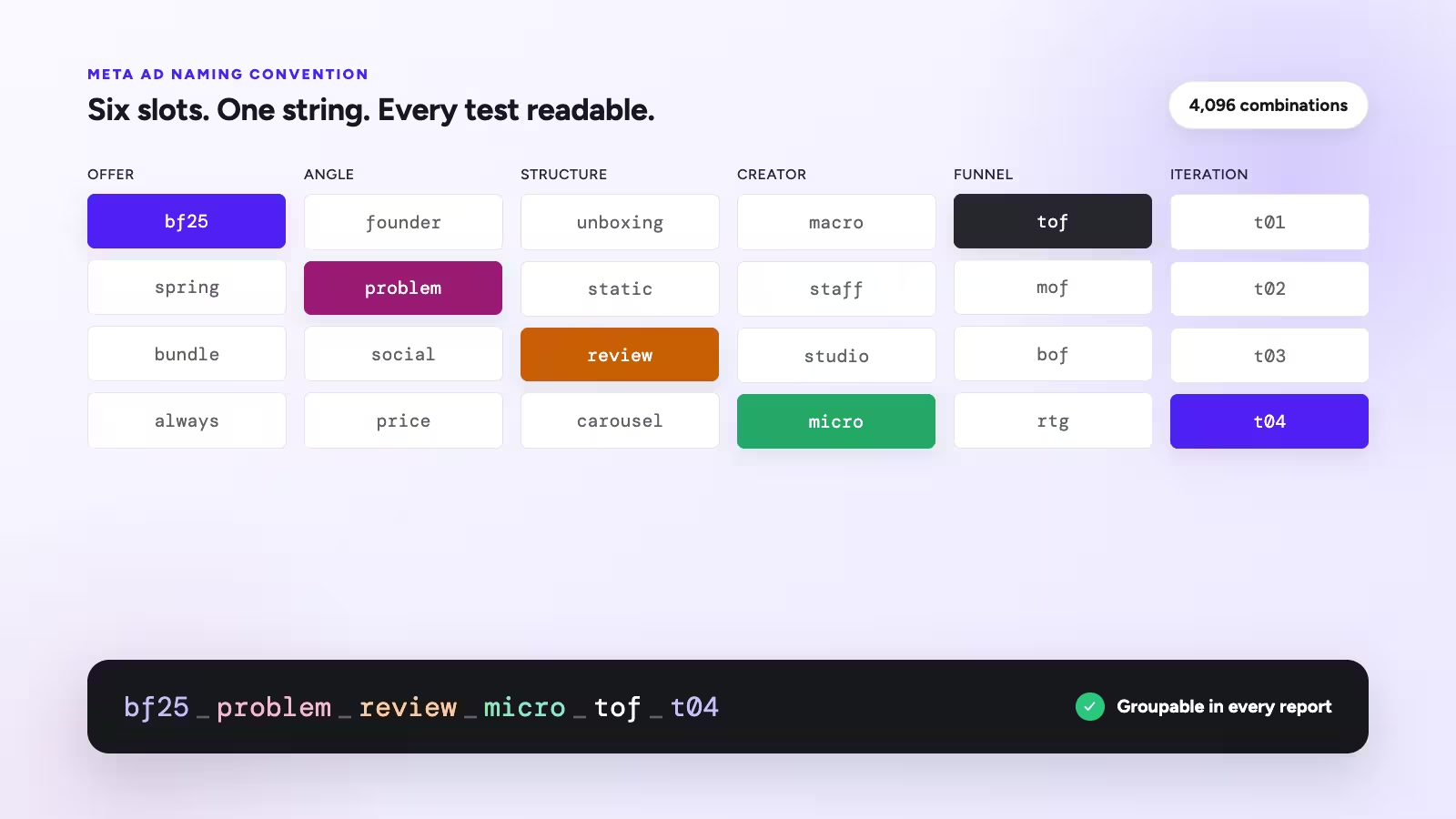
At the end of a quarter you want to answer a simple question: which creative angle is working? Not which ad, which angle. Whether problem led hooks beat social proof hooks, whether user generated content outperforms studio production, whether the bundle offer converts better than the single product offer. The data to answer this exists in your account, but only if the ad names carry it. Ad names are the sole piece of creative metadata that flows through to reporting and through to UTM parameters, and most accounts fill them with things like Ad_3_v2_FINAL_new, which answers nothing.
What you will learn
At the end of a quarter you want to answer a simple question: which creative angle is working? Not which ad, which angle. Whether problem led hooks beat social proof hooks, whether user generated content outperforms studio production, whether the bundle offer converts better than the single product offer. The data to answer this exists in your account, but only if the ad names carry it. Ad names are the sole piece of creative metadata that flows through to reporting and through to UTM parameters, and most accounts fill them with things like Ad_3_v2_FINAL_new, which answers nothing.
A structured naming convention fixes this at essentially zero ongoing cost. It costs thirty seconds when creating an ad and saves the recurring exercise of manually categorising two hundred ads at review time.
The Four Dimensions That Matter
Creative analysis needs a small number of dimensions that are genuinely comparable across campaigns. Four cover most of what teams actually want to know.
Angle. The persuasive approach. This is the most valuable dimension and the one most often missing. Angles worth distinguishing include problem, solution, social proof, comparison, founder story, unboxing, tutorial, and urgency.
Offer. What is being promised. Full price, bundle, discount percentage, free shipping, gift with purchase, new customer offer. This separates creative performance from promotional performance, which otherwise get hopelessly confused.
Product. What is being sold. Category level is usually the right grain rather than SKU, since SKU level fragments the data too far for pattern recognition.
Format. How it is made. UGC, studio, static, carousel, video, animation, review screenshot. Format is the dimension production planning actually needs, because it determines what you commission next.
The Pattern
{angle}_{offer}_{product}_{format}_{iteration}
Producing names like:
problem_fullprice_boots_ugcvideo_v1socialproof_bundle20_skincare_static_v3comparison_fullprice_boots_studiovideo_v2founder_freeship_accessories_ugcvideo_v1
Every component comes from a controlled list. The iteration marker at the end handles versions without polluting the analysable dimensions.
The delimiter rule matters for a practical reason: these names flow into UTM parameters through Meta's dynamic {{ad.name}} macro. Use underscores between components, avoid spaces entirely, and never use characters that need URL encoding. An ad named Problem / Full Price & Boots will produce a broken or unusable UTM value.
Naming Above the Ad Level
The ad name carries creative metadata. Campaign and ad set names should carry the structural metadata, and the two should not overlap.
| Level | Carries | Example |
|---|---|---|
| Campaign | Market, funnel stage, objective, period | de_prospecting_purchase_2026q2 |
| Ad set | Audience, placement strategy, budget type | broad_advantageplacements_cbo |
| Ad | Angle, offer, product, format, iteration | problem_fullprice_boots_ugcvideo_v1 |
This separation is what lets you cross tabulate. With market at campaign level and angle at ad level, you can ask whether the problem led angle works better in Germany than in Austria, which is a question that only exists if the two dimensions live in different fields.
When these names flow into UTM parameters, the mapping falls out naturally:
utm_campaign={{campaign.name}}
utm_term={{adset.name}}
utm_content={{ad.name}}
Your analytics then holds structured, parseable values in three fields, and the entire creative dimension set becomes available in reporting outside the ad platform, joined to actual revenue and margin rather than only to platform reported conversions.
What This Enables
The payoff arrives at review time. Instead of scrolling a list of ads sorted by spend, you can aggregate.
A creative review built on structured names answers questions like:
- Across all products and markets, which angle produces the lowest cost per acquisition?
- Does UGC outperform studio production, or does it only appear to because it is used on better performing angles?
- Which angle and format combination has never been tried on the main product line?
- Are the discount ads winning on volume while losing on contribution margin?
That third question is the one teams find most immediately useful. A structured naming system makes gaps visible. Build a grid of angle against format, fill in what has been tested, and the empty cells are your production brief for next month. Without structure, the same exercise requires someone to manually read and categorise every ad in the account, which is why it does not happen.
The fourth question is where naming intersects with profitability. If offer is a named dimension, you can compare contribution margin across offer types rather than only comparing ROAS, and the discount ads that look strongest on revenue frequently look weakest on profit.
The Roles That Benefit
Media buyers get faster diagnosis. When performance drops, a structured account lets you see immediately whether one angle stopped working or whether the decline is across the board, which distinguishes creative fatigue from an auction shift.
Creative teams get a real brief. "Make more of what works" is not actionable. "Problem led UGC video on the boots category is producing acquisition 30 percent below account average, and we have four assets in that combination while we have eleven in social proof static, which is underperforming" is a production plan.
Agencies get a shared language with the client. Naming conventions are the cheapest possible alignment mechanism between an internal team and an external one.
Analysts stop doing manual categorisation, which in most accounts is a recurring multi hour task that produces inconsistent results because different people categorise differently.
Making It Stick
Conventions decay unless three things are true.
The vocabulary is written down and closed. Each of the four dimensions needs an explicit list of permitted values. Angle in particular tends to sprawl, since everyone has their own vocabulary for persuasive approaches. Eight to ten angle values is enough.
The list is available where ads are created. A pinned document, a template, or a naming helper. If someone has to search for the convention, they will invent a name instead.
Someone audits. Monthly, pull the list of ad names created in the last 30 days and check them against the pattern. Non conforming names get renamed while the ad is still recent, since renaming an ad does not affect delivery but does change what flows into UTM parameters going forward.
The decision factors when designing your own:
- How many dimensions? Four is the practical maximum before names become unwieldy and compliance drops.
- What grain for product? Category almost always, since SKU level fragments patterns beyond recognition.
- Fixed order? Yes, always. Parsing depends on position.
- URL safe characters only? Non negotiable if names flow into UTM parameters.
- Who owns the vocabulary? One person, with a low friction process for adding values.
The fixed order point is what makes the convention machine readable rather than merely tidy. If angle is always first and format is always fourth, a spreadsheet formula or a reporting tool can split the name and produce four columns. If the order varies, the names are readable by humans and useless to software, which defeats most of the purpose.
Summary
Ad names are the only creative metadata that reaches your reporting, and a structured convention turns them from labels into analysable dimensions. Use four components in fixed order, angle, offer, product, and format, drawn from closed vocabularies, separated by underscores, with an iteration marker at the end.
Keep structural metadata at campaign and ad set level so that market, funnel stage, and audience remain separate dimensions from creative attributes. Then map all three levels into UTM parameters so the structure flows through to analytics joined against real revenue. The payoff is a creative review that can aggregate by angle and format rather than scrolling a list of ads, and a production brief derived from the gaps in your own testing grid rather than from opinion.
FAQ
Does renaming an ad affect its performance or reset learning?
Renaming does not change delivery. It does change what dynamic UTM parameters produce going forward, which means historical data will carry the old name and new data the new one. Rename in a batch and note the cutover date rather than renaming continuously.
How many angle values should the vocabulary have?
Eight to ten. Fewer loses meaningful distinctions, more makes consistent classification impossible because different people will categorise the same ad differently. Write a one line definition of each so the boundaries are clear.
Should product be at SKU or category level?
Category level for almost all brands. SKU level produces so many distinct values that patterns become invisible, and the question you usually want answered is which angle works for a product type rather than for one item.
What about ads that combine multiple angles?
Name it for the dominant angle, the one carried by the first three seconds. If a genuine hybrid is common enough to matter, add it to the vocabulary as its own value rather than trying to encode two.
Do I need to rename my entire existing account?
No. Apply the convention to new ads from a fixed date, note the cutover, and let the structured data accumulate. Retroactive renaming of hundreds of ads is rarely worth the effort, and the analysis you want is usually about recent creative anyway.
Decisions start with trust
14-days for free