How to Measure Influencer Marketing When Nobody Clicks

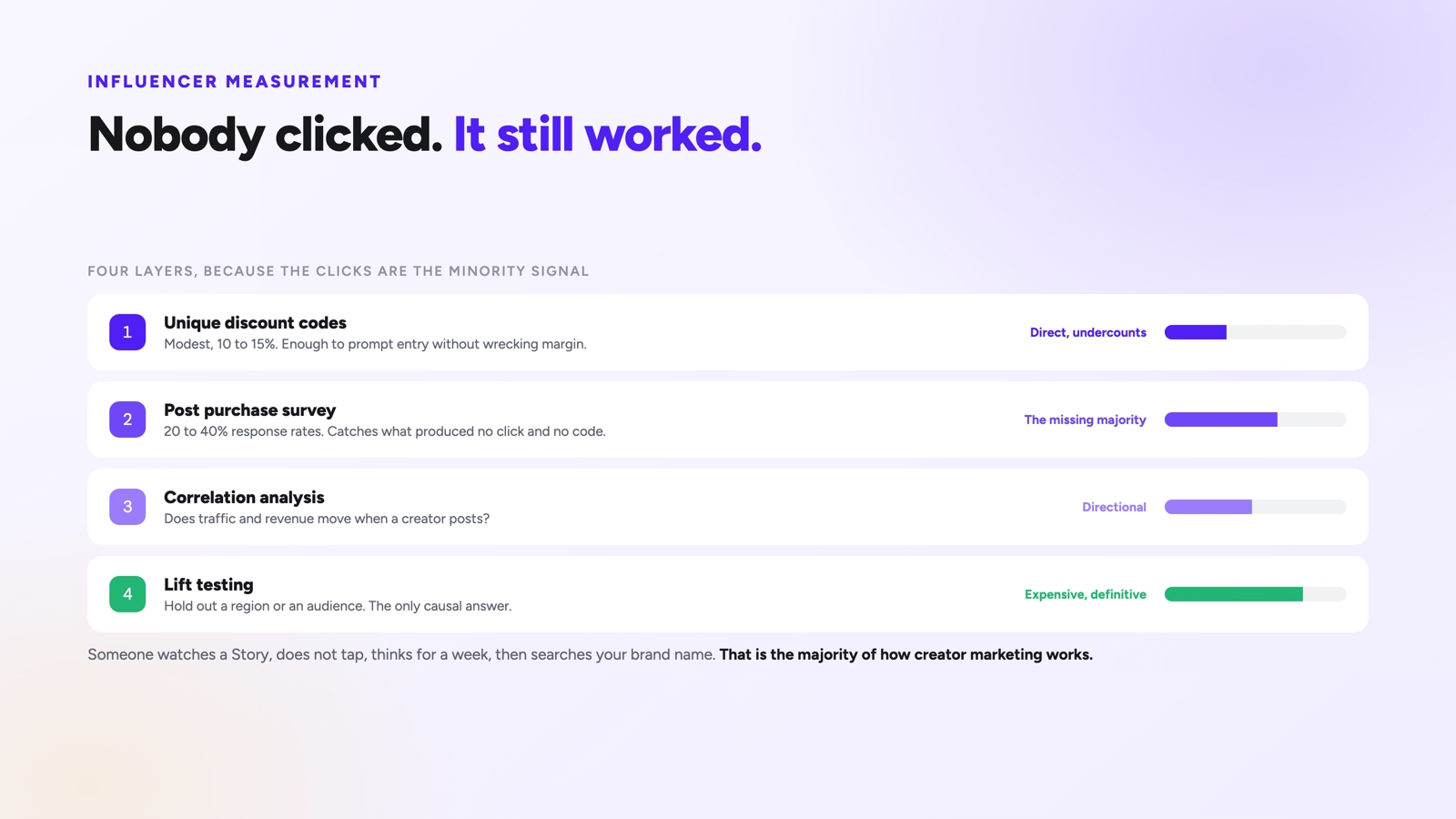
Someone watches a creator talk about your product in a Story, does not tap the link, thinks about it for a week, then searches your brand name and buys. That journey is completely invisible to link based attribution, and it is not an edge case. It is the majority of how creator marketing actually works. The result is that influencer budgets are defended with screenshots and follower counts, because the analytics show a trickle of link clicks that in no way reflects what the channel is doing. Measuring influencer marketing properly means accepting that clicks are the minority signal and building around the ones that are not.
What you will learn
Someone watches a creator talk about your product in a Story, does not tap the link, thinks about it for a week, then searches your brand name and buys. That journey is completely invisible to link based attribution, and it is not an edge case. It is the majority of how creator marketing actually works. The result is that influencer budgets are defended with screenshots and follower counts, because the analytics show a trickle of link clicks that in no way reflects what the channel is doing. Measuring influencer marketing properly means accepting that clicks are the minority signal and building around the ones that are not.
Why Link Attribution Fails Here
Four mechanisms combine to make creator content the least trackable channel most brands run.
Consumption is passive. Stories, Reels, and short form video are watched in a scrolling context where tapping through interrupts the experience. Viewers absorb the message and continue scrolling.
The delay is long. Creator content builds familiarity rather than triggering immediate purchase. The gap between exposure and purchase frequently exceeds any attribution window.
The platform is closed. In app browsers, link stripping, and limited link placement all reduce the share of intent that converts into a trackable click.
Discovery happens in comments and shares. A creator post that gets shared into a group chat produces traffic with no referrer at all.
Taken together, link clicks represent a small and unrepresentative slice of creator impact. Measuring the channel on that slice systematically undervalues it, which is why influencer budgets are so often the first cut and so often missed afterwards.
The Measurement Stack
No single method works. Four layers together produce a defensible picture.
Layer one: unique discount codes
Give every creator a unique code. This is the workhorse of the stack for one reason: a code is entered deliberately at checkout by someone who remembered it, which means it survives every tracking limitation on the list above.
Design considerations that matter:
- Make codes memorable. The creator's handle plus a number works. A random string does not survive a week of consideration.
- Keep the discount modest. A 10 to 15 percent code is enough to prompt entry without materially distorting contribution margin.
- Never post codes to voucher aggregator sites. Codes leak, and once one is on a coupon site it is being entered by people who never saw the creator, which corrupts the measurement and the margin simultaneously. Monitor for leakage and rotate codes that appear.
- Track code entry rate over time per creator. A code that produces steady entries months after the post is measuring lasting influence, which link clicks never capture.
Understand the code's limitation too: it captures only customers who both remembered it and were willing to use it. That is a floor on creator contribution, not a measurement of it.
Layer two: post purchase survey
Add one question at order confirmation: how did you hear about us? Include creator names as options for active partnerships.
This layer captures exactly what the other layers miss, which is influence that produced neither a click nor a code entry. Response rates of 20 to 40 percent are typical, and while individual answers suffer from recall bias, the aggregate distribution is strong signal.
The comparison this enables is the important output. Put attributed revenue, code redemption revenue, and survey mentions side by side per creator. In most brands the survey figure is a large multiple of the link attributed figure, and that ratio is the honest estimate of how much creator influence is going unrecorded.
Layer three: correlation analysis
Plot creator posting dates against daily branded search volume, direct traffic, and total orders. A creator post that produces a visible spike in branded search two days later is producing demand, whether or not anyone clicked.
This works best for larger creators where the effect exceeds background noise, and it works poorly for small creators posting alongside other activity. Use it as supporting evidence rather than as a primary measurement.
Layer four: lift testing
For the largest partnerships, run a proper test. Geographic holdouts work where a creator's audience is geographically concentrated. Timing based tests, comparing periods with and without creator activity while holding other spend constant, are cruder but achievable.
Reserve this for partnerships large enough that being wrong about them is expensive, since the design effort is substantial.
Putting the Layers Together
A working creator scorecard combines all four:
| Signal | What it measures | Coverage |
|---|---|---|
| Link attributed revenue | Clicked and converted | Small, biased low |
| Code redemptions | Remembered and redeemed | Moderate, floor estimate |
| Survey mentions | Recalled as source of discovery | Broad, recall biased |
| Branded search correlation | Demand created | Directional |
| Lift test | Incremental contribution | Definitive but expensive |
The practical approach is to value a creator using code redemptions as the observed floor, scale that by the ratio between survey mentions and code redemptions to estimate total influence, and validate the largest relationships with a lift test.
The ratio is the useful mechanic. If survey data shows a creator mentioned by three times as many customers as redeemed their code, then code redemptions are capturing roughly a third of that creator's influence. Applying that multiplier gives a defensible estimate that is far closer to reality than link attribution alone, while remaining clearly labelled as an estimate.
What This Changes About Creator Programmes
Measuring properly changes how the programme is run, not just how it is reported.
Payment structures. Pure affiliate arrangements paying on tracked conversions systematically underpay creators whose influence does not convert into clicks, which selects for creators who post link heavy conversion content rather than the ones building genuine familiarity. Hybrid structures with a flat fee plus a code based bonus align better with how the channel works.
Creator selection. If code entry rate and survey mentions are the metrics, the creators who win are those whose audiences genuinely trust them, which is not always the ones with the largest followings.
Content direction. Once you accept that most influence produces no click, briefing shifts away from aggressive calls to action and toward memorability: saying the brand name clearly, showing the product in use, and giving the code in a form people can recall.
Budget defence. A programme measured only on link attribution will lose every budget argument against paid social. One measured with survey data and code redemption has evidence.
The Decision Factors
- Is every creator on a unique code? Without this there is no observable floor at all.
- Is a post purchase survey running? It is the only layer that sees unclicked, unredeemed influence.
- Are codes leaking to voucher sites? Monitor and rotate, or the measurement and the margin both degrade.
- Are you comparing survey mentions against attributed revenue? The ratio is the core diagnostic.
- Is the estimate labelled as an estimate? Presenting a survey scaled figure as measured revenue invites a justified challenge.
- Are the largest partnerships tested? Estimates are fine for small relationships and inadequate for large ones.
The code leakage point causes more damage than teams expect. A code that reaches a voucher aggregator gets entered by customers who arrived through paid search or organic and simply searched for a discount at checkout. Those redemptions are attributed to the creator, the creator appears to be performing well, and the brand is paying commission on orders it already had while also giving away margin. Checking the major voucher sites monthly for your active codes takes fifteen minutes and prevents a slow, invisible leak.
Summary
Influencer marketing produces influence that mostly does not click, which makes link attribution a poor and systematically low estimate of its contribution. Build the measurement from four layers instead: unique memorable discount codes as the observable floor, a post purchase survey to capture unclicked influence, branded search correlation as supporting evidence, and lift testing for the partnerships large enough to justify it.
The core diagnostic is the ratio between survey mentions and code redemptions, which tells you what multiple of observed activity the channel is actually producing. Use it to scale your floor estimate into a defensible figure, label it clearly as an estimate, and monitor your codes for voucher site leakage since that single failure corrupts both the measurement and the margin at once.
FAQ
Why do my influencer link clicks look so low compared to reach?
Because most creator content is consumed passively in a scrolling context, links are often not tapped even when the message lands, and the gap between exposure and purchase usually exceeds attribution windows. Low click volume is normal and is not evidence that the channel is not working.
Should each creator have a unique discount code?
Yes. A shared code makes it impossible to attribute redemptions to a specific creator, and unique codes are the only observable signal that survives the tracking limitations affecting this channel. Make them memorable, since people need to recall them days later.
How reliable are post purchase survey answers?
Individually unreliable due to recall bias, but the aggregate distribution carries real signal, particularly for channels that are otherwise invisible. Treat surveys as a corrective input that reveals systematic underreporting rather than as a precise measurement of individual journeys.
How do I stop discount codes leaking to voucher sites?
Monitor the major aggregators monthly for your active codes and rotate any that appear. Keep discounts modest so leaked codes cause less margin damage, and include a clause in creator agreements about code distribution.
Should influencers be paid on tracked conversions?
Pure performance payment underpays creators whose influence does not produce clicks, which pushes the programme toward conversion focused content rather than genuine familiarity building. A hybrid of flat fee plus code based bonus tends to align better with how the channel actually creates value.
Decisions start with trust
14-days for free