GA4 Data Driven Attribution Is Biased Toward Google, According to Google's Own Documentation

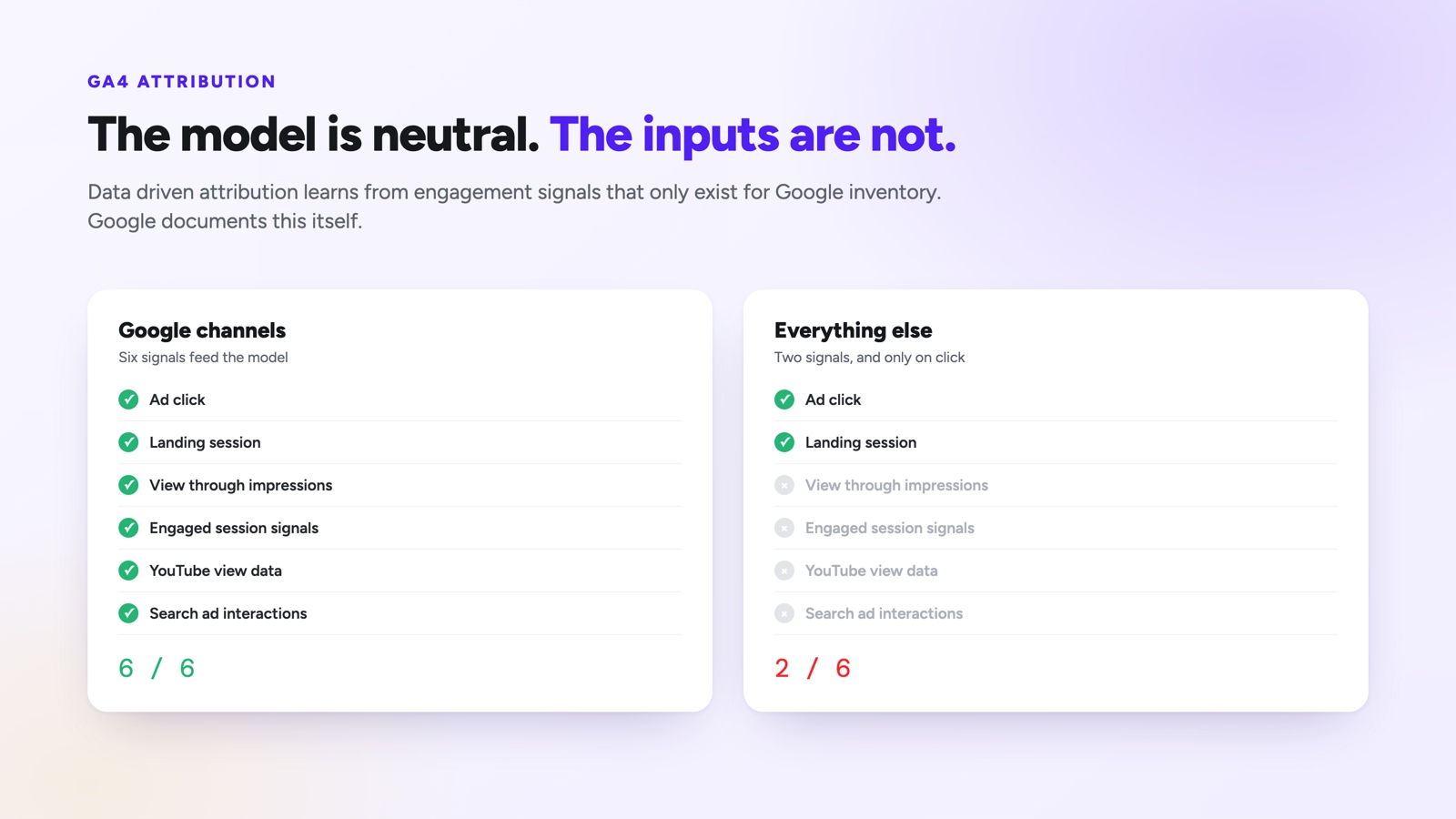
GA4's data driven attribution is presented as the neutral, machine learned alternative to rule based models. It is genuinely more sophisticated than last click. It is also, by Google's own published description of how it works, structurally advantaged toward Google's own channels. This is not an accusation requiring investigation. It follows directly from which signals the model can access for which channels, and Google documents that limitation itself. Understanding it changes how much weight you should give GA4's channel report when deciding where budget goes.
What you will learn
GA4's data driven attribution is presented as the neutral, machine learned alternative to rule based models. It is genuinely more sophisticated than last click. It is also, by Google's own published description of how it works, structurally advantaged toward Google's own channels. This is not an accusation requiring investigation. It follows directly from which signals the model can access for which channels, and Google documents that limitation itself. Understanding it changes how much weight you should give GA4's channel report when deciding where budget goes.
How Data Driven Attribution Actually Works
Data driven attribution assigns fractional credit to touchpoints based on how much they appear to change conversion probability. Rather than applying a fixed rule such as last click or linear, the model compares converting and non converting journeys and estimates each touchpoint's marginal contribution using a counterfactual approach.
The model considers several inputs. Google's documentation lists time from conversion, device type, number of ad interactions, order of exposure, and the type of creative asset. That final category is where the asymmetry enters.
The Engagement Signal Limitation
Google's own help documentation states that engagement signals such as ad impressions, video view time, and ad interaction data are available for Google channels: Search, YouTube, Display, and Demand Gen. For non Google channels, GA4 sees what arrives through the URL and the session: the click, its UTM parameters, and the on site behaviour that follows.
The practical consequence is that the model has richer feature data for some channels than others.
| Signal type | Google channels | Non Google channels |
|---|---|---|
| Click event | Yes | Yes, if tagged |
| Landing session behaviour | Yes | Yes |
| Ad impressions before click | Yes | No |
| Video view duration | Yes | No |
| Ad interaction detail | Yes | No |
| Creative asset type | Yes | No |
A model estimating contribution from available features will attribute more precisely, and generally more favourably, where it has more features. A YouTube touchpoint arrives with view duration attached, so the model can distinguish a two second skip from a full watch. A TikTok touchpoint arrives as a tagged click, and everything before that click is invisible.
This is not a claim that Google deliberately weights its own channels upward. It is a claim about information availability, which is a stronger and less arguable point. A model cannot credit evidence it does not have.
The Second Structural Issue: View Through
GA4's data driven attribution in the default reporting does not credit non Google impressions at all, because it never sees them. Google Ads reporting, meanwhile, incorporates its own view through data. So a Meta impression that genuinely influenced a purchase contributes nothing in GA4's model, while a YouTube view can.
For a brand running substantial upper funnel video on Meta or TikTok, this means the entire top of that funnel is invisible to the model that is meant to be valuing the funnel.
Where This Bias Shows Up in Practice
The distortion is not uniform. It concentrates in predictable places.
Branded search absorbs credit. Branded search is the last stop on a huge share of journeys, and it is a Google channel with full signal availability. Demand created by a Meta video or an influencer post frequently converts through a branded search click, and the model has strong data on that click and no data on what created the demand.
YouTube looks stronger than comparable video elsewhere. Not necessarily because it performs better, but because its contribution is measurable in ways that a TikTok or Meta video view is not.
Non tagged channels disappear entirely. Any traffic arriving without UTM parameters lands in direct or organic. Influencer traffic, dark social sharing, offline campaigns, and QR codes all suffer from this, and none of them are Google channels.
Paid social gets truncated journeys. With a click only view and no impression data, a social channel's contribution is measured from the click onward, which understates the awareness role it usually plays.
The roles that feel this most are heads of growth allocating cross channel budget, agencies defending non Google channel performance to clients, and ecommerce managers who see GA4 and Meta Ads Manager disagreeing in opposite directions and have no neutral referee.
What to Do About It
The point is not to abandon GA4. It remains valuable for on site behaviour, funnel analysis, audience insight, and as one input among several. The point is to stop treating its channel attribution report as a neutral arbiter in cross channel budget decisions.
The practical criteria for handling this:
- Do not use GA4 attribution to compare Google against non Google channels. It is the one comparison the model is least equipped to make fairly.
- Do use GA4 for on site analysis. Funnel drop off, landing page performance, and behavioural segmentation are unaffected by this issue.
- Tag everything rigorously. Consistent UTM parameters at least ensure non Google channels are identified rather than dumped into direct.
- Treat branded search as suspect by default. Assume some portion of its credit was created elsewhere and test it.
- Run incrementality tests where the stakes are high. Geo holdouts and channel pauses produce evidence no attribution model can supply.
- Reconcile to actual revenue. Any model that cannot explain your total shop revenue is describing a subset of reality.
The branded search point deserves more than a line. It is testable, and the test is straightforward. Reduce or pause branded search spend in a controlled way and observe what happens to total orders rather than to branded search orders. In many brands, a meaningful share of that traffic arrives anyway through the organic result, because the customer was searching for you specifically. The gap between what attribution credits to branded search and what disappears when you pause it is the clearest available measure of over attribution.
Incrementality testing is the broader answer, and it is worth being honest about its cost. Geo holdouts require enough volume to detect an effect, they take weeks, and they sacrifice some revenue in the test region. They are not something to run monthly on every channel. They are something to run when a channel represents a large enough share of budget that being wrong about it is expensive.
Between the extremes of trusting GA4 and running full incrementality studies sits the practical middle ground: an attribution layer that applies identical rules to every channel. The essential property is not sophistication, it is symmetry. A model that treats a Meta click, a Google click, a TikTok click, and a newsletter click by the same logic, with the same window and the same weighting, produces comparisons that are at least fair even where they are imperfect. GA4's model is arguably more sophisticated and structurally less symmetric, and for cross channel budget decisions symmetry matters more.
Summary
GA4's data driven attribution incorporates engagement signals including impressions, video view time, and ad interaction data, and Google's documentation confirms those signals are available for Google channels. For non Google channels, the model works from clicks and on site behaviour. That is a difference in information availability, and it produces a systematic advantage for Google inventory in any cross channel comparison.
Keep GA4 for what it is good at, which is on site behaviour and funnel analysis. Do not use it as the referee when deciding whether to move budget from Google to Meta or TikTok, because it has more evidence about one side of that comparison than the other. For allocation decisions, use a measurement layer that applies the same rules to every channel, reconcile the output against your actual shop revenue, and validate the biggest bets with incrementality tests rather than with any model at all.
FAQ
Is GA4 attribution wrong?
Not wrong in the sense of miscalculating. It applies its model consistently to the data it has. The issue is that it has substantially more data about Google channels than about anything else, which makes it unsuitable as a neutral arbiter for cross channel budget decisions.
Does this mean I should stop using GA4?
No. GA4 remains a strong tool for on site behaviour, funnel analysis, audience building, and content performance. The recommendation is narrower: do not use its channel attribution report to decide how much budget Google should get relative to non Google channels.
Which attribution model in GA4 is least biased?
All GA4 models inherit the same underlying data asymmetry, since none of them can see non Google impressions. Switching from data driven to last click changes the rule but not the information gap. The fix is a different data source, not a different setting.
How do I check whether branded search is over credited?
Run a controlled reduction in branded search spend and measure the change in total orders rather than in branded search orders. If total orders barely move, most of that traffic was arriving regardless and the attribution credit was inherited from demand created elsewhere.
What should I use instead for cross channel decisions?
An attribution layer that applies identical rules, windows, and weighting to every channel, reconciles its output against actual shop revenue, and discloses how it treats impressions and unobserved journeys. Validate the largest allocation decisions with incrementality tests where the budget justifies the effort.
Decisions start with trust
14-days for free