A 9 Block Customer Interview Guide for Ecommerce Brands

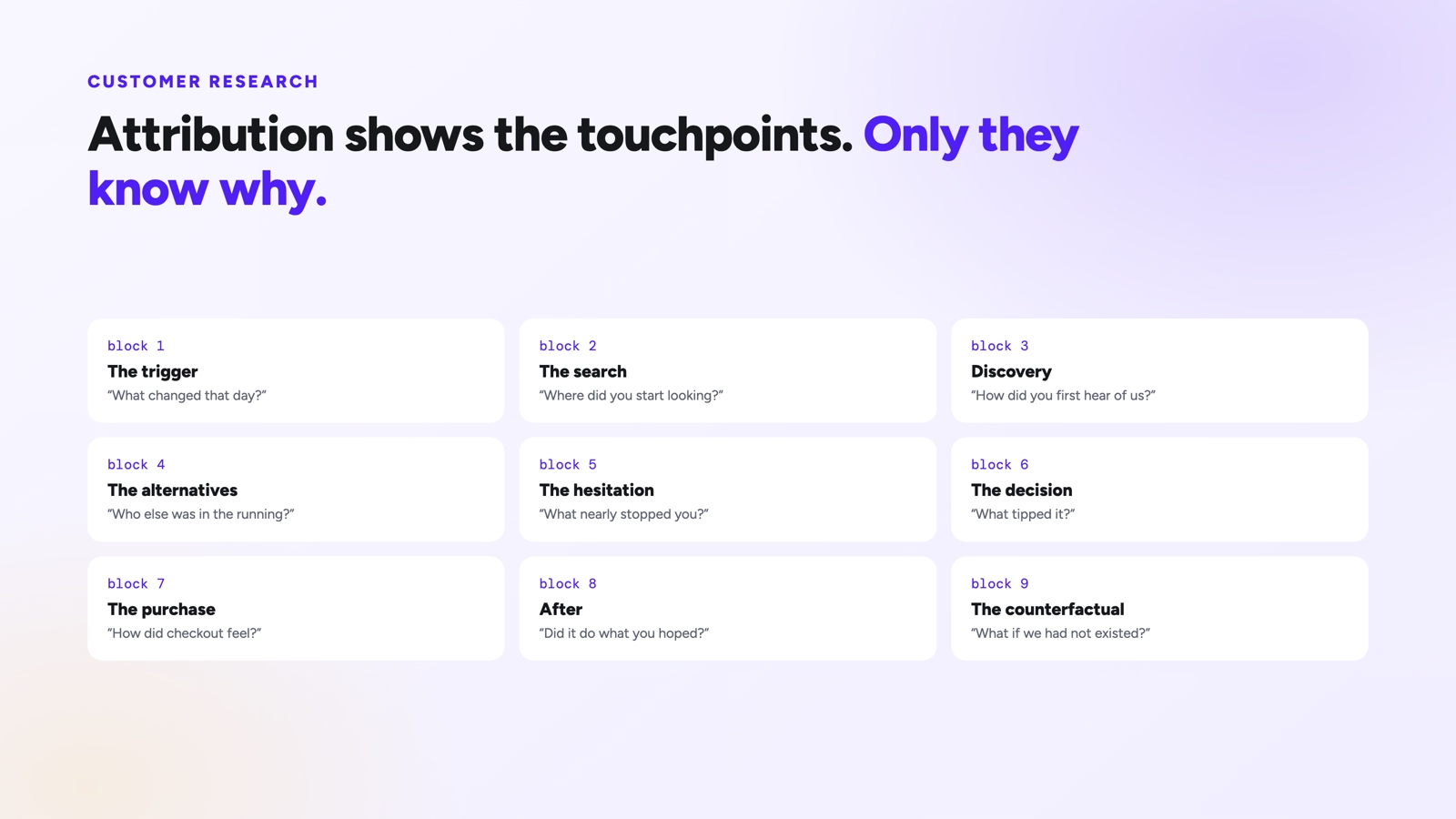
Attribution tells you which touchpoints were present. It cannot tell you what the customer was thinking, which alternative they nearly chose, or which sentence on the product page removed the last objection. Those answers only come from asking, and asking properly is a skill with a structure behind it. This guide sets out nine question blocks that cover the full arc from problem recognition to post purchase, along with the practical mechanics of recruiting, running, and analysing the conversations. It is designed for ecommerce brands and works equally well for a founder doing ten interviews personally or a research function running a formal programme.
What you will learn
Attribution tells you which touchpoints were present. It cannot tell you what the customer was thinking, which alternative they nearly chose, or which sentence on the product page removed the last objection. Those answers only come from asking, and asking properly is a skill with a structure behind it. This guide sets out nine question blocks that cover the full arc from problem recognition to post purchase, along with the practical mechanics of recruiting, running, and analysing the conversations. It is designed for ecommerce brands and works equally well for a founder doing ten interviews personally or a research function running a formal programme.
Before You Start
Three decisions shape everything.
Who to talk to. Recent purchasers, within four weeks, so recall is intact. Mix first time buyers with repeat customers, and include at least a few people who bought once and did not return. Eight to twelve interviews per segment is where patterns become visible and additional interviews start repeating.
How to recruit. A direct email from a real person, offering a modest incentive, asking for twenty five minutes. Response rates of 5 to 10 percent from a recent purchaser list are normal. Avoid recruiting only your most enthusiastic customers, since they will tell you a flattering and unrepresentative story.
How to run it. Video call, recorded with permission, twenty five to forty minutes. One interviewer, not a panel. Transcribe afterwards rather than taking heavy notes during, since note taking degrades the conversation.
The single most important technique: ask about specific past behaviour, not about general preferences or future intentions. "What did you do when you first started looking" produces evidence. "What do you look for in a brand" produces a plausible sounding invention.
The Nine Blocks
Block 1: The trigger
What was happening when the need appeared.
- Take me back to when you first started looking for this. What was going on?
- Had something changed, or had this been building for a while?
- What made you start looking that particular week rather than earlier or later?
The third question is the valuable one. Triggers are usually specific events, and knowing them tells you when your marketing needs to be present rather than only who it should reach.
Block 2: The search
How they went looking.
- Where did you look first?
- What did you type, if you searched?
- How long did the looking go on?
The words people actually used are direct input for search targeting and for the language on your pages. Customers rarely use category terminology, and the gap between their vocabulary and yours is often where traffic is lost.
Block 3: Discovery
How they found you specifically.
- How did you first come across us?
- Do you remember roughly when that was, relative to when you bought?
- Had you heard of us before that?
This block is the qualitative counterpart to your attribution data, and comparing the two is the point. When interviews consistently name a creator or a podcast that your attribution barely registers, that is evidence of systematic under crediting, not a customer misremembering.
Block 4: The alternatives
Who else they considered.
- What else were you looking at?
- How did you compare them?
- What nearly made you choose one of the others?
The last question produces your competitive positioning more reliably than any competitor analysis, because it names the specific thing a real buyer weighed. Note that the alternative is often not a competitor at all but doing nothing, continuing with what they had, or buying second hand.
Block 5: The hesitation
What nearly stopped them.
- Was there a point where you almost did not buy?
- What were you unsure about?
- What resolved it?
This is the highest value block for conversion work. The objections named here are the objections your product pages need to answer, and the resolutions people describe are frequently things you did not know were doing that job, such as a review mentioning a specific detail or a shipping policy line.
Block 6: The decision
What tipped it.
- What made you finally go ahead?
- Was there a specific moment or thing?
- Anything that would have made you decide sooner?
The last question surfaces friction that customers tolerated but that likely lost you other buyers who did not.
Block 7: The purchase experience
The mechanics.
- How was the actual ordering process?
- Anything confusing or annoying?
- How did delivery go against what you expected?
Lower on insight density than the previous blocks, but it surfaces concrete fixes and it warms people up for the harder questions that follow.
Block 8: After the purchase
The experience of the product.
- How has it been since it arrived?
- Did it match what you expected from the site?
- Have you told anyone about it?
The expectation gap question is the leading indicator of returns and of repeat purchase. Where the product exceeds what the page promised, you are underselling. Where it falls short, you have a returns problem forming.
Block 9: The counterfactual
The closing question, and often the most revealing.
- If we had not existed, what would you have done?
- How disappointed would you be if you could not buy from us again?
- Who would you recommend us to, and what would you say?
The first question is a qualitative incrementality probe. If most customers say they would simply have bought a specific competitor, your differentiation is weaker than you think. If they describe going without or making do, you are serving a need nobody else is.
The third question gives you positioning language in the customer's own words, which is usually better than anything written internally.
Running the Conversation
A few techniques matter more than the script.
Silence. After an answer, wait. The second thing people say is usually more honest than the first, and interviewers fill silence out of discomfort.
Ask why up to three times. "It seemed better quality." Why did it seem that way? "The photos." What about the photos? Each layer moves from opinion toward specifics you can act on.
Never defend. When someone criticises the site or the product, the instinct is to explain. Explaining ends the useful part of the conversation. Ask what they expected instead.
Do not pitch. The moment the interview becomes a sales conversation, the customer starts being polite.
Follow the interesting thread. The script is a checklist, not an order of service. If block four surfaces something unexpected, stay there.
Analysing What You Get
Interviews produce a large volume of unstructured text, and the analysis is where most programmes fail.
The workable approach is to tag every transcript against the nine blocks, then read across interviews block by block rather than reading each interview end to end. Patterns appear at the block level: five of nine people named the same hesitation, six described the same trigger, four discovered you through a channel your attribution barely shows.
| Block | What the pattern feeds |
|---|---|
| Trigger | Campaign timing and seasonality |
| Search | Keyword targeting and page language |
| Discovery | Attribution validation and channel investment |
| Alternatives | Competitive positioning and comparison content |
| Hesitation | Product page content, FAQ, reviews strategy |
| Decision | Offer structure and urgency mechanics |
| Purchase | Checkout and logistics fixes |
| After | Returns prevention and retention |
| Counterfactual | Differentiation and brand positioning |
Set a threshold before you start. Something mentioned by three or more people in a set of ten is a pattern worth acting on. Something mentioned once is an anecdote, however vivid, and vivid anecdotes are the main way interview programmes produce bad decisions.
Run the programme quarterly rather than once. Customer language shifts, competitors change, and the value compounds because you start noticing what changed between rounds rather than only what is true now.
Summary
Nine blocks cover the arc of a purchase decision: trigger, search, discovery, alternatives, hesitation, decision, purchase experience, post purchase, and counterfactual. Ask about specific past behaviour rather than preferences or intentions, interview recent purchasers within four weeks, and run eight to twelve per segment until answers repeat.
The two blocks that pay for the whole exercise are hesitation and discovery. Hesitation names the objections your pages need to answer, in the customer's own words. Discovery gives you a qualitative check on your attribution, and the gap between what customers say and what your data shows is one of the more useful diagnostics available for finding systematically under credited channels. Analyse by reading across interviews block by block rather than interview by interview, and treat three mentions in ten as the threshold between a pattern and an anecdote.
FAQ
How many customer interviews do I need?
Eight to twelve per segment. Patterns typically stabilise around eight, and beyond twelve you are mostly hearing repetition. Running smaller sets more frequently beats one large batch, because customer language and competitive context both shift.
Who should I interview?
Recent purchasers within four weeks so recall is intact, mixing first time and repeat buyers, and deliberately including some who bought once and did not return. That last group is the hardest to recruit and often the most informative.
Should I offer an incentive?
Yes, a modest one such as a voucher. It improves response rates substantially without biasing answers noticeably. Making it large enough to attract people who only want the incentive is the failure mode to avoid.
What is the most valuable single question?
"Was there a point where you almost did not buy, and what resolved it?" It surfaces the specific objection and the specific thing that overcame it, both of which are directly actionable on product pages and in creative.
How do interviews relate to attribution data?
They are a qualitative check on it. When customers consistently name a discovery source your attribution barely credits, that gap is evidence of systematic under crediting rather than faulty memory, particularly for channels such as creators, podcasts, and word of mouth that produce influence without clicks.
Decisions start with trust
14-days for free