CTR Explained: What Click Through Rate Measures and How to Read It Without Fooling Yourself

Click through rate is the fastest signal in performance marketing. It moves within hours of a creative launch, long before conversions accumulate enough to say anything reliable, which makes it the metric teams reach for when they need an early read. It is also the metric most likely to produce a confident wrong answer, because a click is a very cheap action and there are many ways to buy more of them without buying more customers. Understanding CTR properly means knowing what it is measuring, which definition your platform is using, and what a change in it does and does not imply.
What you will learn
Click through rate is the fastest signal in performance marketing. It moves within hours of a creative launch, long before conversions accumulate enough to say anything reliable, which makes it the metric teams reach for when they need an early read. It is also the metric most likely to produce a confident wrong answer, because a click is a very cheap action and there are many ways to buy more of them without buying more customers. Understanding CTR properly means knowing what it is measuring, which definition your platform is using, and what a change in it does and does not imply.
The Formula and Its Variants
Click through rate is the share of impressions that resulted in a click.
CTR = (clicks / impressions) x 100
Serve an ad 50,000 times, receive 900 clicks, and your CTR is 1.8 percent. The arithmetic is trivial. The complications come from the word "click."
Which Clicks Count
Meta alone reports several distinct click metrics, and they can differ by a factor of three on the same ad.
| Metric | What it counts |
|---|---|
| All clicks (CTR) | Every interaction: link clicks, reactions, comments, shares, profile taps, image expands |
| Link clicks | Clicks on the destination link, including to an in platform destination |
| Outbound clicks | Clicks that take the person off the platform to your site |
| Unique CTR | Share of people reached who clicked, rather than share of impressions |
An ad with a strong reaction rate can show an "all clicks" CTR of 3.2 percent and an outbound CTR of 0.9 percent. Reporting the first as a traffic driving metric is misleading, since only the second corresponds to someone arriving at your shop. When comparing across platforms, or building any cost model, outbound or link CTR is the version to use.
Google Search reports a simpler CTR, since search ads have essentially one interaction, but the benchmark levels are entirely different. A search CTR of 5 percent is unremarkable, because the person actively typed the query. A social feed CTR of 5 percent would be exceptional, because the person was scrolling past unrequested content.
Where CTR Sits in the Cost Chain
CTR is one of the two inputs that determine cost per click.
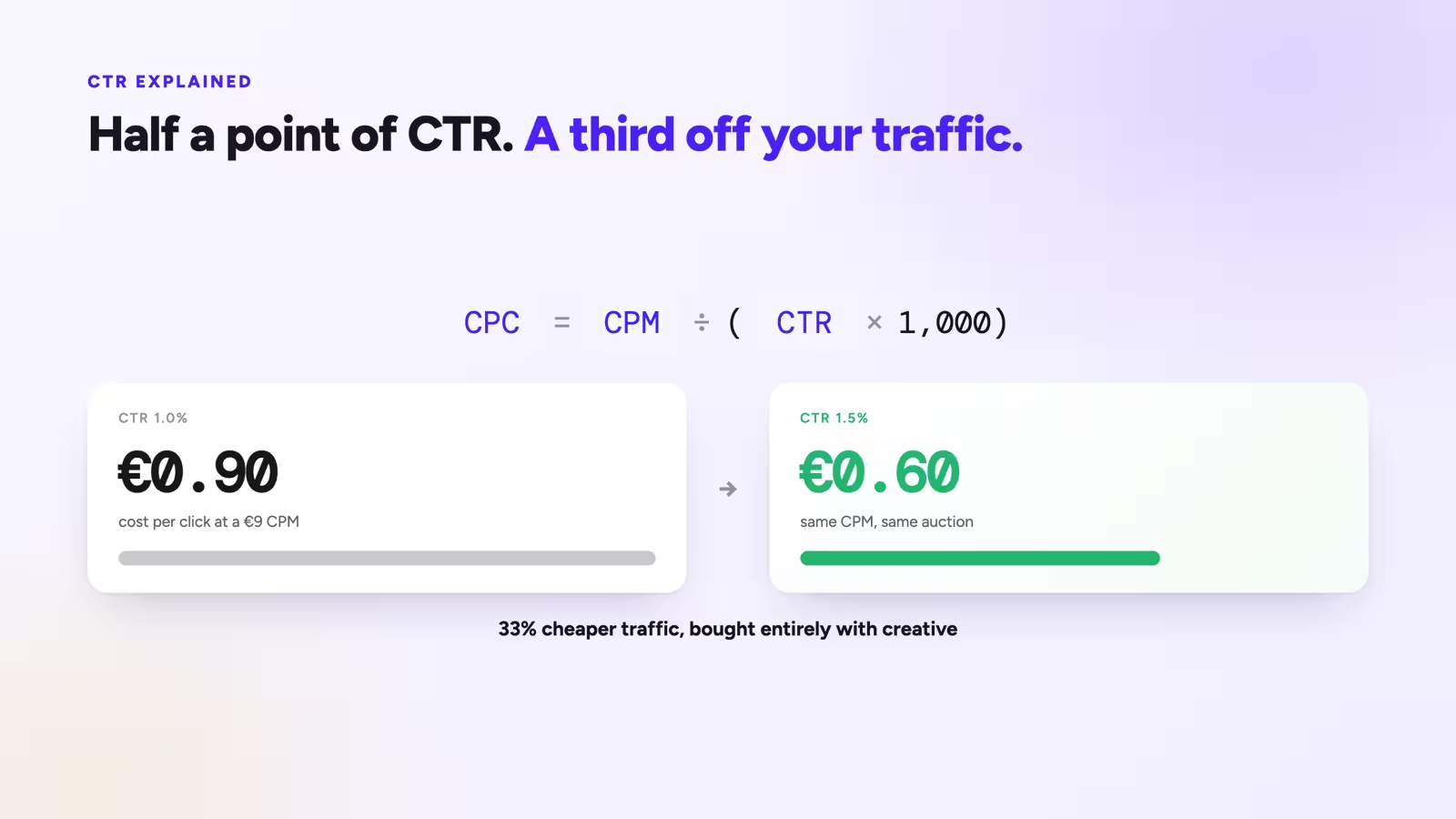
CPC = CPM / (CTR x 1000)
At a fixed CPM of 9 euros, moving CTR from 1.0 percent to 1.5 percent takes CPC from 0.90 euros to 0.60 euros. That is a 33 percent reduction in traffic cost achieved entirely through creative, and it is the main reason CTR is worth watching at all.
On search platforms, CTR does additional work. Expected click through rate is a component of quality score, which affects both ad rank and actual CPC. A high CTR ad therefore wins more auctions and pays less per click, compounding the advantage.
Where CTR Belongs in the Workflow
Creative teams get the most legitimate value from CTR, because it is the fastest available measure of whether an ad earns attention. In a creative testing programme where five concepts launch on Monday, CTR gives a usable signal by Tuesday, while cost per acquisition may need a week or more to stabilise. Used as a first filter, it removes obvious failures quickly and cheaply.
Search marketers use CTR at keyword and ad copy level as a relevance signal. A low CTR on a keyword with high impression volume usually indicates a mismatch between search intent and ad copy, and often means the keyword is triggering on queries you did not intend.
Email and lifecycle teams use the same metric on sends, where it measures how well subject line and content pair. The dynamics differ, since the audience is already known to you, but the logic is identical.
Ecommerce managers and heads of growth should treat CTR strictly as a diagnostic. It is upstream of every metric that matters and correlates with them only loosely.
The situations where CTR earns real attention:
- Creative fatigue detection. A steady CTR decline at rising frequency is the clearest early warning that an ad has been seen too often.
- New creative screening. Early CTR separates concepts that get noticed from concepts that do not, before spend accumulates.
- Search query mismatch. Low CTR on high volume keywords points to intent mismatch rather than bid problems.
- Landing page mismatch. A high CTR with a poor conversion rate usually means the ad promised something the page does not deliver.
Reading the Number Correctly
The factors that decide whether a CTR figure means anything:
- Definition consistency. Compare outbound to outbound, link to link. Never compare a Meta all clicks CTR to a Google search CTR.
- Placement mix. Stories, Reels, feed, and audience network produce very different rates. A CTR shift can be a placement distribution shift.
- Audience temperature. Retargeting audiences click at multiples of cold prospecting rates. Blending them makes the average uninterpretable.
- Frequency. CTR falls predictably as frequency rises. Read the two together or you will misdiagnose creative quality.
- Conversion rate downstream. CTR without post click performance describes attention, not intent.
The last point is where the metric most often misleads. There are reliable ways to increase click through rate that make a campaign worse. Curiosity gap headlines, aggressive discount claims, and visually loud creative all lift CTR by attracting people who are not qualified. The resulting traffic converts poorly, the conversion rate drops, and cost per order rises even though the click level metrics improved. A team that judges creative on CTR alone will systematically select for this.
The reliable interpretation is to read CTR and conversion rate as a pair:
| CTR | Conversion rate | Likely diagnosis |
|---|---|---|
| High | High | Genuine message and audience fit |
| High | Low | Ad overpromises, or targeting is too broad and unqualified |
| Low | High | Ad is failing to attract, but the offer resonates with those who arrive |
| Low | Low | Wrong audience, wrong offer, or both |
The third row is frequently misread as a failing campaign when it is often the most fixable situation in the table. The offer works. Only the creative is failing to get attention, which is a solvable creative problem rather than a strategic one.
One further caveat concerns attribution. CTR is measured entirely inside the ad platform, so it is unaffected by consent rates, cookie loss, or tracking gaps. That makes it stable and comparable over time, which is genuinely useful. It also means it cannot tell you anything about which clicks led to revenue. Pairing platform level CTR with independently attributed post click performance is what turns a fast signal into a decision you can act on.
Summary
Click through rate divides clicks by impressions and expresses the result as a percentage. It is the fastest read available on whether creative earns attention, it directly determines cost per click at a given CPM, and on search it feeds quality score and therefore the price you pay.
Use it as a screening and diagnostic metric rather than a target. Fix the click definition you report, hold placement and audience temperature constant when comparing, read it alongside frequency to catch fatigue, and always pair it with conversion rate downstream. A creative that raises CTR and lowers conversion rate has not improved the campaign, it has only made the failure arrive faster.
FAQ
What is a good CTR?
It depends entirely on channel and audience temperature. Google Search commonly sits between 3 and 8 percent on branded and high intent terms. Meta feed prospecting outbound CTR often lands between 0.8 and 2 percent, with retargeting considerably higher. Compare against your own historical baseline rather than a published benchmark.
Why is my Meta CTR so much higher than my Google Analytics sessions suggest?
Usually because you are reading the all clicks CTR, which counts reactions, comments, and image expands. Switch to outbound clicks. Some gap will remain from people who leave before the page loads and from consent related session loss.
Does a higher CTR always lower my CPC?
At a constant CPM, yes, since CPC equals CPM divided by CTR times a thousand. In practice CPM also moves, so a creative that lifts CTR while attracting a more competitive audience may not reduce cost per click as much as the maths alone suggests.
Can CTR be too high?
It can be high for the wrong reasons. Clickbait framing and misleading discount claims lift CTR while attracting unqualified traffic, which shows up as a falling conversion rate and rising cost per order. High CTR paired with weak post click performance is a warning, not a win.
How quickly can I judge a new creative on CTR?
Once each variant has accumulated a few thousand impressions you generally have a usable directional read, often within a day. That is early enough to cut obvious failures, but not enough to declare a winner, since the final judgement depends on conversion and contribution profit.
Decisions start with trust
14-days for free