CPC Explained: What Cost Per Click Means, How It Is Calculated, and What Really Drives It

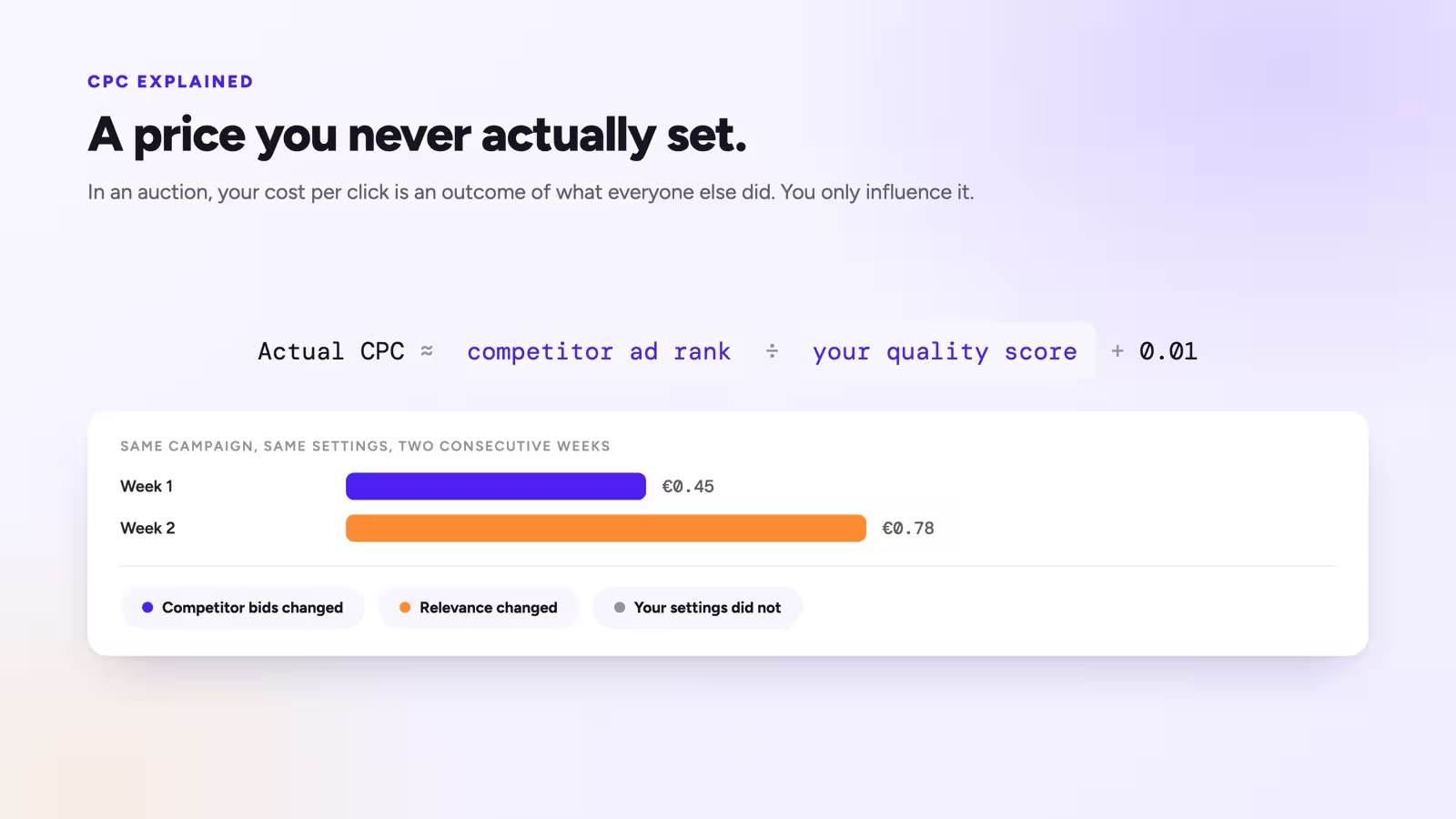
Cost per click is the metric most people learn first and misread longest. It looks like a price you control, and it behaves like an outcome you mostly do not. In an auction driven system, your CPC is determined by what competitors bid, how relevant the platform considers your ad, and how many people click it, which means the same campaign can pay 0.45 euros one week and 0.78 euros the next without a single setting changing. Understanding CPC properly means understanding what sits underneath the number, and knowing when a higher cost per click is a problem and when it is the price of reaching better traffic.
What you will learn
Cost per click is the metric most people learn first and misread longest. It looks like a price you control, and it behaves like an outcome you mostly do not. In an auction driven system, your CPC is determined by what competitors bid, how relevant the platform considers your ad, and how many people click it, which means the same campaign can pay 0.45 euros one week and 0.78 euros the next without a single setting changing. Understanding CPC properly means understanding what sits underneath the number, and knowing when a higher cost per click is a problem and when it is the price of reaching better traffic.
What CPC Is and How It Is Calculated
Cost per click measures the average amount you pay each time someone clicks your ad.
CPC = total ad spend / total clicks
Spend 1,200 euros and receive 2,400 clicks, and your average CPC is 0.50 euros. That is the reported figure, an average across every auction you won during the period.
The number is closely tied to two other metrics, and it is worth seeing the relationship explicitly:
CPC = CPM / (CTR x 1000)
Cost per mille is what you pay for a thousand impressions. Click through rate is the share of impressions that produce a click. If your CPM is 8 euros and your CTR is 1.6 percent, then a thousand impressions cost 8 euros and produce 16 clicks, giving a CPC of 0.50 euros. This identity is the most useful thing to know about CPC, because it shows that cost per click is not really a lever at all. It is the ratio of two other things, and you influence it by changing either the cost of reaching people or the rate at which they respond.
Bid CPC Versus Actual CPC
On search platforms, you may set a maximum CPC bid, which is the most you are willing to pay. What you actually pay is usually less, because most search auctions use a second price style mechanism. Your actual cost is roughly determined by what it takes to beat the next competitor, adjusted for ad quality.
Actual CPC ≈ (ad rank of competitor below you / your quality score) + 0.01
The practical consequence is that improving ad relevance and landing page experience lowers your cost per click at the same bid. Two advertisers bidding the same amount for the same keyword can pay meaningfully different prices, and the one with the more relevant ad pays less.
On social platforms such as Meta, TikTok, and Pinterest, you generally do not bid on clicks at all. You bid on an outcome, usually a conversion, and the system buys impressions on your behalf. CPC there is purely a reported byproduct of CPM and CTR, and optimising toward it directly tends to attract cheap, low intent clicks.
Where CPC Actually Gets Used
CPC has a narrow but real set of legitimate uses, and a much larger set of misuses.
Search marketers use it as a genuine cost input, because search advertising is bought on clicks. Keyword level CPC determines whether a term is affordable given the conversion rate and average order value behind it. A keyword at 3.20 euros per click with a 2 percent conversion rate implies 160 euros of cost per order, which either clears your margin or does not.
Media planners use industry CPC ranges for feasibility work. Before entering a new market or category, knowing that competitive terms cost 4 euros per click rather than 0.40 tells you what budget is required for the channel to produce meaningful volume at all.
Creative teams use CPC as a diagnostic for creative performance, though CTR is the cleaner signal. Because CPC falls as CTR rises at constant CPM, a creative that halves the cost per click is usually a creative that people actually want to look at.
Ecommerce managers should mostly not use CPC as a performance target. A campaign optimised for cheap clicks reliably finds cheap audiences, and cheap audiences convert poorly. The chain from click to revenue runs through conversion rate and average order value, and CPC knows nothing about either.
The situations where CPC becomes a live concern:
- Rising auction competition. Seasonal peaks, new entrants, and category consolidation all push CPC up regardless of what you do.
- Broad targeting shifts. Widening an audience typically lowers CPM and CPC while diluting intent.
- Creative fatigue. As frequency rises, CTR falls, and CPC rises even with a flat CPM.
- Landing page changes. On search, a slower or less relevant landing page reduces quality score and raises actual CPC at the same bid.
Reading CPC Without Being Misled
A set of decision points that keep the metric useful:
- Always read CPC alongside conversion rate. A cheap click that never converts costs more per order than an expensive one that does.
- Compare within a channel, not across. Search CPC and display CPC come from entirely different auctions and inventory.
- Decompose before reacting. If CPC rose, check whether CPM rose or CTR fell. The fix is different in each case.
- Watch placement mix. On social platforms, a shift in placement distribution changes CPC without any change in campaign strategy.
- Distinguish link clicks from all clicks. Meta reports several click definitions, and CPC on "all clicks" includes interactions that never reached your site.
That last item is a frequent source of confusion. A CPC that looks impressively low on one platform may be counting reactions, expansions, and profile taps as clicks. When comparing platforms or building a cost model, always use the outbound or link click definition, since it is the only one that corresponds to a person arriving at your shop.
Decomposition deserves emphasis as well. When cost per click rises 30 percent, the useful question is which of the two components moved. If CPM rose, the cause is external: more competition, a seasonal peak, or a narrower audience. If CTR fell, the cause is internal: creative fatigue, an audience that has seen the ad too many times, or a message that no longer matches the offer. Reacting to the composite number without splitting it means you will frequently apply the wrong fix, most often cutting budget when the real answer was refreshing creative.
The deeper limitation is that CPC sits far from money. It measures the cost of an interaction, not the cost of a customer. A brand that drove CPC down by 40 percent while cost per order rose by 15 percent has optimised itself into a worse position, and the click level reporting will look like a success the entire time. CPC belongs in a diagnostic panel next to CTR and CPM, not on the dashboard where budget decisions get made. Cost per order, customer acquisition cost, and contribution margin belong there.
Summary
Cost per click is total spend divided by clicks, and it is mathematically the ratio of CPM to click through rate. On search you can bid on it and improve it through ad relevance and quality score. On social platforms you buy outcomes and CPC is simply a consequence of how expensive impressions are and how compelling your creative is.
Use CPC as a diagnostic rather than a target. When it moves, split it into its CPM and CTR components to find the actual cause, check which click definition your platform is reporting, and always read it next to conversion rate. Judge campaigns on cost per order and contribution profit, and let cost per click do the job it is good at, which is explaining why the numbers further down the funnel moved.
FAQ
What is a good CPC?
There is no universal answer, because it depends on the channel, the category, and the auction. The meaningful test is whether CPC multiplied by the clicks needed to produce one order leaves acceptable contribution profit. A 4 euro click can be excellent in high ticket B2B and ruinous in low margin retail.
Why did my CPC increase without changing anything?
Almost always because CPM rose or CTR fell. Competitors entering the auction, seasonal demand, audience saturation, and creative fatigue are the usual causes. Check both components before assuming the campaign broke.
Can I lower CPC directly?
On search, yes, by improving ad relevance, expected click through rate, and landing page experience, all of which feed quality score. On social platforms you influence it indirectly through better creative, which raises CTR, and through audience and placement choices, which affect CPM.
Should I optimise campaigns for cost per click?
Rarely. Optimising for cheap clicks tends to buy low intent traffic that converts poorly. Optimise for conversions or value, and treat CPC as a diagnostic that explains movements in the metrics you actually care about.
How does CPC relate to CPM and CTR?
CPC equals CPM divided by CTR times one thousand. That relationship is why creative improvements that raise click through rate lower cost per click even when the cost of impressions has not changed at all.
Decisions start with trust
14-days for free