Cookie Banner Design Is a Data Quality Decision, Not Just a Legal One

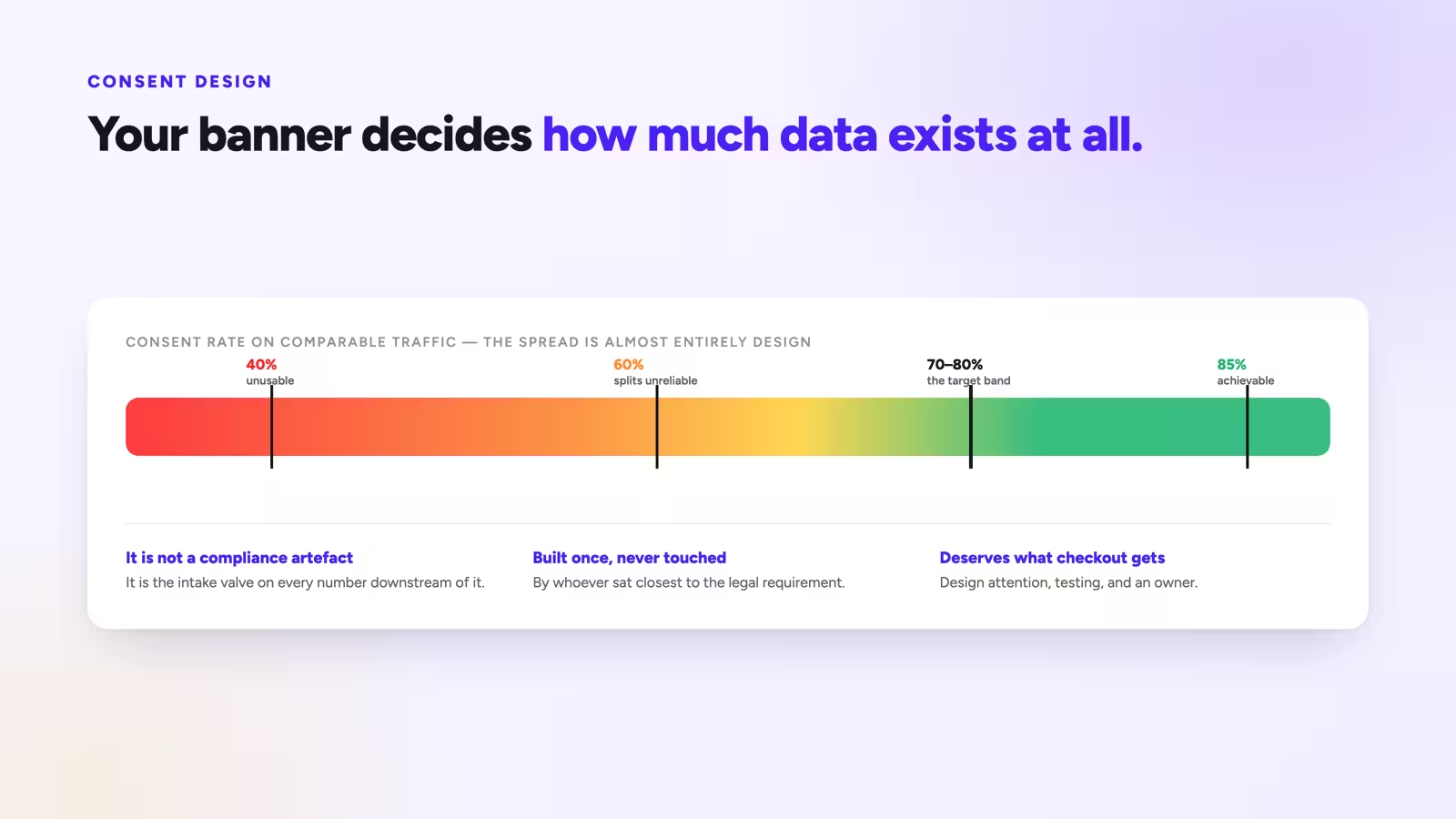
Most cookie banners are built once, by whoever was closest to the legal requirement, and never touched again. That is a strange way to treat the single component that determines how much of your marketing data exists at all. A banner with a 45 percent consent rate and a banner with a 75 percent rate produce completely different analytics, different channel mixes, and different budget decisions, on identical traffic. The banner is not just a compliance artefact. It is the intake valve on your entire measurement stack, and it deserves the same attention you give to a checkout page.
What you will learn
Most cookie banners are built once, by whoever was closest to the legal requirement, and never touched again. That is a strange way to treat the single component that determines how much of your marketing data exists at all. A banner with a 45 percent consent rate and a banner with a 75 percent rate produce completely different analytics, different channel mixes, and different budget decisions, on identical traffic. The banner is not just a compliance artefact. It is the intake valve on your entire measurement stack, and it deserves the same attention you give to a checkout page.
What Consent Rate Actually Controls
When a visitor declines tracking, the marketing touchpoint that brought them to your site becomes unobservable. No identifier is set, the session is not linked to any later visit, and if that person eventually buys, the order arrives with no journey attached to it.
Attribution systems handle that missing journey in one of two ways. They either exclude it, which understates total marketing contribution, or they model it, which means the order gets assigned based on assumptions about how similar journeys behaved. Both are worse than having observed the journey.
The relationship is close to linear. A consent rate of 70 percent means roughly 30 percent of journeys are unobserved. That share becomes your modelled portion, and once modelled orders climb above roughly 20 to 30 percent of the total, channel level conclusions become fragile because they increasingly reflect the model's priors rather than your customers' actual behaviour.
This gives a practical target. Design the banner to keep modelled orders under that threshold, which for most brands means a consent rate somewhere in the 70 to 80 percent range depending on how much of the gap other identification layers can close.
The Asymmetry That Makes It Worse
Consent refusal is not random. The visitors who decline skew toward privacy conscious users, certain device and browser combinations, and certain age groups. More importantly, the loss concentrates on first sessions, because that is when the banner appears.
A first session is disproportionately likely to be the discovery touchpoint: the moment an upper funnel channel introduced the brand. Later sessions, where the person returns directly or through branded search, are more likely to happen after consent has been granted. The result is systematic: consent loss removes more upper funnel evidence than lower funnel evidence, which biases your reporting toward the bottom of the funnel even before any attribution model runs.
Design Choices That Move the Number
Consent rates vary from below 40 percent to above 85 percent on comparable traffic, and the difference is almost entirely design. The following factors matter most, roughly in order of impact.
Number of clicks to accept. A single, clearly labelled accept action outperforms any flow requiring navigation into a preferences screen. Every additional step loses people, and those people default to no consent.
Visual prominence and contrast. The accept action needs to be immediately findable. Low contrast text links compete poorly against a prominent styled button, and many banners inadvertently make the reject path the most visible one.
Banner size and placement. A full screen overlay forces a decision, which produces higher accept rates and also higher rejection rates than a subtle bottom bar that many visitors ignore. Ignoring is functionally a rejection in most implementations, so a banner people can scroll past is not a neutral option.
Copy. Generic legal text performs worse than a short plain language sentence explaining what the data is used for. "We use cookies to understand which of our content is useful and to improve the shop" is more persuasive than a paragraph of regulatory citation.
Timing. A banner that appears before the page has rendered gives the visitor nothing to evaluate. Allowing the page to paint first, with the banner arriving a moment later, lets people see what they are consenting to be part of.
Mobile layout. A banner that covers the entire mobile viewport, or that pushes the accept button below the fold, will underperform badly. Mobile is usually the majority of traffic and frequently the worst performing consent surface.
Repeat prompting. Asking again on every visit annoys people and depresses rates over time. Storing the decision properly and respecting it is both better practice and better performance.
What You Cannot Do
The boundary is important, and getting it wrong creates a legal exposure that dwarfs any measurement benefit. Consent must be freely given, specific, informed, and unambiguous. That rules out pre ticked boxes, accept only banners with no reject path, designs where rejection requires substantially more effort than acceptance, and interfaces that use colour and hierarchy to make rejection genuinely hard to find.
The design space is real but bounded: you can make acceptance clear, easy, and well explained. You cannot make rejection obscure or burdensome. Regulators across the EU have been explicit about dark patterns in consent interfaces, and enforcement has been active.
Testing a Banner Properly
Treat the banner as a conversion surface and test it like one, within the legal boundary.
| Variable to test | Typical effect | Risk level |
|---|---|---|
| Copy wording and length | Moderate | Low |
| Button contrast and sizing, both paths equal | Moderate to high | Low if symmetry maintained |
| Overlay versus bar | High | Low |
| Timing of appearance | Low to moderate | Low |
| Mobile layout and fold position | High | Low |
| Number of steps to accept | High | Requires equal ease of rejection |
Run each test long enough to reach significance on consent rate, and watch two secondary metrics alongside it: bounce rate and conversion rate. A banner that lifts consent by ten points while raising bounce by three is not a win, because you have improved the measurement of a smaller number of visitors.
Involve legal or your data protection contact before shipping any change that touches the balance between the accept and reject paths. The measurement upside of an aggressive banner is not worth the regulatory downside, and a documented review makes the decision defensible.
The Decision Factors
The points that determine whether your banner is helping or quietly costing you:
- Do you know your current consent rate? A surprising number of brands do not measure it at all.
- Is it segmented by device and market? Mobile and desktop often differ by fifteen points or more, and country level variation is substantial.
- Is it tracked over time? A consent rate that drifts downward after a consent platform update is a common and invisible failure.
- Does the modelled share of orders sit below your threshold? This is the number the banner ultimately controls.
- Have you tested anything? Most banners have never been through a single iteration.
- Is the rejection path genuinely available? Both a compliance requirement and, given enforcement activity, a business risk if not.
Measuring the rate is the prerequisite for everything else, and it is easy to overlook because the consent platform reports it separately from your analytics. Pull it into the same dashboard where you watch traffic and conversion, segmented by device and market, and treat a decline in it the way you would treat a decline in checkout completion.
The device split matters more than most teams expect. If mobile consent runs at 52 percent and desktop at 74 percent, and mobile is 70 percent of your traffic, then your blended figure is being dragged down by a surface that probably has a fixable layout problem. Fixing the mobile banner alone can move the blended rate by ten points, which is a larger improvement than any attribution model change would produce.
Summary
Your cookie banner determines what share of your marketing journeys exist in your data at all, and consent loss concentrates on first sessions, which means it removes upper funnel evidence disproportionately. That makes banner design a measurement decision with direct consequences for how your channels appear to perform.
Measure your consent rate, segment it by device and market, and aim to keep the resulting modelled share of orders below roughly 20 to 30 percent. Improve the rate through clarity, prominence, plain language, and mobile layout rather than through friction on the rejection path, which is both prohibited and legally risky. Then test the banner the way you test a checkout page, with legal review on anything that touches the balance between the two choices, and watch bounce and conversion alongside consent so you are not trading traffic for visibility.
FAQ
What is a good consent rate?
It depends on market and audience, but 70 to 80 percent is achievable for most consumer ecommerce with a well designed banner. Below 60 percent, the modelled share of your orders is likely large enough to make channel level conclusions unreliable.
Can I make the accept button more prominent than reject?
There is limited room for clarity and good design, but making rejection meaningfully harder to find or execute than acceptance is treated as a dark pattern and has drawn regulatory enforcement across the EU. Keep the two paths comparably easy and compete on clarity of explanation instead.
Does server side tracking remove the need for consent?
No. Consent requirements attach to the processing of personal data, not to where the code runs. Server side collection improves data quality within consent by surviving ad blockers and browser storage limits, but it is not a legal workaround.
How does consent rate affect my channel reporting specifically?
Consent loss is concentrated on first sessions, which are disproportionately upper funnel discovery touchpoints. The practical effect is that low consent rates make top of funnel channels look weaker and bottom of funnel channels look stronger than they are.
Should I show the banner before or after the page renders?
Letting the page paint first generally produces better consent rates, because visitors can see what they are being asked to join. The relevant technical requirement is that non essential tracking must not fire before consent is given, which is about script execution rather than banner timing.
Decisions start with trust
14-days for free