Contribution Margin in Ecommerce: Definition, Formula, and How to Use It in Marketing Decisions

Gross margin says a product is profitable. Contribution margin says whether the order was. The gap between the two is filled with shipping, payment fees, packaging, picking, discounts, and returns, and in a typical ecommerce business that gap runs between 10 and 25 percentage points. Contribution margin is the number that survives all of it, which makes it the only sensible basis for deciding how much you can afford to pay for a customer. This article defines contribution margin, sets out the full cost stack, and shows how to translate it into an ad spend target you can actually defend.
What you will learn
Gross margin says a product is profitable. Contribution margin says whether the order was. The gap between the two is filled with shipping, payment fees, packaging, picking, discounts, and returns, and in a typical ecommerce business that gap runs between 10 and 25 percentage points. Contribution margin is the number that survives all of it, which makes it the only sensible basis for deciding how much you can afford to pay for a customer. This article defines contribution margin, sets out the full cost stack, and shows how to translate it into an ad spend target you can actually defend.
What Contribution Margin Measures
Contribution margin is what remains from revenue after all variable costs, meaning costs that scale with each additional order. It is the money that contributes toward fixed costs such as rent, salaries, and software, and then toward profit.
Contribution margin = revenue - variable costs
Contribution margin % = (revenue - variable costs) / revenue
The distinction from gross margin is the cost list. Gross margin subtracts cost of goods sold and stops. Contribution margin keeps going.
The Full Variable Cost Stack
| Cost | Typical range | Frequently forgotten? |
|---|---|---|
| Cost of goods sold | 30 to 60% of revenue | No |
| Inbound freight and duty | 2 to 6% | Often |
| Payment processing | 1.5 to 3% | Sometimes |
| Outbound shipping | 4 to 12% | No |
| Packaging | 1 to 3% | Often |
| Pick, pack, fulfilment | 2 to 5% | Sometimes |
| Returns handling and lost value | 2 to 15% | Very often |
| Discounts and vouchers | 3 to 15% | Very often |
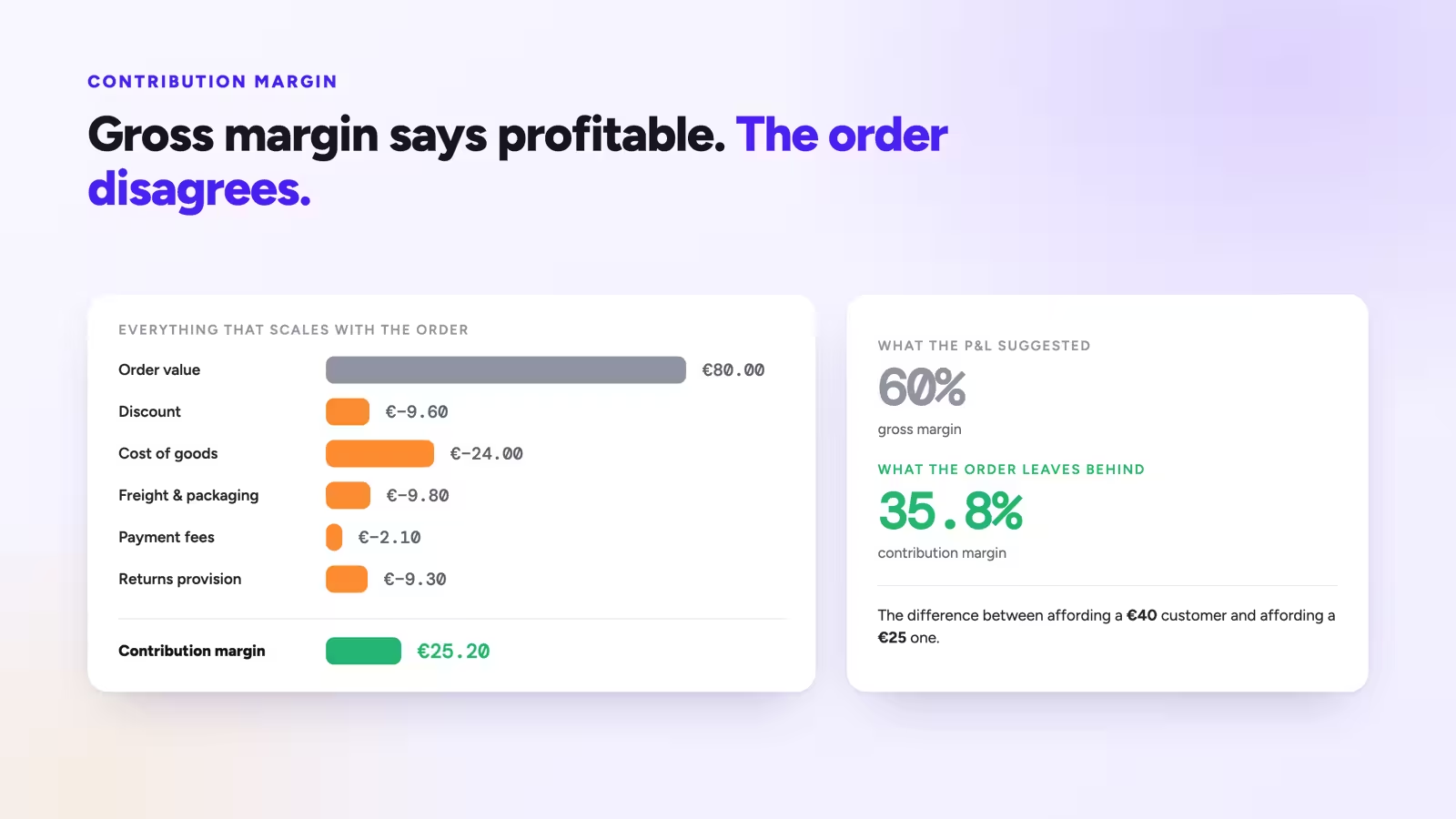
Work a concrete example. An order of 80 euros with cost of goods at 32 euros gives a gross margin of 60 percent, which sounds excellent. Now subtract 2 euros payment fees, 6 euros shipping, 1.20 euros packaging, 3 euros fulfilment, and a 12 percent welcome discount worth 9.60 euros. Then account for a 20 percent return rate that costs 5 euros per returned order in handling and lost value, adding roughly 1 euro of expected cost to every order.
Revenue after discount is 70.40 euros. Variable costs total 45.20 euros. Contribution margin is 25.20 euros, or 35.8 percent of the discounted revenue. The business that thought it had 60 percent to work with has 36 percent.
That difference is not academic. It is the difference between being able to pay 40 euros to acquire a customer and being able to pay 25.
Contribution Margin After Marketing
Some teams take one step further and subtract acquisition cost as well, producing a second level figure sometimes called CM2 or contribution profit after marketing.
Contribution margin after marketing = contribution margin - customer acquisition cost
This is the number that answers whether an acquisition channel is genuinely creating value. It is also the number that makes discounting visible, because a promotion increases orders while reducing both the revenue base and the margin on every unit sold.
Where the Metric Earns Its Keep
Contribution margin is where finance and marketing finally speak the same language, so it appears wherever those two functions have to agree.
Performance marketers use it to set the break even ROAS. If contribution margin is 36 percent, then break even on ad spend sits at roughly 2.8, because you need 2.8 euros of revenue to generate 1 euro of contribution to cover the media cost. Any target ROAS below that is spending money to lose money, no matter how good the campaign looks in platform reporting. This is one calculation that immediately makes channel targets concrete rather than aspirational.
Break even ROAS = 1 / contribution margin %
Merchandising and category teams use it to decide what to promote. Two products with identical gross margin can have very different contribution margins if one is bulky and expensive to ship or sits in a category with a 40 percent return rate. Pushing paid traffic to the high revenue, low contribution product is a common and expensive mistake, especially in apparel and furniture.
Founders use it to understand whether a growth period is building or destroying value. Revenue growth with declining contribution margin is the signature of buying volume through discounting, and it shows up in contribution margin long before it shows up in the bank balance.
The situations where contribution margin matters most:
- Categories with high return rates. Apparel and footwear cannot be managed on gross margin at all.
- Free shipping thresholds. The threshold is a contribution margin decision, not a conversion rate decision, and setting it below the point where the order covers its own shipping is a direct subsidy.
- Discount and voucher strategy. Every percentage point of discount comes straight out of contribution.
- Bulky or heavy products. Shipping and packaging can consume more margin than cost of goods.
- Marketplace selling. Platform commission is a variable cost that changes the entire picture per channel.
Getting the Number Right
The criteria that separate a usable contribution margin from a comforting one:
- Allocate at order level, not product level. Shipping and payment fees attach to the order, not the item, so a basket of three items and a basket of one item have very different margins on the same products.
- Use net revenue after discounts. A discount is a reduction in revenue, not a marketing expense to be tucked away elsewhere.
- Include expected returns as a per order cost. Apply the category return rate as an expected cost on every order rather than trying to match refunds back to specific orders.
- Separate fixed from variable rigorously. Warehouse rent is fixed. Pick and pack labour that scales with volume is variable. Getting this wrong distorts the break even calculation.
- Recalculate quarterly. Freight rates, payment fees, and supplier costs move, and a margin assumption from last year is a liability.
The allocation point is where most spreadsheets fail. A brand that calculates contribution margin per product line and then applies it to marketing decisions will misjudge every campaign that changes basket composition. If a campaign lifts average order value by pushing multi item baskets, the shipping cost per euro of revenue falls, and the contribution margin on those orders is meaningfully better than the product level average suggests. Order level calculation captures this automatically.
The returns point matters most in exactly the categories where people ignore it. A 40 percent return rate does not simply remove 40 percent of orders from the numerator. The returned order still incurred outbound shipping, return shipping, handling, and often a reduction in resale value. In apparel, an unaccounted return rate can be the entire difference between a business that looks profitable on gross margin and one that loses money on every acquisition campaign.
Finally, contribution margin closes a loop that pure marketing metrics leave open. ROAS and MER both measure revenue, and revenue can be bought with discounts. A team optimising toward revenue targets will find discounting, because it works on every revenue metric and nothing else. Putting contribution margin next to those metrics, or moving to a profit based measure such as POAS, removes the incentive.
The Practical Takeaway
Contribution margin is revenue minus every cost that scales with the order: goods, freight, payment fees, shipping, packaging, fulfilment, discounts, and returns. It is typically 10 to 25 points below gross margin, and it is the correct basis for deciding what you can afford to pay for a customer.
Calculate it at order level rather than product level, include expected returns and discounts, and convert it into a break even ROAS so that your marketing targets are anchored to real economics instead of a number someone picked. Then run the same calculation per channel and per campaign, because the campaigns that look most efficient on revenue are frequently the ones leaning hardest on the discount code that made the margin disappear.
FAQ
What is the difference between gross margin and contribution margin?
Gross margin subtracts only cost of goods sold. Contribution margin subtracts every variable cost, including shipping, payment fees, packaging, fulfilment, discounts, and the cost of returns. Contribution margin is always lower and is the more useful number for marketing decisions.
How do I turn contribution margin into an ad spend target?
Divide 1 by your contribution margin percentage to get break even ROAS. At 36 percent contribution margin, break even ROAS is roughly 2.8. Set your target above that by whatever amount you need to cover fixed costs and profit.
Should returns be subtracted from contribution margin?
Yes, as an expected cost applied to every order based on your category return rate. The returned order still consumed outbound shipping, return logistics, and handling, and often loses resale value, so ignoring returns overstates margin substantially in apparel and footwear.
Are discounts a marketing cost or a revenue reduction?
Economically they are a reduction in revenue and should be treated that way in the contribution margin calculation. Recording them as a separate marketing expense hides their effect on per order economics and makes discounted campaigns look more efficient than they are.
Should salaries be included?
Not in contribution margin, because most salaries are fixed and do not scale per order. Contribution margin is what remains to cover those fixed costs. Variable labour that genuinely scales with order volume, such as per unit pick and pack fees, does belong in the calculation.
Decisions start with trust
14-days for free