Your Consent Rate Is 60 Percent. Here Is What That Does to Your Channel Mix.

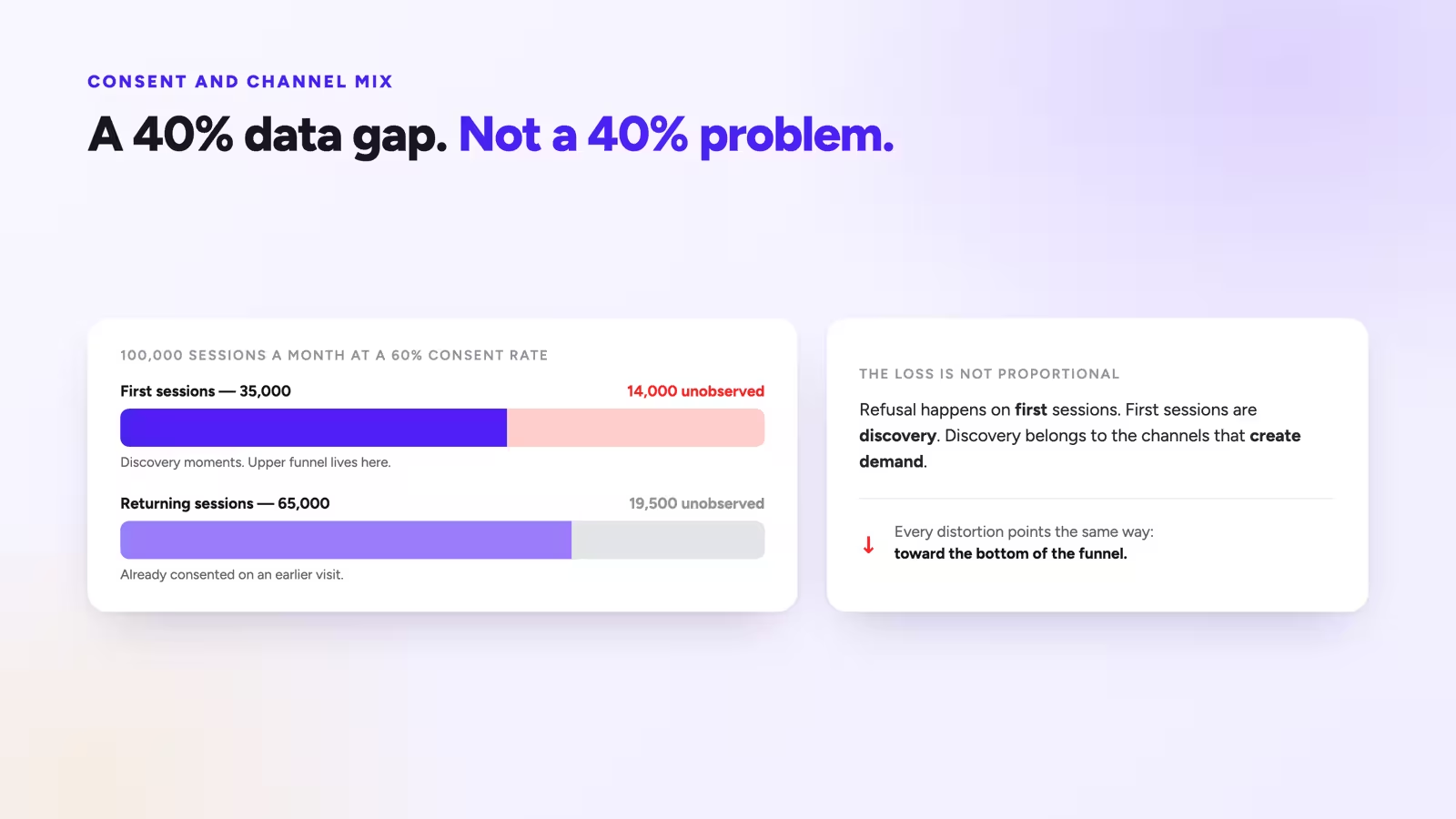
A 60 percent consent rate sounds like a 40 percent data loss, which sounds manageable. It is not, and the reason is that the loss is not distributed evenly across your channels. Consent refusal happens on first sessions, first sessions are disproportionately discovery moments, and discovery moments belong to upper funnel channels. The result is that a 40 percent gap in raw coverage translates into a much larger distortion in your channel mix, one that consistently points in the same direction: toward the bottom of the funnel and away from the channels creating demand.
What you will learn
A 60 percent consent rate sounds like a 40 percent data loss, which sounds manageable. It is not, and the reason is that the loss is not distributed evenly across your channels. Consent refusal happens on first sessions, first sessions are disproportionately discovery moments, and discovery moments belong to upper funnel channels. The result is that a 40 percent gap in raw coverage translates into a much larger distortion in your channel mix, one that consistently points in the same direction: toward the bottom of the funnel and away from the channels creating demand.
Why the Loss Is Not Proportional
Start with the mechanics. A visitor arrives, the banner appears, they decline. No identifier is set. That session exists in aggregate traffic counts but is not linked to anything before or after it.
Now consider when the banner appears. It appears on the first visit. A returning visitor who consented previously carries their decision forward. So consent refusal filters out first sessions specifically, at a rate far higher than it filters out later sessions.
The next step is the one that does the damage. First sessions are where discovery happens. Somebody clicks a Meta video ad, arrives for the first time, and declines the banner. Two weeks later they return via branded search, consent this time because the banner appears again on a fresh browser state or because they simply click through, browse, and buy. The order is recorded. The journey attached to it begins at branded search.
The Meta touchpoint that created the customer is gone. Branded search receives the credit.
Multiply that across thousands of journeys and the picture that emerges is not a smaller version of reality. It is a systematically distorted one.
Quantifying the Distortion
Take a simplified but realistic model. A brand receives 100,000 sessions per month, of which 35,000 are first sessions. Consent rate is 60 percent overall.
| Session type | Volume | Consented | Unobserved |
|---|---|---|---|
| First sessions | 35,000 | 21,000 | 14,000 |
| Returning sessions | 65,000 | 45,500 | 19,500 |
The 14,000 unobserved first sessions are the problem, because each one represents a discovery touchpoint that will never be connected to a later purchase. If those 14,000 sessions had the same channel distribution as observed first sessions, and if upper funnel paid social accounts for say 45 percent of first sessions, then roughly 6,300 paid social discovery events per month vanish from the record.
Those customers do not vanish. A portion of them buy later. Their orders get attributed to whatever touchpoint was observable, which is overwhelmingly branded search, direct, and email, because those are the channels people use when they already know who you are.
The observable consequence in reporting:
- Branded search and direct inflate. They absorb credit for demand created upstream.
- Email inflates. Newsletter subscribers who first discovered you through paid social appear to have arrived through email.
- Paid social and paid video deflate. Their contribution is measured only on the journeys where the customer happened to consent immediately.
- Organic search inflates. Same mechanism as branded search, at a smaller scale.
The Budget Consequence
This is not an academic reporting issue. It changes where money goes.
A head of growth looking at a report where branded search returns a ROAS of 8.0 and prospecting social returns 1.9 will, entirely rationally, shift budget toward branded search. Six months later, new customer acquisition has slowed, the branded search volume has stopped growing because nothing is feeding it, and blended MER has quietly declined even though every individual channel still looks fine.
That sequence is one of the most common failure patterns in EU ecommerce, and low consent rates are a significant contributor to it.
Where This Hits Hardest
Certain business profiles are far more exposed than others.
Brands with long consideration cycles suffer most, because the gap between discovery and purchase gives more opportunity for the observable journey to diverge from the real one. A customer who buys within an hour of first arriving produces a journey that is either fully observed or fully missing. A customer who takes six weeks produces a journey that is partially observed, and the partial view is biased.
Brands doing heavy upper funnel investment suffer most in absolute terms, because they have the most to lose. A brand spending 60 percent of its budget on prospecting video is systematically underreporting the return on the majority of its spend.
Brands in strict enforcement markets face the largest raw gaps. Germany, Austria, the Netherlands, and France all have active enforcement and consent conscious populations, and rates below 60 percent are common where the banner has not been optimised.
Brands with strong existing brand equity are most likely to be misled, because their branded search volume is already substantial and the inflated attribution looks plausible rather than suspicious.
What to Do About It
The response has three parts, in order of leverage.
Raise the consent rate. This is the highest leverage action available and it is usually unexploited. Banner clarity, prominence, plain language explanation, and particularly mobile layout regularly move consent rates by ten to twenty points. That is a larger improvement in data quality than any change of attribution vendor would produce.
Strengthen identification within consent. Server set first party identifiers persist far longer than client side browser storage, which means consented journeys stay intact across weeks rather than fragmenting into separate visitors. Server side event collection removes losses to ad blockers and script failures. Neither of these bypasses consent, both of them make consented data far more complete.
Correct for what remains with a second evidence layer. A post purchase survey asking how the customer heard about you captures exactly the influence that consent loss removes: the discovery touchpoint. Response rates of 20 to 40 percent are typical, and the aggregate signal is strong enough to correct the systematic bias even though individual responses are unreliable.
The decision factors when assessing your own exposure:
- What is your consent rate, split by device and market? Mobile is usually far worse and usually fixable.
- What share of your orders are modelled rather than observed? Above 20 to 30 percent, channel splits are unreliable.
- How long is your typical purchase cycle? Longer cycles amplify the distortion.
- What proportion of budget sits in upper funnel? The more you invest there, the more you are underreporting.
- Does branded search performance look implausibly good? It usually does, and consent loss is one of several reasons.
The branded search test is the most immediately useful diagnostic available. Reduce branded search spend in a controlled way and watch total orders rather than branded search orders. In most brands, a large share of that traffic arrives anyway through the organic result, because the customer was specifically looking for you. The gap between the credit attribution assigns to branded search and the volume that actually disappears when you pause it is a direct measure of over attribution, and consent driven journey truncation is a meaningful part of it.
Summary
A 60 percent consent rate does not remove 40 percent of your data uniformly. It removes first sessions preferentially, and first sessions are where discovery happens, so the loss falls hardest on the upper funnel channels that create demand. What remains is a channel mix that overstates branded search, direct, and email while understating paid social and paid video.
The distortion compounds into budget decisions, and the pattern is predictable: money moves toward channels that harvest existing demand until there is less demand to harvest. Address it by raising the consent rate first, since that is where the leverage is, then by strengthening first party identification within consent so the journeys you do observe stay intact, and finally by adding a self reported layer that can see the influence your tracking cannot.
FAQ
Does a low consent rate mean my attribution is useless?
Not useless, but increasingly directional. Below roughly 60 percent consent, the modelled share of orders is usually large enough that channel level splits reflect the model's assumptions as much as your customers' behaviour. Aggregate metrics such as MER remain reliable because they do not depend on tracking individuals.
Why does branded search benefit specifically from consent loss?
Because it is where people go once they already know your brand, which is usually after the discovery touchpoint. When the discovery session is unobserved and the branded search session is observed, the journey appears to begin at branded search.
Can modelled conversions fix this?
Partially. Modelling estimates the missing journeys from patterns in observed ones, which helps at the aggregate level. It cannot recover the specific first touch, and if the observed journeys are themselves biased toward the bottom of the funnel, the model inherits that bias.
Is raising the consent rate really more impactful than changing attribution tools?
Usually yes. Moving from 55 to 75 percent consent increases observed journeys by more than a third, and every downstream model works better on more complete data. No modelling improvement compensates for evidence that was never collected.
How do post purchase surveys help?
They capture the discovery source directly from the customer, which is exactly the information consent loss destroys. Individual answers are unreliable due to recall bias, but the aggregate distribution corrects the systematic underreporting of channels that operate before the consent decision.
Decisions start with trust
14-days for free