CAC vs CPO: The Difference Between Customer Acquisition Cost and Cost Per Order

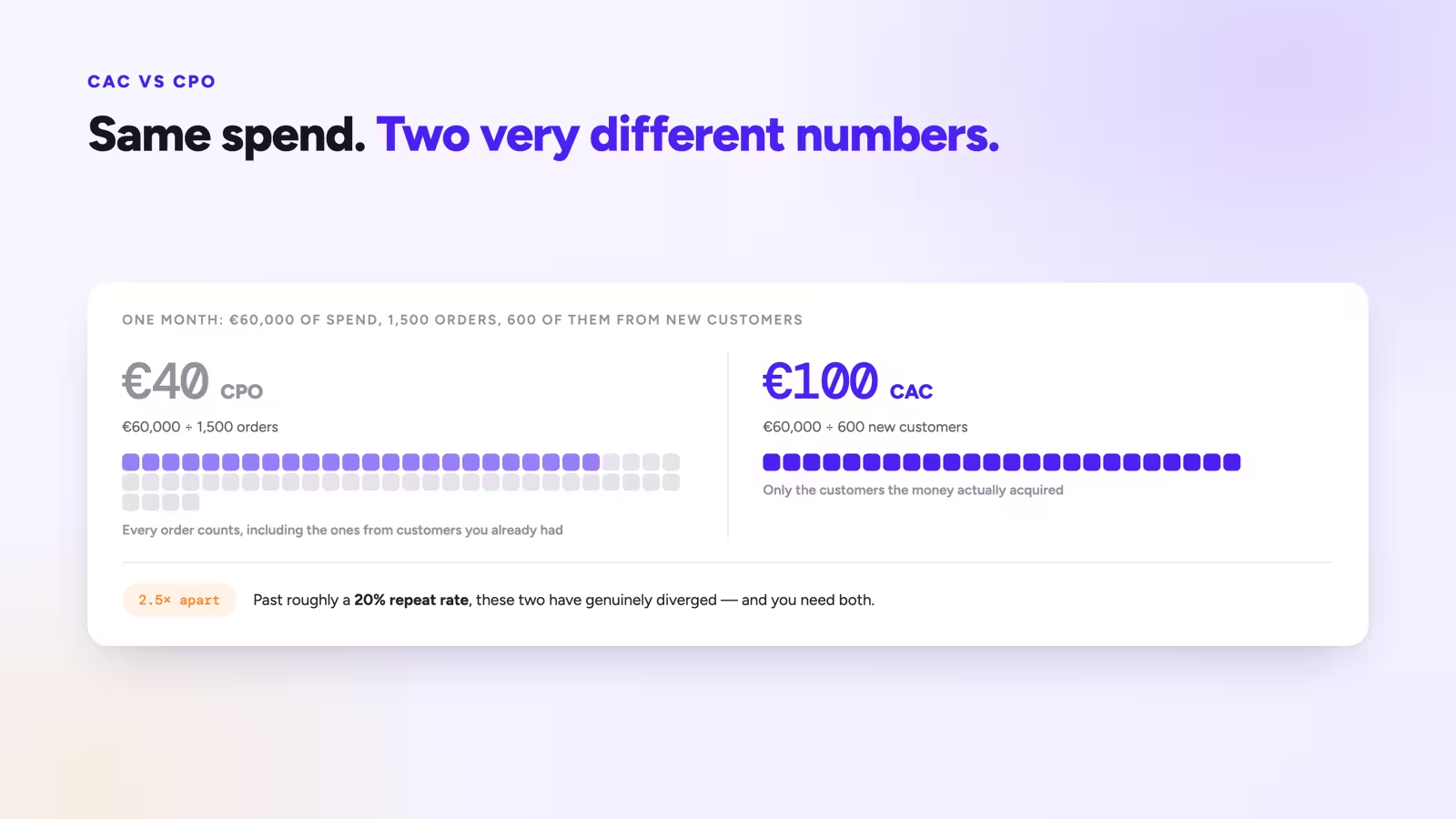
Two brands can run the same campaign, spend the same money, and report completely different numbers because one measures CAC and the other measures CPO. The gap is not a rounding error. On a business with strong repeat purchase behaviour, customer acquisition cost can be two or three times higher than cost per order, and a team that mixes the two will systematically overestimate how efficient its paid marketing is. This article defines CAC vs CPO precisely, walks through both calculations with real numbers, and explains which one belongs in a weekly performance review and which one belongs in a board deck.
What you will learn
Two brands can run the same campaign, spend the same money, and report completely different numbers because one measures CAC and the other measures CPO. The gap is not a rounding error. On a business with strong repeat purchase behaviour, customer acquisition cost can be two or three times higher than cost per order, and a team that mixes the two will systematically overestimate how efficient its paid marketing is. This article defines CAC vs CPO precisely, walks through both calculations with real numbers, and explains which one belongs in a weekly performance review and which one belongs in a board deck.
What Each Metric Actually Counts
Customer acquisition cost answers a question about people. It tells you what it costs to turn a stranger into a first time buyer. Cost per order answers a question about transactions. It tells you what it costs to produce one order, regardless of whether the buyer has purchased from you fifty times before.
The formulas differ in the denominator only, which is exactly why the two get confused.
Customer acquisition cost
CAC = marketing spend / number of new customers acquired
Cost per order
CPO = marketing spend / total number of orders
Take a month where you spent 50,000 euros on paid media and generated 2,000 orders. Of those orders, 800 came from people buying for the first time and 1,200 came from returning customers. Your CPO is 25 euros. Your CAC is 62.50 euros. Same spend, same period, same order table, and a number that differs by 150 percent depending on which denominator you pick.
That difference is not a flaw in either metric. It is the entire point. CPO measures the efficiency of your revenue engine as a whole. CAC measures the cost of growth, meaning the cost of expanding the customer base rather than harvesting it.
The Numerator Is Where Most Teams Get It Wrong
The denominator debate gets all the attention, but the numerator causes more damage in practice. Three questions decide whether your CAC is comparable to anyone else's:
- Do you count only paid media, or all marketing costs? Blended CAC includes agency retainers, creative production, influencer fees, tooling, and salaries. Paid CAC includes only media spend. Both are legitimate. Reporting one and calling it the other is not.
- Do you count spend on retention campaigns? Email flows, loyalty programmes, and retargeting aimed at existing customers produce orders but not new customers. Leaving that spend in the numerator inflates CAC.
- Do you count spend that has not converted yet? Marketing spent in March can produce a first order in May. If your purchase cycle is long, a strict monthly CAC will overstate cost in growth months and understate it in flat months.
The practical answer is to define CAC once, write the definition down next to the number, and keep it stable. A CAC of 60 euros that everyone understands beats a technically perfect CAC that three people calculate three different ways.
Where CAC and CPO Show Up in Real Decisions
CPO is the metric that survives contact with daily operations. A performance marketer adjusting bids on Monday morning does not know which clicks will come from new customers until the order lands and the email address is matched. CPO is available immediately, it maps cleanly onto platform reporting, and it is the natural companion to average order value when you are deciding whether a campaign clears its own cost.
CAC is the metric that survives contact with the finance team. When a founder asks whether the business can afford to grow faster, the answer depends on what a new customer costs and how long that customer takes to pay back. CPO cannot answer that, because a CPO of 25 euros tells you nothing about whether those orders came from the existing base or from expansion.
The roles that care about each metric split predictably:
| Role | Primary metric | Why |
|---|---|---|
| Performance marketer | CPO | Available in near real time, maps to campaign level decisions |
| Head of growth | CAC | Measures whether the customer base is expanding profitably |
| Finance and leadership | CAC | Feeds LTV to CAC, payback, and cash planning |
| Ecommerce manager | Both | Needs order efficiency and customer economics together |
A brand with a subscription model or a high repeat rate feels this split hardest. Consider a coffee brand where the average customer orders six times per year. If retargeting and email drive most of those repeat orders cheaply, blended CPO looks excellent. Meanwhile the cost of acquiring the next new customer may be climbing steadily because the addressable prospecting audience is saturating. Only CAC surfaces that, and it usually surfaces it about two quarters after the problem started.
The reverse trap exists too. A brand with almost no repeat purchase, say a mattress retailer, will see CAC and CPO converge to nearly the same number. In that situation, arguing about the distinction wastes time. Nearly every order is a new customer, so pick one metric and move on.
Choosing Between Them, and Reading Them Correctly
The decision is less about which metric is better and more about which question you are asking. A few criteria help:
- Repeat rate. If more than roughly 20 percent of your orders come from returning customers, CAC and CPO have genuinely diverged and you need both.
- Time horizon. CPO is a weekly and monthly metric. CAC is best read over a period long enough to cover your typical consideration window, often a quarter.
- Attribution quality. Both metrics inherit whatever bias exists in your attribution. If your measurement over credits branded search, both CAC and CPO will look artificially low on that channel.
- New customer identification. CAC requires a reliable way to flag a first time buyer. Guest checkout, multiple email addresses per household, and marketplace orders all corrupt that flag.
- Margin context. Neither metric knows anything about profitability. A CPO of 25 euros is excellent on a 120 euro basket and fatal on a 30 euro basket.
That last point deserves more than a bullet. CAC and CPO are cost metrics, not profit metrics. They tell you what you paid, not what you kept. A team optimising purely for a lower CPO will drift toward discounting, because discounts lift conversion rate and pull the cost per order down while quietly destroying contribution margin. Pairing CPO with contribution margin per order, and pairing CAC with lifetime value, is what turns these numbers from vanity into decisions.
The attribution point deserves emphasis as well. If your platform reporting and your independent measurement disagree about which channel produced an order, then your channel level CAC and CPO are disagreeing too. Comparing a Meta reported CPO against a Google reported CPO is comparing two different definitions of a conversion. Any serious comparison across channels needs a single measurement layer that applies the same rules to every touchpoint.
Common Mistakes Worth Avoiding
Teams repeat the same four errors. They calculate CAC on total orders instead of new customers, which is really just CPO wearing a better job title. They exclude organic and email from the denominator while leaving all spend in the numerator, which inflates the number. They compare their CAC to a benchmark from a different industry with different margins. And they report a single blended figure while making channel level decisions with it, which hides the fact that one channel is carrying the average while another is bleeding.
The Short Version
CAC and CPO differ in one place, the denominator, and that single difference changes what the number means. Cost per order divides marketing spend by every order you received and tells you how efficiently the whole machine converts spend into transactions. Customer acquisition cost divides that same spend by first time buyers only and tells you what growth actually costs. In a business with meaningful repeat purchase, CPO will always look better, and mistaking it for CAC will make you believe you can scale more cheaply than you can.
The practical recommendation: report CPO weekly for campaign management, report CAC monthly or quarterly against lifetime value and payback for budget decisions, and write both definitions down so nobody recalculates them on the fly. Then check that the attribution feeding both numbers treats every channel by the same rules, because a clean formula on top of biased inputs still produces the wrong answer.
FAQ
Is CAC always higher than CPO?
Yes, whenever any of your orders come from returning customers, because the denominator for CAC is a subset of the denominator for CPO. The two are equal only in the theoretical case where every single order is a first purchase.
Should CAC include salaries and agency fees?
It depends on the decision. Blended CAC with all marketing costs is the honest figure for company level planning and investor conversations. Paid media CAC is more useful for judging whether a specific channel is working. Track both, label them clearly, and never swap them mid conversation.
What is a good CAC or CPO?
There is no universal benchmark, because both depend entirely on your margin and repeat behaviour. The meaningful test is whether CAC is comfortably below the contribution profit a customer generates within your payback window, and whether CPO leaves positive contribution margin on an average order.
How do returning customers get counted if they check out as guests?
They usually do not, which quietly inflates your new customer count and understates CAC. Matching on email address or hashed customer identifier across orders, rather than relying on account creation, is the standard fix.
Which metric should we put on the weekly dashboard?
CPO, with contribution margin next to it, because it updates fast enough to act on. Keep CAC on the monthly view where the numbers have had time to settle and where lifetime value and payback are in the same frame.
Decisions start with trust
14-days for free