Why Your Attribution Tool Shows Fewer Conversions Than Meta Ads Manager

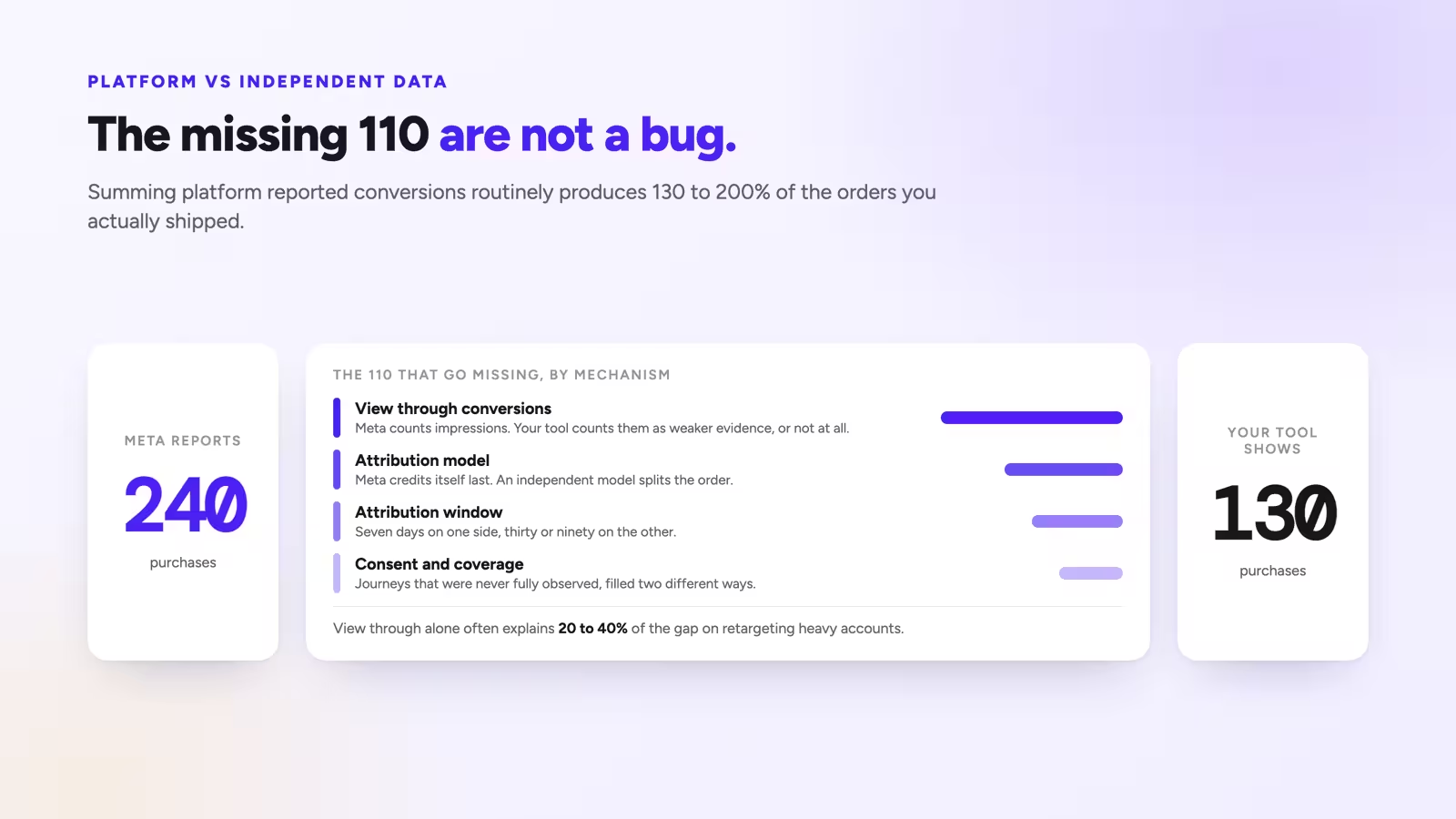
Every brand that installs an independent attribution tool has the same conversation in week one. Meta Ads Manager reports 240 purchases. The attribution tool shows 130. Somebody has to explain the missing 110, and the instinctive assumption is that the new tool is broken. It usually is not. The gap between platform reported conversions and independently attributed conversions is structural, predictable, and explainable line by line. This article breaks the discrepancy into its actual components so you can work out how much of your own gap is normal and how much is a genuine tracking problem worth fixing.
What you will learn
Every brand that installs an independent attribution tool has the same conversation in week one. Meta Ads Manager reports 240 purchases. The attribution tool shows 130. Somebody has to explain the missing 110, and the instinctive assumption is that the new tool is broken. It usually is not. The gap between platform reported conversions and independently attributed conversions is structural, predictable, and explainable line by line. This article breaks the discrepancy into its actual components so you can work out how much of your own gap is normal and how much is a genuine tracking problem worth fixing.
Why the Two Numbers Cannot Match by Design
The core issue is that Meta and an independent attribution layer are answering different questions.
Meta asks: of the people who saw or clicked my ads, how many later purchased? It has a list of everyone it showed ads to, it receives purchase events from your site, and it matches the two. Any purchase by someone Meta touched within the attribution window counts as a Meta conversion.
An attribution tool asks: for each order this shop received, which touchpoints contributed and how much credit does each deserve? It starts from the order, works backwards through the journey, and distributes credit across everything that contributed.
The first question produces overlapping answers. The second produces exclusive ones. If a customer clicked a Google ad, saw a Meta ad, opened a newsletter, and then searched your brand name before buying, Meta counts one conversion, Google counts one conversion, your email platform counts one conversion, and your attribution tool counts one order split four ways. Nobody miscounted. The definitions differ.
This is why summing platform reported conversions across networks routinely produces 130 to 200 percent of your actual order count. The overlap is not a bug in the platforms, it is what self reported attribution means.
Breaking the Gap Into Its Components
A discrepancy is only alarming when you cannot decompose it. In practice, five factors account for nearly all of it.
View Through Conversions
Meta's default attribution setting is seven day click plus one day view. The view through portion credits Meta for purchases by people who saw an ad, did not click it, and bought within a day. In retargeting campaigns aimed at people already browsing your site, this can be a large share of reported conversions.
Independent attribution tools treat impressions as weaker evidence than clicks, usually assigning them a fraction of the credit a click receives or excluding them entirely from deterministic matching. That difference alone often explains 20 to 40 percent of the gap on retargeting heavy accounts.
Check this first. In Ads Manager, switch the attribution setting to seven day click only and re run the comparison. Whatever difference that reveals is the view through component.
Attribution Model
Meta credits itself with the full order value on a last touch basis within its own window. A multi touch attribution model splits that order across every contributing channel. If Meta genuinely contributed 45 percent of a journey, an independent model will report roughly 45 percent of the order value against Meta while Meta reports 100 percent.
This is not the tool being conservative. It is the tool declining to give one channel credit for work several channels did.
Attribution Window
A seven day click window ends at seven days. If your average consideration period runs longer, Meta will not count purchases that happen on day nine, even though it may have been the first touch. Conversely, on fast moving purchases the windows overlap heavily and the gap narrows.
Compare the windows explicitly. A tool using a 30 or 90 day window with time decay weighting and a platform using seven days will disagree in both directions, and the net effect depends on your purchase cycle.
Consent and Tracking Coverage
In the EU, a share of visitors decline tracking. Meta partially compensates through modelled conversions, server side event matching via the Conversions API, and its own identity graph across logged in users. An attribution tool operating on consented first party data will only report what it can actually observe, plus whatever modelling it applies transparently.
If your consent rate is 65 percent, roughly a third of journeys are partially unobserved. How each system fills that gap is a methodological choice, and the two choices differ.
Deduplication and Event Quality
Missing or mismatched event identifiers between browser pixel and server side events cause double counting inside Meta. A purchase sent from both the pixel and the Conversions API without a shared event identifier is counted twice. This inflates the platform number rather than deflating the tool number, and it is worth ruling out early because it is genuinely a bug rather than a definitional difference.
Working Out Whether Your Gap Is Normal
Here is a practical sequence for diagnosing your own discrepancy.
| Step | What to check | What it isolates |
|---|---|---|
| 1 | Total shop orders versus sum of all platform conversions | Overall overlap and double counting |
| 2 | Meta at 7 day click only versus default 7d click 1d view | View through component |
| 3 | Attribution windows in both systems | Window mismatch |
| 4 | Consent rate over the same period | Observable coverage |
| 5 | Event deduplication setup, pixel and CAPI event identifiers | Genuine tracking bugs |
| 6 | Attributed revenue total versus shop revenue total | Whether the tool reconciles |
Step six is the decisive one. An independent attribution tool should reconcile to your actual shop revenue within a small margin. If it attributes 940,000 euros across all channels and your shop system reports 1,000,000 euros, the model is accounting for 94 percent of reality and the remainder sits in genuinely unobservable journeys. That is a healthy result.
If it attributes 600,000 euros against a million, something is wrong: consent is too low, tracking is broken on part of the site, or a channel is not being ingested at all. That is worth investigating.
Meta cannot pass this test, because Meta is not trying to explain your revenue. It is trying to explain its own contribution, and it has a commercial interest in that number being generous.
Which Number Should Drive Decisions
The answer depends on the decision, and this is where most teams go wrong by trying to pick a single source of truth for everything.
Use Meta's numbers for in platform optimisation. The algorithm needs its own signal to learn from, and comparing ad set A against ad set B inside Meta is a fair comparison because both carry the same bias. Turning off Meta's conversion signal to make the numbers match your attribution tool actively damages campaign performance.
Use independent attribution for budget allocation across channels, for forecasting, and for anything that reaches finance. These decisions require numbers that sum correctly and that treat Google, Meta, TikTok, email, and organic under the same rules. Platform numbers cannot do that.
The practical criteria for judging whether your attribution tool is trustworthy:
- Does it reconcile against shop revenue? This is non negotiable.
- Is the model inspectable? You should be able to see why a specific order was split the way it was.
- Is the treatment of view through disclosed and capped? Impressions influence behaviour, but crediting them like clicks reproduces the platform's bias.
- Is the attribution window matched to your purchase cycle? Not to a vendor default.
- Does it show the unobserved share honestly? A tool that claims 100 percent coverage in a consent regulated market is modelling more than it admits.
The consent point is worth expanding, because it is the part brands in Germany, Austria, and Switzerland feel most acutely. If a visitor declines tracking on their first session, the touchpoint that introduced them to the brand is invisible to any first party measurement, no matter how well built. That missing first touch tends to be an upper funnel channel, which means low consent rates systematically shift apparent credit toward the bottom of the funnel. Raising the consent rate through better banner design is, in that sense, a measurement investment as much as a compliance one.
What to Take Away
Your attribution tool shows fewer conversions than Meta Ads Manager because the two are measuring different things. Meta counts every purchase it touched within its own window, including view throughs, and does not care that Google and your email platform are counting the same order. An attribution tool counts each order once and divides the credit among everything that contributed.
Diagnose your own gap rather than accepting or rejecting it wholesale. Switch Meta to click only to isolate view through, compare attribution windows, check your consent rate, and verify event deduplication. Then apply the one test that settles the argument: does total attributed revenue reconcile with what your shop actually sold? If it does, the lower number is the honest one, and it is the number that belongs in every decision about where the next euro of budget goes.
FAQ
How big a gap between Meta and my attribution tool is normal?
It varies with your channel mix, but seeing independently attributed Meta conversions land at 50 to 70 percent of Meta reported conversions is common for accounts with meaningful retargeting and multi channel journeys. What matters more than the percentage is whether you can explain it component by component.
Is Meta lying about its conversions?
No. Meta is applying its own attribution rules consistently and disclosing them. The problem is that those rules credit Meta for any order it touched, which is reasonable from Meta's perspective and unusable when you need channel numbers that sum to your actual revenue.
Should I turn off Meta's conversion tracking if I have an attribution tool?
No. Meta's algorithm needs conversion signal to optimise delivery, and degrading it will hurt campaign performance. Keep the pixel and Conversions API running properly, and use the independent numbers for budget decisions rather than for in platform bidding.
Why do the numbers get closer during some periods?
Usually because journey overlap fell. During a period dominated by direct response campaigns with short consideration cycles and little cross channel exposure, single touch and multi touch attribution converge. Long consideration periods and heavy retargeting widen the gap again.
What if my attribution tool reports far less revenue than my shop system?
That points to a genuine coverage problem rather than a methodological difference. Check consent rates, confirm tracking fires on every checkout path including express checkout and mobile app flows, and verify that every marketing channel including offline and coupon based sources is being ingested.
Decisions start with trust
14-days for free