Attribution Modeling: A Decision Framework for eCommerce Marketers

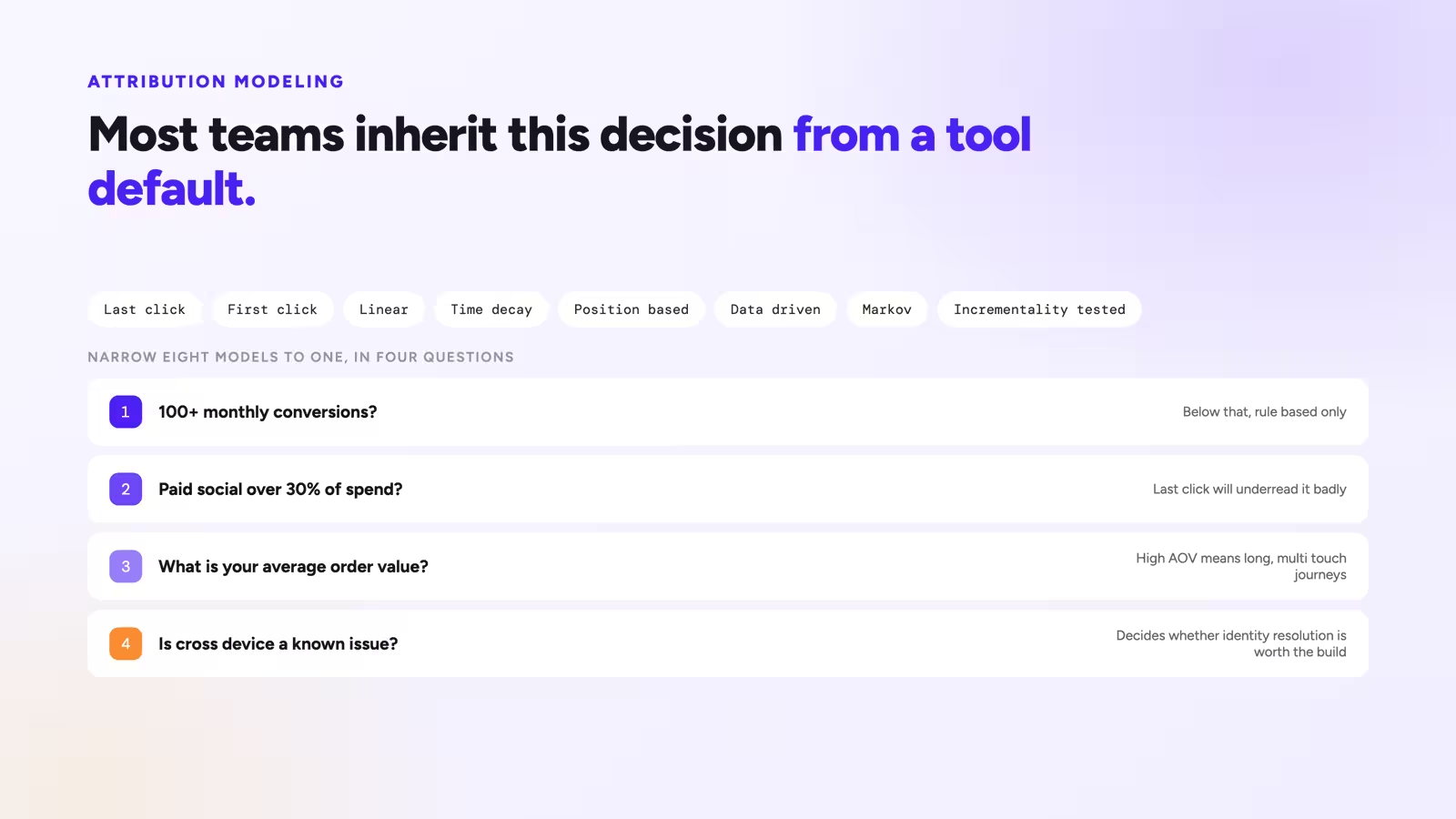
Attribution modeling is the decision of how conversion credit gets split across your marketing touchpoints, and most teams inherit that decision from a tool default instead of making it. This page is built to be bookmarked, not read like an essay: a comparison table scoring 8 models across 6 criteria, then a decision tree that narrows your choice in 4 questions. If you need the foundations first, start with our guide on what is marketing attribution. If you already know the concepts and need to pick a model for your store, you are in the right place.
What you will learn
ModelSetup effortData requirementsKnown biasCostBest forAuditabilityFirst-clickNone (built into most tools)LowOver-credits discovery channels, ignores closingFreeDiagnosing where demand originatesFullLast-clickNone (the default everywhere)LowOver-credits branded search and direct, erases prospectingFreeSingle-touch businesses, very low volumesFullLinearLowMedium (needs full path data)Treats a glance and a decisive touch as equalFree to lowFirst step out of single-touchFullTime decayLowMedium (paths + timestamps)Assumes recency equals influenceFree to lowShort cycles, promo-driven storesFullPosition-basedLowMedium (full path data)The 40/20/40 weights are arbitraryFree to lowBalanced view without modeling effortFullData-driven (GA4-style)None, but volume thresholds applyHigh (large conversion volumes)Skews to observable clicks; behavior unknowableFreeHigh-volume brands that accept opacityNoneMulti-touch (dedicated platform)Medium (pixel, store and ad integrations)Medium (first-party tracking in place)Depends on configuration; visible if vendor is transparentPaidPaid-social-heavy eCommerceFull, if the vendor exposes journeysMarketing mix modelingHigh (months of historical data, statistical setup)Very high (spend, sales, external factors)Smooths short-term effects; slow to updatePaidLong-term budget allocation across all channelsFull
What Attribution Modeling Actually Decides
An attribution model does not change what happened; it changes the story your reports tell about what happened. The same set of orders can show paid social as your best channel or your worst depending purely on the model applied, as the worked example in our last-click attribution article demonstrates in euros.
That makes the model choice a budget-allocation decision wearing an analytics costume. Whichever model you pick determines which channels look efficient, which look wasteful, and therefore where next quarter's money flows. Choosing deliberately matters more than choosing perfectly, because every model is a trade-off between three things: accuracy (how well credit matches real causal contribution), practicality (what data and effort it demands), and auditability (whether you can explain the number to whoever challenges it).
One framing before the table: there is no universally best model. An enterprise B2B company with 9-month sales cycles, 5 stakeholders per deal, and CRM-tracked opportunities has a completely different measurement problem than a DTC brand running Meta prospecting into a Shopify store. Copying the model your enterprise peers use is one of the most common ways eCommerce teams end up with reporting that fights their channel mix.
The 8 Models, Side-by-Side
Attribution modeling decisions start here. This comparison scores each model on the six criteria that actually drive the choice. Deep explanations live in the dedicated guides: last-click (which also covers first-click), data-driven attribution, and multi-touch attribution.
ModelSetup effortData requirementsKnown biasCostBest forAuditabilityFirst-clickNone (built into most tools)LowOver-credits discovery channels, ignores closingFreeDiagnosing where demand originatesFullLast-clickNone (the default everywhere)LowOver-credits branded search and direct, erases prospectingFreeSingle-touch businesses, very low volumesFullLinearLowMedium (needs full path data)Treats a glance and a decisive touch as equalFree to lowFirst step out of single-touchFullTime decayLowMedium (paths + timestamps)Assumes recency equals influenceFree to lowShort cycles, promo-driven storesFullPosition-basedLowMedium (full path data)The 40/20/40 weights are arbitraryFree to lowBalanced view without modeling effortFullData-driven (GA4-style)None, but volume thresholds applyHigh (large conversion volumes)Skews to observable clicks; behavior unknowableFreeHigh-volume brands that accept opacityNoneMulti-touch (dedicated platform)Medium (pixel, store and ad integrations)Medium (first-party tracking in place)Depends on configuration; visible if vendor is transparentPaidPaid-social-heavy eCommerceFull, if the vendor exposes journeysMarketing mix modelingHigh (months of historical data, statistical setup)Very high (spend, sales, external factors)Smooths short-term effects; slow to updatePaidLong-term budget allocation across all channelsFull
Setup Effort, Data Needs, and Cost Compared
Three patterns in that table are worth making explicit, because they define the real trade-off space.
First, the free models are free because your analytics tool already computed them; the cost shows up later as misallocated budget, which is the most expensive line item nobody reports. Second, data requirements gate your options harder than budget does. Path-based models need complete journeys, and data-driven models need volume on top of that: GA4's data-driven attribution degrades quietly when conversions are thin, and a model trained on sparse data is worse than an honest simple rule. Third, auditability is binary in practice. Every rules-based model can be recomputed by hand; GA4's data-driven model cannot be inspected at all; and platform-based multi-touch sits wherever the vendor chooses to sit, which is exactly what you should test in a demo.
Marketing mix modeling (MMM) operates at a different level from journey-based models: it uses historical spend and sales data to estimate channel contribution through regression analysis, without needing individual-level tracking. That makes it uniquely useful for validating budget allocation across offline and online channels together, and for checking whether your attribution numbers hold up at a macro level. The tradeoff is time: MMM requires months of data to train and weeks to update, so it complements rather than replaces real-time attribution.
Decision Tree: Pick a Model in 4 Questions
Four questions narrow the attribution modeling decision for almost every eCommerce brand. Answer them in order.
Do You Have 100+ Monthly Conversions?
This is the data-driven gate. Algorithmic models need volume to estimate touchpoint contribution reliably; below roughly 10k monthly conversions, their outputs get noisy, and below a few hundred, path-based models in general start wobbling. If you are low-volume, prefer a simple, fully auditable rules-based model (position-based is a sensible default over last-click) and revisit as you grow. If you are high-volume, every option is on the table and the next questions decide.
Is Paid Social More Than 30% of Spend?
This is the single most decisive question for eCommerce. Paid social creates demand that converts later through search and direct, so single-touch models structurally erase it. If Meta, TikTok, or influencer spend is over roughly 30% of your budget, last-click is disqualified, and you need a multi-touch view of some kind, full stop. If paid social is minor and you acquire mainly through non-brand search and email, last-click's bias costs you little and simplicity may win.
What Is Your Average Order Value?
AOV is a proxy for journey length. Sub-€50 impulse products often convert in one or two touches, where simple models are roughly honest and time decay handles the short tail well. High-AOV products (say €150+) involve research, comparison, and return visits over weeks, which means long multi-touch paths and a hard requirement for a model that sees the whole journey, plus an attribution window long enough to contain it.
Is Cross-Device a Known Issue?
If customers discover on mobile (where social ads live) and buy on desktop, cookie-based tracking splits one journey into two, and no model, however clever, fixes broken input data. If cross-device journeys are material for you, the question stops being which model and becomes which tracking: you need a platform doing first-party, identity-stitched tracking, and the model runs on top of that. This is a tooling decision; our marketing attribution software overview covers what to check.
Putting it together: high paid-social share plus meaningful AOV plus any cross-device exposure, which describes most scaling DTC brands, points to transparent multi-touch on a dedicated platform. Low volume plus search-and-email acquisition points to a simple rules-based model you fully understand. The enterprise B2B playbook (CRM-based, opportunity-level, often W-shaped models) fits neither of these and should not be copied just because it sounds rigorous.
Not sure where you landed? Take the Attribution Model Matcher Which attribution model fits your business? Answer the 4 questions above in an interactive quiz and get a recommendation with the reasoning shown. Take the quiz →
When to Switch Models
Model choice is not permanent, but switching has a reporting cost, so do it on signal rather than fashion. The clear triggers: your channel mix shifted (paid social crossed that 30% line), your volume crossed a threshold that unlocks better options, journeys lengthened because you moved upmarket or raised AOV, or you keep seeing the telltale last-click pattern of branded search and direct dominating while prospecting "loses money."
When you switch, do not flip the switch silently. Re-baseline channel targets under the new model, brief whoever reads the reports on why every number is about to move, and keep the old view available for a quarter so the team can map between them.
The Case for Running Two Models in Parallel
The strongest practical setup for most brands is not one model but two, viewed side by side. Keep a simple reference model (last-click is fine for this single purpose) next to your multi-touch view, and treat the gap between them as a metric in its own right. The delta tells you where demand creation and demand capture diverge, which channels are being subsidized by which, and whether a channel's "improvement" is real or a crediting artifact. Model comparison is also the fastest way to build internal trust during a migration: nobody has to take the new numbers on faith when they can see both views and understand why they differ.
Common Mistakes When Choosing a Model
A few failure modes account for most bad model choices, and all of them are avoidable.
- Keeping the default because it is the default. Last-click is an active decision to over-fund bottom-funnel channels; not choosing is choosing.
- Equating sophistication with accuracy. A black-box algorithmic model you cannot audit is not an upgrade over a simple rule you can defend, as our data-driven attribution breakdown of GA4 shows in detail.
- Copying a different business type. B2B-style models and eCommerce channel mixes solve different problems; the trade-offs do not transfer.
- Choosing a model before fixing tracking. Any model on top of broken, cross-device-blind data produces confident nonsense.
- Switching models without re-baselining. Every channel target calibrated under the old model becomes wrong on day one of the new one.
The common thread in these mistakes: treating the model as a settings toggle instead of a decision with budget consequences. Each one is cheap to avoid at choice time and expensive to unwind after two quarters of decisions made on the wrong view.
What Modeling Can't Solve
Honesty about limits makes the framework more useful, not less. Attribution modeling redistributes credit among the touchpoints it can see; it cannot conjure the ones it cannot. View-through influence, word of mouth, dark social, and offline exposure stay invisible to every model on this page. Modeling also measures correlation in journey data, not causation: the only way to prove a channel is incremental is to run holdout or geo experiments and compare against what attribution claims.
So the mature setup is layered. Transparent multi-touch attribution for week-to-week, channel-level decisions; periodic incrementality tests to validate the channels carrying the most budget; and a healthy refusal to read any single number, from any model, as ground truth.
Conclusion
Attribution modeling is a trade-off decision: accuracy versus practicality versus auditability, constrained by your conversion volume, channel mix, AOV, and tracking quality. The comparison table gives you the trade-off space, and the four questions (volume, paid social share, AOV, cross-device) collapse it to a shortlist in a few minutes. For most scaling eCommerce brands the answer is transparent multi-touch on first-party tracking, with a simple reference model running alongside; for low-volume, search-led stores, a fully understood rules-based model beats an under-fed algorithm. What almost no eCommerce brand should do is copy its enterprise B2B peers, keep the last-click default unexamined, or trust a model whose reasoning it cannot open.
See Kickbite run multiple models side-by-side on your data → Get a Live Walkthrough
FAQ
What is attribution modeling? Attribution modeling is the method used to distribute conversion credit across the marketing touchpoints in a customer journey. The model can be a fixed rule (like last-click or linear) or a statistical algorithm (like data-driven attribution), and the choice determines which channels appear to drive revenue in your reports.
Which attribution model is best for eCommerce? For most brands spending meaningfully on paid social, a transparent multi-touch model on first-party tracking fits best, because single-touch models structurally erase prospecting channels. Low-volume stores acquiring mainly through search and email are often better served by a simple, fully auditable rules-based model. There is no single best model; there is a best fit for your volume, channel mix, and journey length.
How do I choose an attribution model? Answer four questions: monthly conversion volume (algorithmic models need roughly 10k+), paid social share of spend (over 30% disqualifies single-touch), average order value (higher AOV means longer journeys needing multi-touch), and whether cross-device journeys are material (if so, fix tracking before choosing a model). The decision tree above walks through each.
What is the difference between single-touch and multi-touch attribution models? Single-touch models (first-click, last-click) give all credit to one touchpoint. Multi-touch models (linear, time decay, position-based, data-driven) spread credit across the journey. Single-touch is simpler but systematically biased toward whichever end of the journey it looks at; multi-touch is more representative but requires complete path data.
Can I use two attribution models at the same time? Yes, and it is often the strongest setup. Keep a simple reference model next to your primary multi-touch view and monitor the delta between them. The gap shows where demand creation and demand capture diverge, and makes crediting artifacts visible that neither model would reveal alone.
Does GA4 let me choose an attribution model? GA4 has consolidated reporting around its data-driven model, with paid-and-organic last-click as the remaining alternative; earlier rules-based options like first-click, linear, time decay, and position-based have been retired. If you want to compare a wider set of models, or audit how credit was assigned, you need a dedicated attribution platform.
Decisions start with trust
14-days for free