Last-Click Attribution: What It Is and the Real Cost for eCommerce

Last click attribution is the model most eCommerce brands still use, often without choosing it. Shopify reports lean on it, ad platforms default to versions of it, and it quietly shapes every budget decision you make. The catch: it gives 100% of the credit to the final touchpoint, which is rarely the one that created the sale. This article defines last click attribution, explains why it became the default, and then walks through a concrete set of Shopify orders to show, in euros, how much revenue gets credited to the wrong channel and what that does to next month's budget.
What you will learn
Last click attribution is the model most eCommerce brands still use, often without choosing it. Shopify reports lean on it, ad platforms default to versions of it, and it quietly shapes every budget decision you make. The catch: it gives 100% of the credit to the final touchpoint, which is rarely the one that created the sale. This article defines last click attribution, explains why it became the default, and then walks through a concrete set of Shopify orders to show, in euros, how much revenue gets credited to the wrong channel and what that does to next month's budget.
What Is Last-Click Attribution?
Last-click attribution is a rules-based attribution model that assigns all conversion credit to the final touchpoint a customer interacted with before purchasing. If someone discovers your brand through a Meta ad, joins your email list, and converts three days later via a branded Google search, the branded search gets 100% of the revenue credit. The Meta ad and the email get nothing.
It is the simplest member of the attribution model family. If you want the full landscape of models and how they differ, our complete guide to what is marketing attribution covers it, and our deeper piece on attribution modeling compares each model in detail. The short version: every model is a rule (or an algorithm) for splitting conversion credit across touchpoints, and last-click is the rule that pretends there was only one touchpoint.
Last-Click vs First-Click Attribution
The last click vs first click comparison is useful because the two models make opposite mistakes. First-click attribution gives 100% of the credit to the first recorded touchpoint, so it flatters discovery channels (Meta, TikTok, organic content) and ignores everything that closed the sale. Last-click flatters closing channels (branded search, direct, email at the end of a flow) and ignores everything that created the demand.
Last-clickFirst-clickCredit goes toFinal touchpoint before purchaseFirst recorded touchpointFlattersBranded search, direct, retargetingProspecting ads, content, organicHidesWhere demand came fromWhat converted the demandTypical biasCut prospecting, scale bottom-funnelScale prospecting, starve conversion
Neither is more "correct." They are two different single-touch simplifications of a multi-touch reality. Comparing your data under both is actually a cheap diagnostic: if a channel's credited revenue swings heavily between the two views, your customer journeys are multi-touch and any single-touch model is misleading you.
Why Last-Click Became the Default
Last-click did not win on accuracy. It won on practicality, at a time when the practical constraints were different.
It is trivial to implement: the last click before a conversion is the easiest touchpoint to observe, requiring no identity resolution and no path stitching. It is deterministic and easy to explain, which made it the natural default for early web analytics tools, and defaults are sticky. And in the early 2000s, when journeys were shorter and search dominated, the last click captured a larger share of the truth than it does now.
None of those conditions hold for a modern eCommerce brand. A typical DTC purchase journey now spans multiple sessions, devices, and channels, with paid social doing the discovery work and search or direct collecting the hand-off. Last-click was a reasonable simplification for 2005-era journeys. Applied to 2026-era journeys, it is a systematic error, and the rest of this article quantifies it.
What Last-Click Reports
Before the worked example, it helps to know what last-click looks like in practice, because most marketers are looking at it daily without labeling it as such. A typical last-click channel report for a DTC brand shows branded search and direct dominating credited revenue, email performing well, and paid social prospecting showing a ROAS that barely clears 1, if that.
The pattern is so common it has become an industry in-joke: "our best channels are people googling our name and people typing in our URL." Both are mostly collection points for demand created elsewhere. Nobody types your URL out of nowhere. The problems with last click attribution all flow from this one structural feature: the model rewards being last in line, and the channels that are last in line are the ones closest to a purchase decision that was already made.
A Worked Example: 5 Shopify Orders
Abstract critique is easy, so let's count actual euros. Below is a simplified but realistic set of five Shopify orders from a fictional DTC skincare brand. The channel mix (Meta and TikTok prospecting, branded and non-brand Google search, email, organic content, direct) mirrors what a typical €100k/month store runs.
Customer Personas and Channel Mix
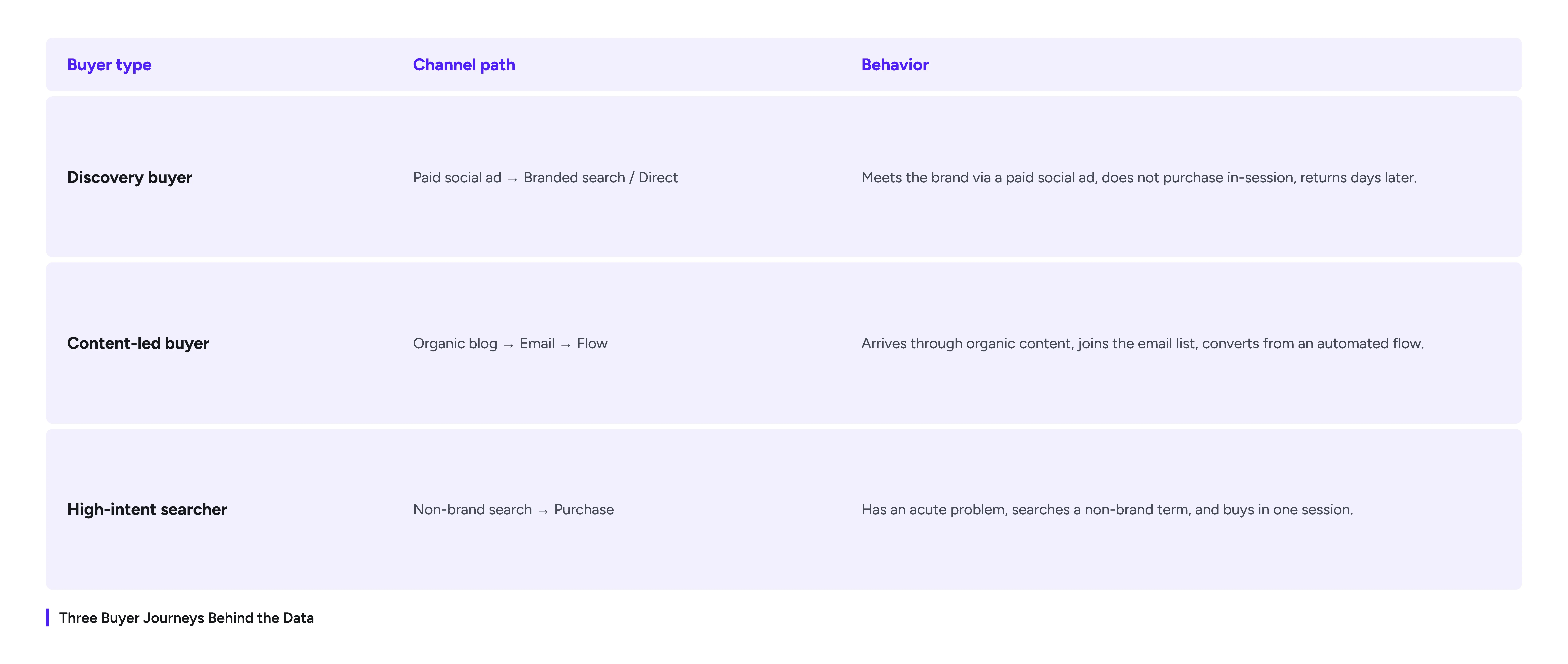
The five orders come from three buyer types you will recognize. The discovery buyer first meets the brand through a paid social ad, does not purchase in that session, and comes back days later via branded search or direct. The content-led buyer arrives through an organic blog post, joins the email list, and converts from a flow. The high-intent searcher has an acute problem, searches a non-brand term, and buys in one session. Most DTC revenue is a blend of these three, and only the third one is honestly described by last-click.
Touchpoint Sequences and Order Values
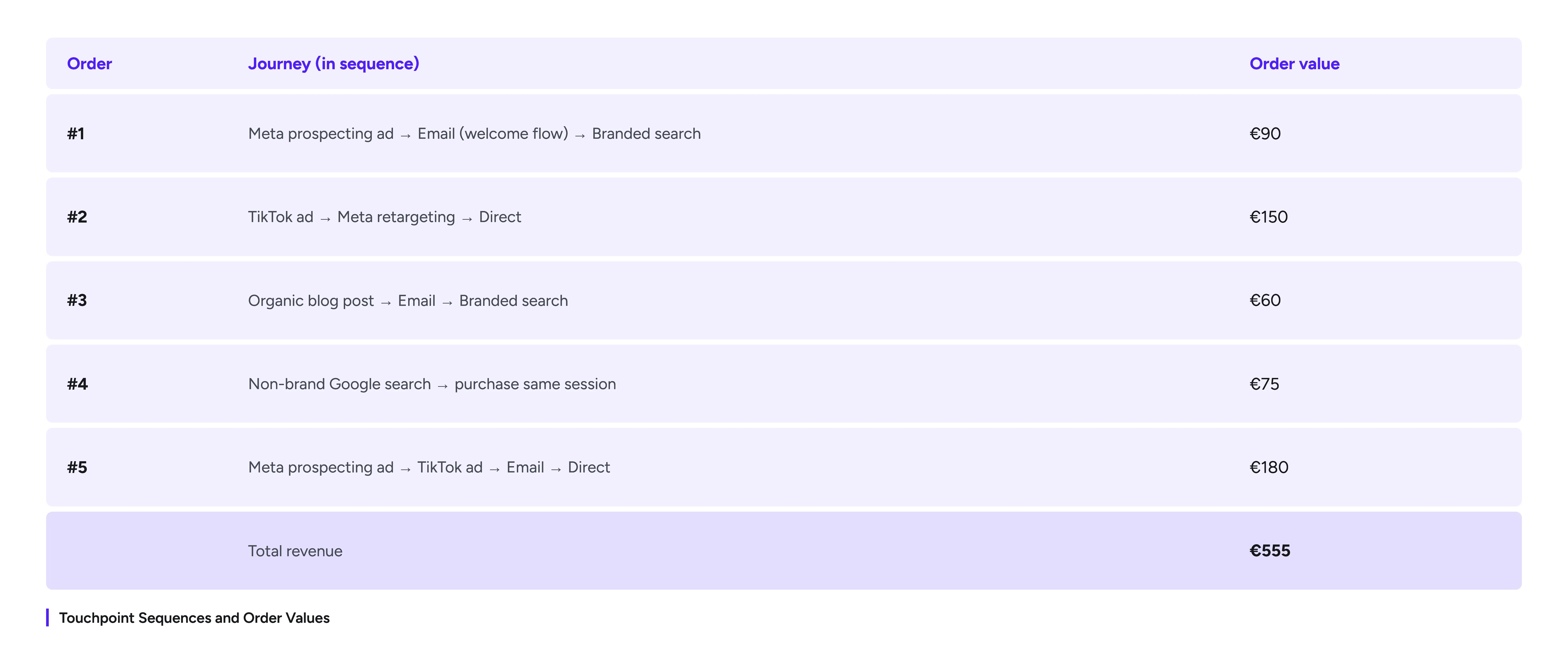
Under the last-click attribution model, each order's full value goes to the final touchpoint:
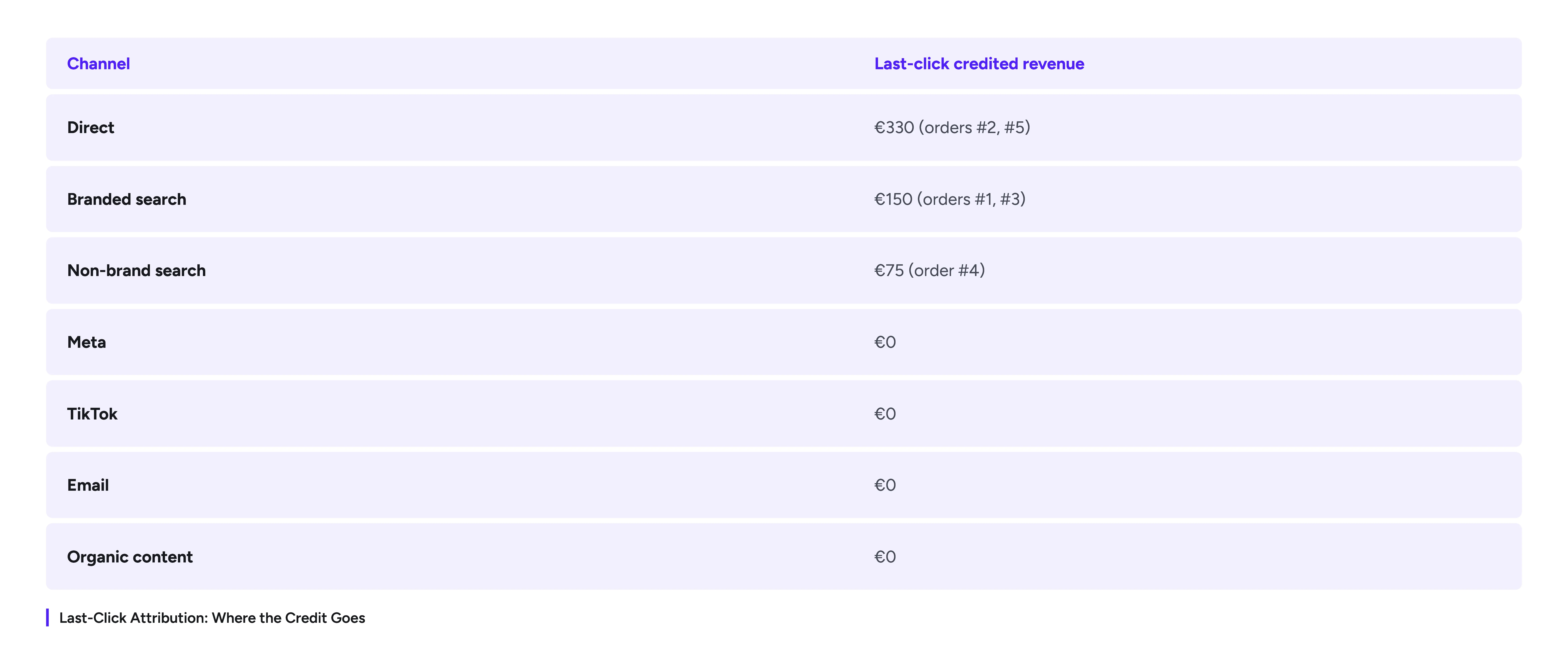
Read that table the way your reporting tool presents it: direct and branded search "drove" 87% of revenue, and the €X you spent on Meta and TikTok produced nothing.
What a Multi-Touch View Reports
Now run the same five orders through a simple multi-touch model. We will use linear attribution (equal credit to every touchpoint) because it is the easiest multi-touch model to verify by hand; a data-driven or position-based model would shift the exact numbers but not the direction. For a full treatment of these models, see our guide to multi-touch attribution.
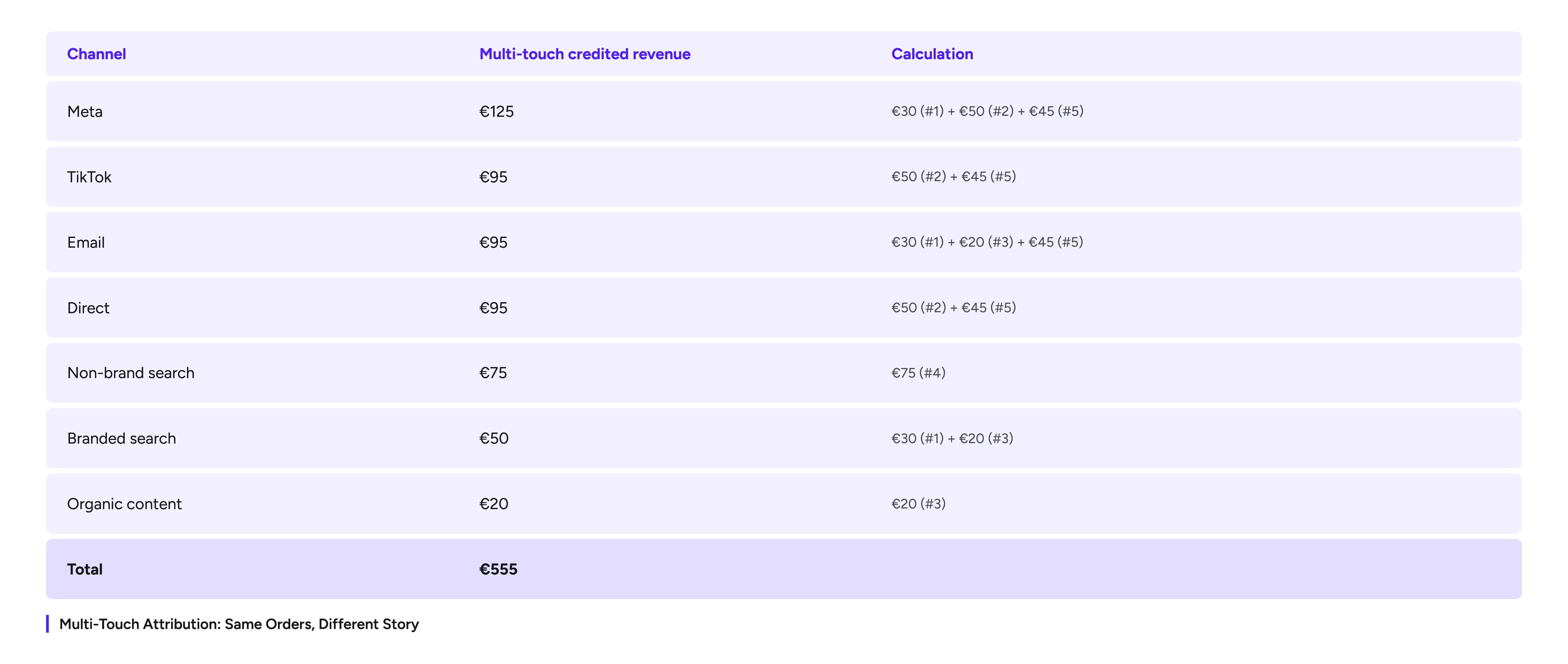
Same orders, same €555, radically different story. Meta goes from worst channel to best. Branded search drops from €150 to €50. Direct drops from €330 to €95, because direct was never a channel; it was the return visit of a customer some other channel created.
The Delta: Where Budget Is Being Misallocated
Putting the two views side by side makes the misattribution explicit:
In this sample, €335 of €555, roughly 60% of revenue credit, sits on the wrong channel under last-click. Real stores vary, and your number depends on how multi-touch your journeys are. But even if your journeys are half as layered as this example, a store doing €100,000 a month is making decisions on €30,000 or more of misplaced revenue credit, every month.
Over-Credited Channels: Branded Search and Direct
The over-crediting is not random; it always lands on the same two places. Branded search only exists because something upstream made the customer know your name, so paying Google for branded clicks and then crediting those clicks with the revenue means paying twice for demand you already created. Direct is even less of a channel: it is what tracking gaps and return visits look like in a report. When these two dominate your last-click view, the honest reading is "our prospecting is working and we cannot see it," not "we should invest more in branded search and direct."
Under-Credited Channels: Meta and TikTok Prospecting
Prospecting takes the mirror-image damage, and it compounds. Paid social discovery rarely converts in-session: users see the ad, build awareness, and convert later through search or direct, exactly the journeys in orders #1, #2, and #5. Last-click therefore reports prospecting ROAS far below its true contribution. Apple's App Tracking Transparency framework and in-app browsers (which strip click parameters) widen the gap further by breaking even the click trails that do exist. The result is a channel that looks unaffordable in your dashboard while quietly filling the top of every journey that ends in a "branded search" conversion.
The €-Impact on Next Month's Budget
Here is where the reporting error becomes a cash error. Suppose this brand spends €30,000 a month: €15,000 on Meta, €5,000 on TikTok, €4,000 on branded search, €6,000 on non-brand search. The last-click view says Meta and TikTok return almost nothing, so the obvious "data-driven" move is to cut €5,000 from prospecting and push it into branded search and retargeting, the channels with the great ROAS.
But branded search cannot scale beyond the demand that exists for your name, so the extra €5,000 buys more expensive clicks from people who would mostly have converted anyway. Meanwhile the prospecting cut means fewer people learn the brand exists, and six to eight weeks later branded search volume and "direct" revenue start sliding. The dashboard then blames the bottom-funnel channels, inviting another round of the same wrong fix. That is the real cost of last-click: not a reporting inaccuracy, but a feedback loop that reallocates budget in exactly the wrong direction while looking rigorous.
What to Use Instead
The fix is not to find the one perfect model; it is to stop making budget decisions on a single-touch view. In practice that means three steps.
First, move to a multi-touch model so every touchpoint in the journey is at least visible, and prospecting stops being invisible by construction. Second, insist on transparency: you should be able to open any conversion, see its touchpoints, and understand exactly why credit was assigned the way it was. A multi-touch black box just replaces one unexplainable number with another. Third, validate with incrementality where stakes are high: holdout tests and geo experiments tell you what attribution alone cannot, namely what happens when a channel is actually switched off.
When comparing tools that can do this on top of your Shopify and ad platform data, our overview of marketing attribution software breaks down the options and what to check before committing.
Conclusion
Last click attribution assigns all credit to the final touchpoint, which made sense when journeys had one touchpoint and stopped making sense when they grew to five. The worked example shows the consequence in hard numbers: the same €555 of orders tells two opposite stories, with around 60% of revenue credit landing on the wrong channel, always in the same direction. Branded search and direct get inflated, Meta and TikTok prospecting get erased, and budgets follow the inflation, paying twice for captured demand while starving the channels that create it.
The takeaway: treat your last-click report as a record of where journeys ended, never as a measure of what caused them. Run your own orders through a multi-touch view, look at the delta, and let that delta, not the default report, drive the next budget round.
See your own last-click gap in Kickbite → Get a Live Walkthrough
FAQ
How does last-click attribution work? Last-click attribution is a crediting rule that gives 100% of a sale's value to the last marketing touchpoint before purchase. If a customer saw your Meta ad, opened two emails, and finally bought after a Google search, last-click reports the sale as 100% Google search.
Is last-click attribution ever the right choice? It is acceptable when journeys are genuinely single-touch, for example a brand acquiring almost entirely through non-brand search, or when volumes are too low for anything else to be reliable. For any brand spending meaningfully on paid social or content, it is the wrong default because those journeys are multi-touch by nature.
What is the difference between last click and first click attribution? Last-click credits the final touchpoint; first-click credits the first one. Last-click over-values closing channels like branded search and direct, while first-click over-values discovery channels like Meta and TikTok. A large gap between the two views for the same channel is a strong signal that your journeys are multi-touch.
Why does direct traffic look so strong under last-click? Direct is mostly return visits from customers other channels created, plus journeys where tracking broke. Because those return visits often happen right before purchase, last-click hands direct the full credit. Treating direct as a high-performing channel is one of the most common and expensive misreadings of last-click data.
How do I find out how much last-click is costing my store? Compare the same period under last-click and a multi-touch model and look at the per-channel delta, exactly as in the worked example above. Most analytics and attribution tools support model comparison. The size and direction of the delta tells you which channels your current reporting is over- and under-feeding.
Does switching away from last-click change my actual revenue? No. Attribution models change how existing revenue is credited, not how much there is. The benefit is decision quality: budget flows toward channels that actually create customers, which is what changes revenue over the following quarters.
Decisions start with trust
14-days for free